
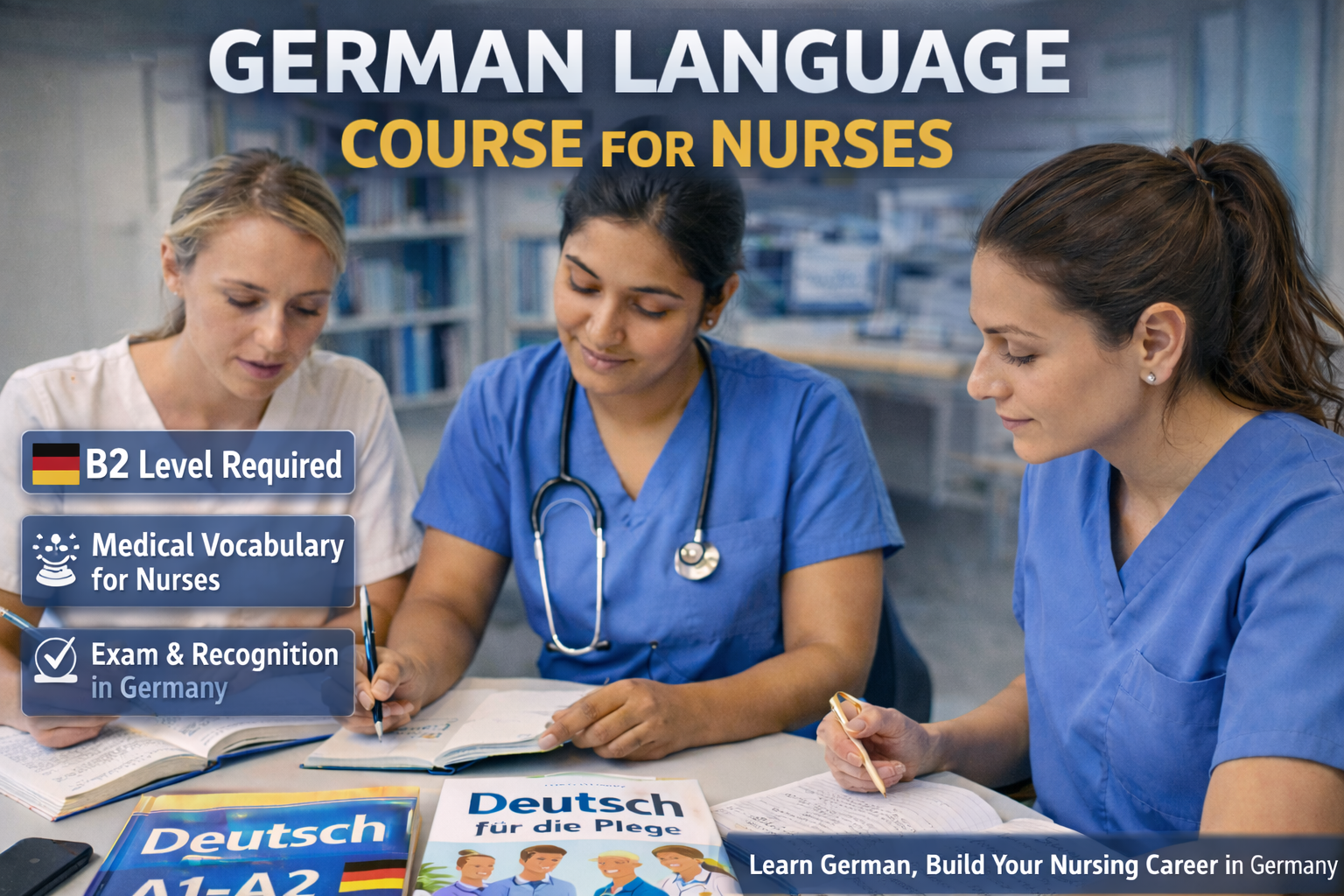
German Language Course for Nurses
German Language Course for Nurses: Complete Guide
Germany has become one of the most popular destinations for international nurses seeking stable careers, competitive salaries, and long-term professional growth. However, one essential requirement stands between you and your dream job in Germany — enrolling in a German Language Course for Nurses.
If you are planning to work as a nurse in Germany, language preparation is not just a formality. It is the foundation of your professional success. This guide explains everything you need to know about German language courses for nurses, required levels, course structure, exam preparation, career benefits, and how to choose the right institute.
Why a German Language Course for Nurses Is Essential
Germany’s healthcare system is highly structured and communication-driven. Nurses are expected to interact clearly with patients, doctors, and administrative staff. Since German is the official language used in hospitals, proper communication is mandatory.
A German Language Course for Nurses prepares you to:
-
Understand patient complaints accurately
-
Record medical history in German
-
Communicate with doctors and senior staff
-
Explain medications and procedures
-
Handle emergency conversations confidently
Without strong language skills, even a highly experienced nurse may struggle in a German hospital environment. That is why language certification is required for visa approval and professional recognition
.
What Level Is Required in a German Language Course for Nurses
One of the most common questions nurses ask is: “Which level should I complete?”
Most German states require at least B1 level for visa processing. However, B2 level is strongly recommended and often mandatory for professional recognition.
At B1 level, you can manage basic conversations and understand routine instructions.
At B2 level, you can participate in detailed medical discussions, write professional reports, and communicate confidently in stressful situations.
For better job opportunities and faster recognition, completing a German Language Course for Nurses up to B2 level is highly advisable.
Structure of a German Language Course for Nurses
A professional course is usually divided into levels following the Common European Framework of Reference (CEFR):
A1 Level
This is the beginner stage. You learn basic grammar, sentence structure, common phrases, and everyday vocabulary. The focus is on building a foundation.
A2 Level
At this stage, you develop stronger conversational skills and improve listening comprehension. You begin forming longer sentences and understanding routine dialogues.
B1 Level
Here, communication becomes more structured. You practice speaking about experiences, understanding workplace situations, and writing short formal messages.
B2 Level
This is the advanced level required for most nurses. You learn complex grammar, professional writing, medical communication, and exam-oriented speaking practice.
A structured ensures smooth progression from beginner to professional level.
Medical Vocabulary Training in German Language Course for Nurses
Medical vocabulary is a key part of specialized language training. Regular German courses may not focus on healthcare-specific terms.
In a specialized German Language Course for Nurses, you learn:
-
Terms related to symptoms and diagnosis
-
Hospital department names
-
Patient care instructions
-
Medication-related vocabulary
-
Emergency communication phrases
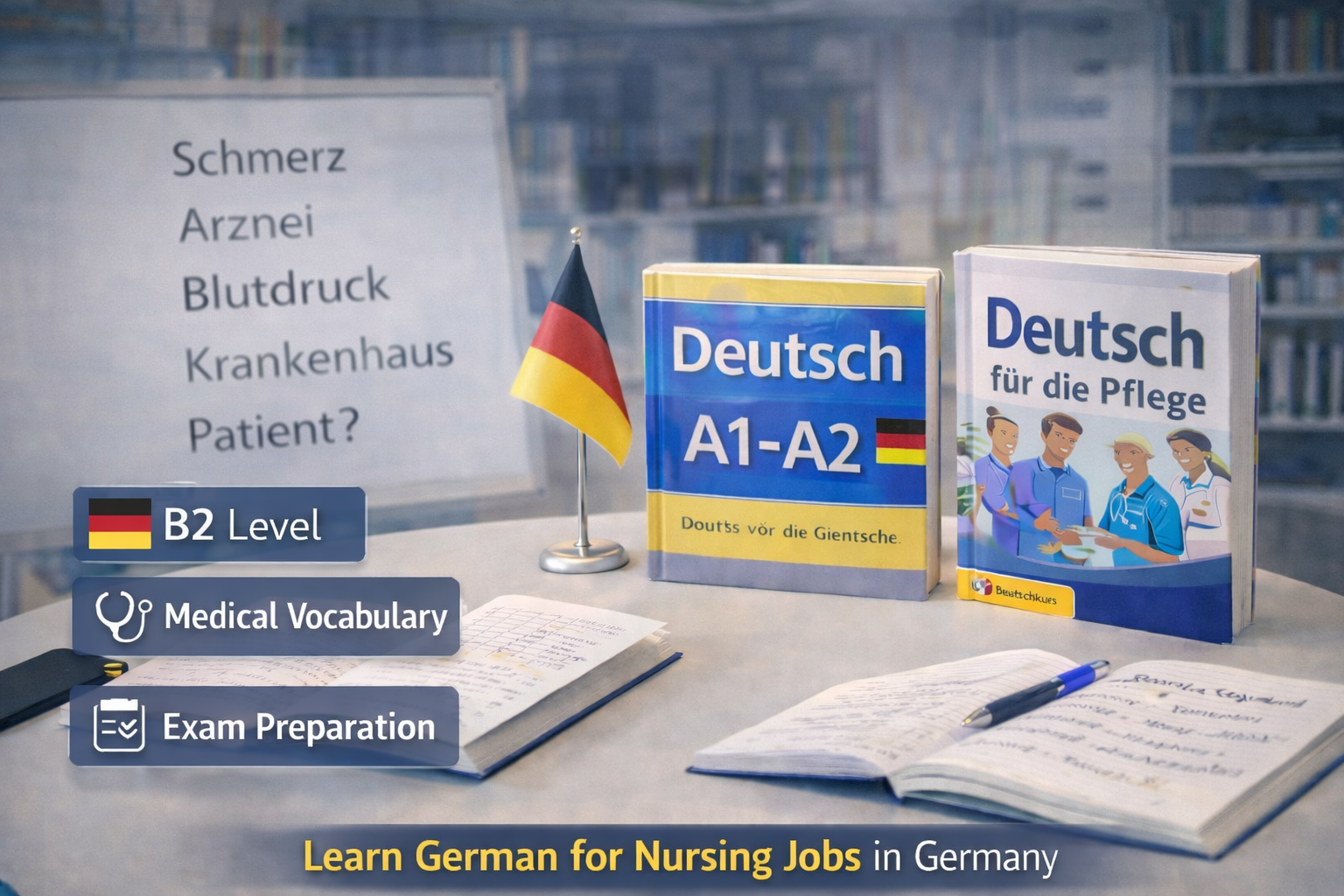
Understanding words like Schmerz (pain), Blutdruck (blood pressure), and Medikament (medicine) is essential for real hospital interaction.
Specialized vocabulary training increases confidence during interviews and professional exams.
Duration of a German Language Course for Nurses
The duration depends on your starting level and study consistency.
On average:
-
A1 and A2: 4–6 months
-
B1: 3–4 months
-
B2: 4–6 months
Overall, completing a full German Language Course for Nurses up to B2 may take 10–15 months.
If you study consistently for 2–3 hours daily, you can achieve faster results. Intensive programs may reduce the duration.
Online vs Offline German Language Course for Nurses
Many nurses today prefer online learning because of flexibility. However, both online and offline courses have advantages.
Online courses offer flexible timing, recorded sessions, and affordability. They are suitable for working professionals.
Offline courses provide direct interaction, classroom discipline, and immediate feedback.
When choosing a German Language Course , ensure the institute provides:
-
Live speaking practice
-
Mock exams
-
Medical vocabulary sessions
-
Certified trainers
-
Exam guidance
Quality training matters more than the format.
Exams After Completing German Language Course for Nurses
After finishing your course, you must clear a recognized German language exam.
Accepted exams usually include:
-
Goethe Certificate B1 or B2
-
TELC B2
-
ÖSD B2
Some states may also require a professional language test related to healthcare communication.
Your German Language Course should prepare you specifically for the exam format, including reading, writing, listening, and speaking sections.
Role of German Language in the Recognition Process
Professional recognition (Anerkennung) is mandatory for foreign nurses in Germany.
Language certificate is required for:
-
Visa application
-
Professional recognition
-
Registration with nursing authorities
-
Employment contracts
Without completing a proper the recognition process cannot move forward.
Career Opportunities After Completing German Language Course for Nurses
Once you achieve B2 level and complete recognition, you can work in:
-
Public hospitals
-
Private clinics
-
Elderly care homes
-
Rehabilitation centers
-
Specialized departments like ICU or emergency care
The average monthly salary ranges between €2,500 and €3,500 before taxes. With experience and specialization, earnings increase significantly.
Completing a German Language Course opens the door to long-term residency and career stability in Germany.
Challenges in Learning German for Nurses
Learning German can feel challenging at first.
Grammar rules such as cases and gender articles require practice. Pronunciation of long compound words may seem difficult.
Listening to fast native speakers can be overwhelming in the beginning.
However, with structured guidance and consistent effort, mastering the language becomes achievable.
A professional simplifies these challenges through systematic teaching and practical exercises.
Study Strategy for Faster Success
To complete your language course successfully, follow a disciplined routine.
Practice grammar daily for at least 30 minutes.
Learn 10–15 new words every day.
Listen to German audio or news regularly.
Practice speaking with partners or trainers.
Write short paragraphs or case notes daily.
Consistency is more important than speed. Regular practice ensures steady progress in your German Language Course
How to Choose the Right German Language Course for Nurses
Before enrolling, consider these factors:
-
Does the institute offer B2 level training?
-
Are trainers certified and experienced?
-
Does the course include medical vocabulary?
-
Are mock exams included?
-
Is speaking practice regular?
Choosing the right institute saves time and increases your chances of clearing the exam on the first attempt.
A well-structured should focus on both exam preparation and real-life hospital communication.
Cost of German Language Course for Nurses
The cost varies depending on institute, duration, and level.
In India, complete training from A1 to B2 may cost between ₹40,000 and ₹1,20,000. Exam fees are additional.
While this may seem like a significant investment, the return is high considering the salary and career growth opportunities in Germany.
Investing in a professional is an investment in your international future.
Why 2026 Is the Right Time to Start
Germany continues to face a shortage of skilled healthcare professionals. As older nurses retire, demand for qualified international nurses increases.
Starting your preparation now gives you a competitive advantage. Within one year, you can complete your German Language Course for Nurses and be ready for visa application.
Early preparation increases job opportunities and reduces processing delays.
Conclusion
A successful nursing career in Germany begins with language preparation. Enrolling in a professional German Language Course for Nurses is the first and most important step toward international career growth.
Language proficiency ensures patient safety, professional confidence, and smoother integration into the German healthcare system.
With consistent study, structured training, and proper exam preparation, achieving B2 level is completely possible. Once you step into a German hospital as a qualified nurse, the effort you invested in learning the language will prove invaluable.
If you are serious about building a stable and rewarding nursing career in Germany, start your German language journey today. Your future in international healthcare begins with the right course and the right commitment.

Heard some buzz about mexluckycasino. Gonna give it a whirl. If I win big, I’m coming back here to tell ya’ll! mexluckycasino
So, I downloaded PHMobaApp. Pretty cool app. I’ve had more fun than I thought I would give it a try! Click here to find the phmobaapp.
SMJiliCasino is growing on me. It isn’t bad. If you got time give it a shot: smjilicasino.