

Anerkennung Process for Indian Nurses: Complete 2026 Guide
Germany will not let you touch a patient as a nurse until one document exists. That document proves a German authority has recognised your qualification. This is the entire point of the Anerkennung process for Indian nurses, and it catches more applicants off guard than any visa rule does. It is not a formality you sign once and forget. It is a multi-month evaluation of your degree, your training hours, and your clinical experience. Skip it or misunderstand it, and even a confirmed job offer will not get you onto a hospital floor. This guide walks through exactly how the process works. It also covers what outcome to realistically expect, and how to avoid the delays that trip up most Indian applicants.
What Is the Anerkennung Process for Indian Nurses?
Germany strictly regulates the nursing profession. German law protects the title itself, Pflegefachperson. Only people who hold formal recognition for their qualifications can use it or work under it. Anerkennung is the official procedure for checking this. It compares your Indian nursing degree or GNM diploma against the training German nurses receive. Each of Germany’s 16 federal states runs its own recognition authority — the Anerkennungsstelle. You apply through the state where you plan to work. One state’s recognition does not automatically transfer to another. A transfer is possible later, but it takes extra time.
You can look up your exact authority and required documents on the official Anerkennung in Deutschland portal.
Anerkennung Process for Indian Nurses: Step by Step
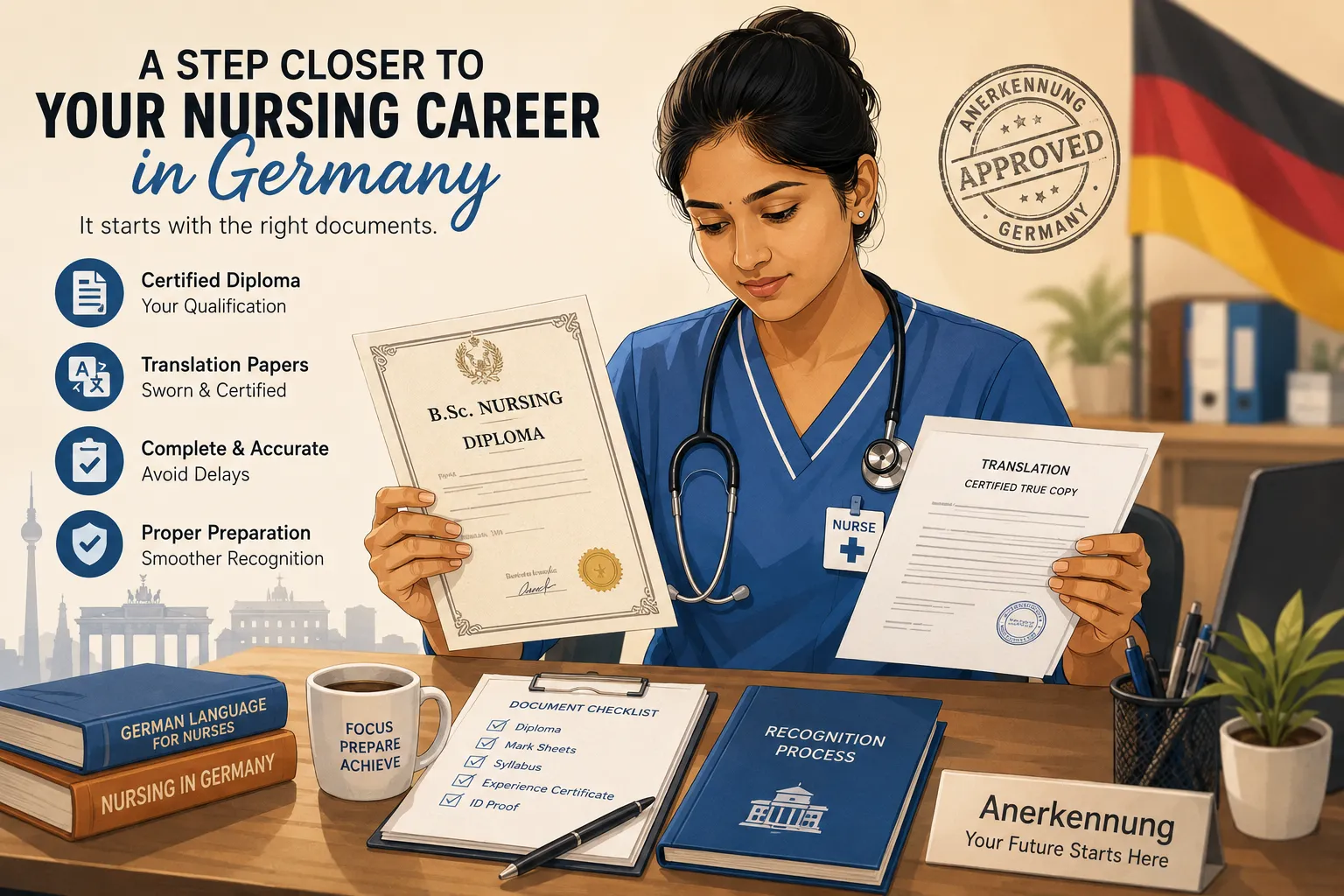
Start by choosing the German state you want to work in. That choice decides which authority reviews your file. Next, gather your certified diploma, full training transcripts, and a detailed curriculum or syllabus. Add proof of clinical hours and sworn German translations of every document. Submit your application to the relevant Anerkennungsstelle. You can do this online, by post, or through your employer or recruitment partner. The authority compares your training duration and content against the German standard. It checks for substantial differences between the two. You then receive one of two outcomes: full equivalence, or partial equivalence with a formal deficiency notice. If your file is complete, this review stage typically takes three to four months.
Full vs Partial Recognition: What You Should Actually Expect
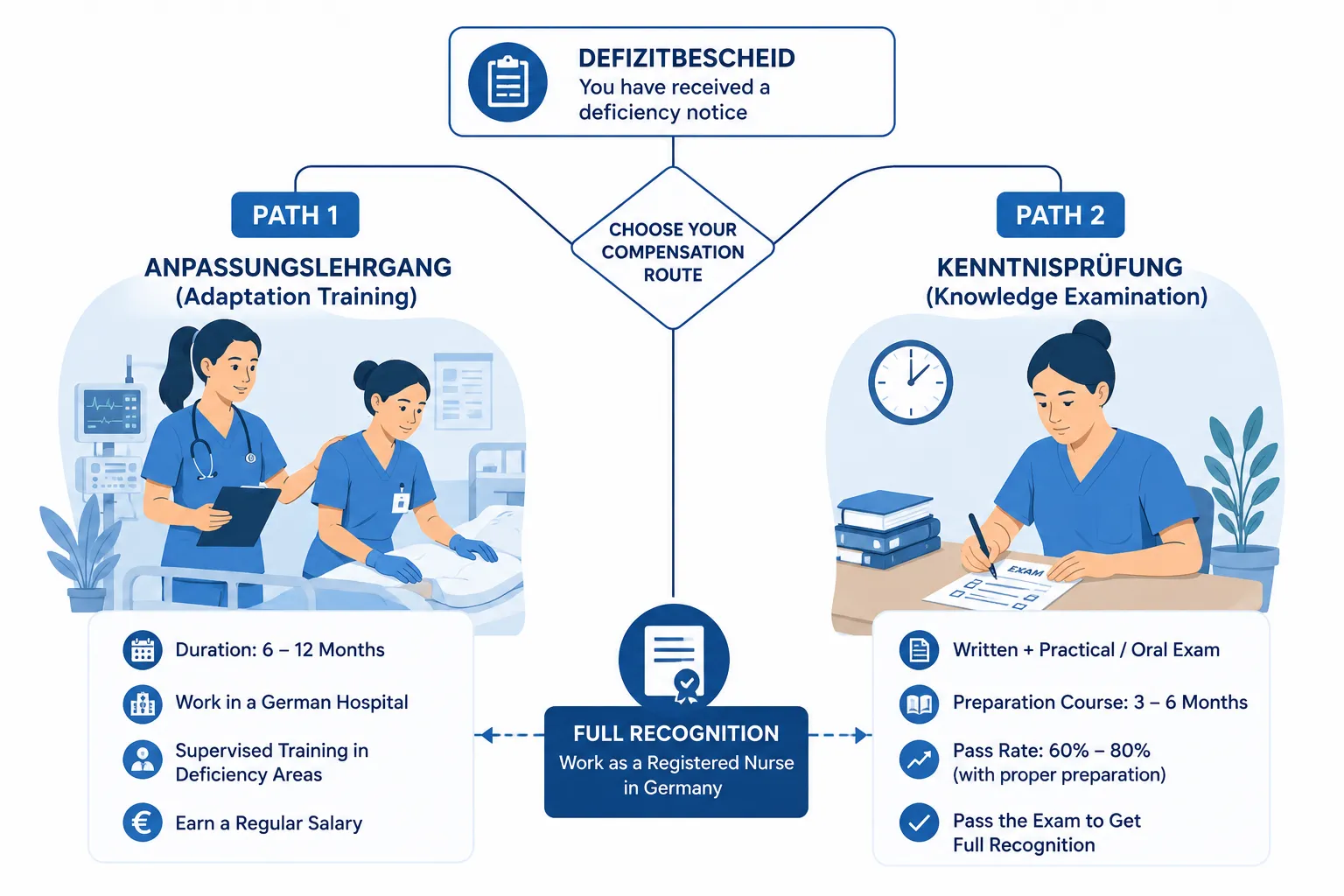
Full equivalence is the best possible outcome. It means the authority accepts your training as fully equal to the German standard. In practice, it is rare. More than 85% of non-EU applicants, Indian nurses included, receive partial recognition instead. This comes with a Defizitbescheid, a deficiency notice. It lists exactly which subjects or clinical hours your training did not cover. A Defizitbescheid is not a rejection. It is a checklist. Closing it is the only thing standing between you and full licensure.
Kenntnisprüfung or Anpassungslehrgang: Choosing Your Compensation Route
Once you have a Defizitbescheid, you close the gaps through a compensatory measure. In most cases, you get to choose between two routes. The Anpassungslehrgang is a supervised adaptation period inside a German hospital. It usually lasts six to twelve months. You work in exactly the areas your notice flagged, while earning a regular salary. The Kenntnisprüfung is a single knowledge exam instead. It combines a written test with a practical or oral component. Most candidates take a three to six month preparation course first. Pass rates for well-prepared candidates typically land between 60% and 80%. Nurses who want faster, hands-on integration tend to prefer the Anpassungslehrgang. Nurses confident in exam settings often choose the Kenntnisprüfung to finish sooner.
How Much Does the Anerkennung Process for Indian Nurses Cost?
Official recognition fees typically range from €170 to €845. The exact amount depends on the state and the specific profession. On top of that, budget for certified translations. If you need a compensatory measure, factor in that cost too. Kenntnisprüfung preparation courses generally cost between €1,000 and €2,500. Funding through the Federal Employment Agency’s Bildungsgutschein voucher is often available, though. Counting document preparation, the review period, and any compensatory measure, most Indian nurses reach full licensure in twelve to eighteen months. Working through a structured plan from day one is what keeps that timeline from stretching further.
Recruitment Support: Triple Win and Employer-Sponsored Pathways
Many Indian nurses do not navigate the Anerkennung process alone. Germany’s Federal Employment Agency and GIZ run Triple Win, a joint recruitment programme, and India counts as one of its official partner countries. It matches nurses with vetted German employers before departure, and it usually covers language training, document handling, and travel support as part of the package. Hospitals that recruit through Triple Win, or through Germany’s nursing recruitment pathways, often handle the Anerkennungsstelle application on your behalf. This does not remove the recognition requirement itself, but it does remove most of the paperwork burden, and it typically keeps your timeline closer to the twelve-month end of the range rather than the eighteen-month end.
German Language: A2 to Enter, B2 to Get Fully Licensed
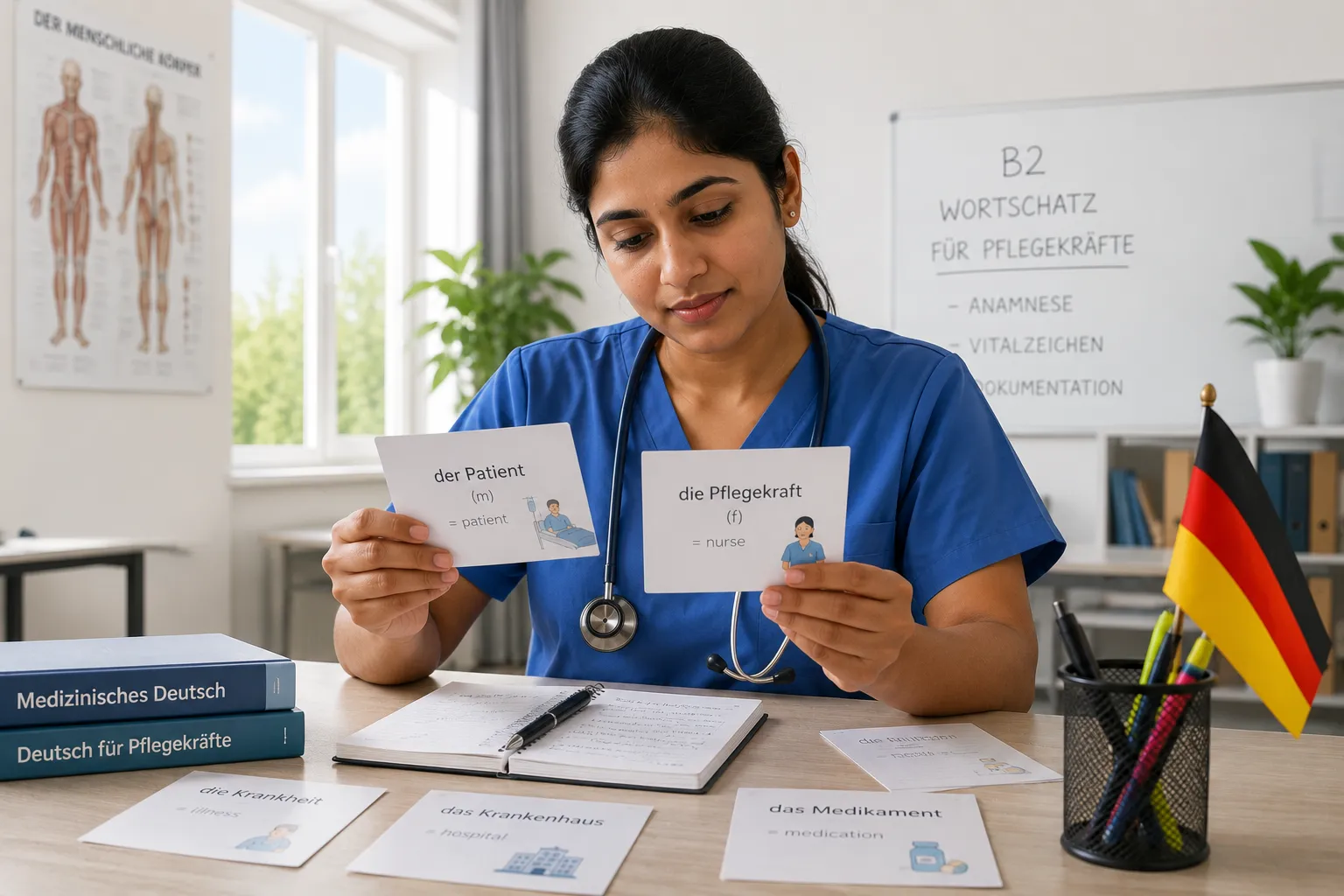
Since March 2024, the Anerkennungspartnerschaft route has changed the timeline. It allows nurses to enter Germany with just A2 German. You then continue the recognition process and language study after arrival. This is a major shift from the older rule, which required B1 or B2 before you could even travel. Full licensure, however, still requires German at B2 level. You also need to pass a separate Fachsprachprüfung, a medical language exam. It tests whether you can communicate safely with patients, doctors, and colleagues in clinical German. A German language course built for nurses closes exactly this gap. Generic B1 or B2 classes rarely cover ward vocabulary, documentation language, or exam-style medical scenarios.
Common Mistakes That Delay the Anerkennung Process for Indian Nurses
Applying to a state without researching its processing times is a common error. Wait times vary noticeably between states. Submitting translations that skip a certified sworn translator is another mistake, and it sends applications back for correction. Leaving out a detailed curriculum or syllabus is a third mistake. Providing only a diploma certificate almost guarantees a Defizitbescheid with vague, hard-to-close gaps. Waiting for the recognition decision before starting German lessons is another costly delay. B2 preparation takes months on its own, so it should run alongside document review, not after it.
Frequently Asked Questions
Is Anerkennung compulsory for every Indian nurse who wants to work in Germany?
Yes. Germany strictly regulates nursing as a profession. You can only use the protected title Pflegefachperson after formal recognition, regardless of your experience level in India.
What happens if I only receive partial recognition?
You get a Defizitbescheid listing the exact gaps. You then complete either an Anpassungslehrgang or a Kenntnisprüfung to close them and receive full licensure.
Can I move to Germany before I finish my recognition?
Yes, through the Anerkennungspartnerschaft route. It allows entry on A2 German while you complete recognition and language study inside Germany.
How long does the entire Anerkennung process for Indian nurses usually take?
Most applicants reach full licensure in twelve to eighteen months. This includes document review, any compensatory measure, and reaching B2 German.
Does every German state process applications at the same speed?
No. Processing times differ by state. Researching your target state’s average timeline before applying is worth the extra effort.
Conclusion
The Anerkennung process for Indian nurses is not a bureaucratic hurdle designed to slow you down. It is the exact mechanism that turns an Indian nursing degree into a legally protected German career. The outcome is largely predictable once you understand the steps. A Defizitbescheid is normal, not a setback. Choosing the right compensatory route can shorten your timeline significantly. The nurses who move fastest are the ones who start their German language preparation on day one. They do not wait for their recognition decision to arrive first. Get that sequencing right, and full licensure in Germany becomes a matter of when, not if.