

Chancenkarte for Indians: Germany’s New Visa Route 2026
For years, moving to Germany meant clearing one hurdle first: a confirmed job offer. Without it, your visa application never left the ground. That barrier is gone now. Chancenkarte for Indians has become the fastest-growing route into the German job market in 2026. The numbers back it up clearly. Out of 11,640 Opportunity Card visas issued worldwide, Indian applicants collected 3,721 of them. That is roughly one in every three approvals. The approval rate for Indians sits at 83%. If you have been waiting for a legal way to search for work in Germany without an employer lined up first, this is it. Here is exactly how the Chancenkarte works, why interest in it is exploding right now, and why your German language level quietly decides the outcome.
What Is the Chancenkarte (Opportunity Card)?
The Chancenkarte was introduced under Section 20a of the German Residence Act on June 1, 2024. It is a one-year residence permit built specifically for job seekers. Unlike a normal work visa, it does not require an offer before you land. Once you arrive, you can work part-time for up to 20 hours a week in any sector. You can also take short trial placements of up to two weeks, with as many employers as you like, while you search. When an employer finally makes you an offer, you convert the Chancenkarte into a long-term work permit at your local Ausländerbehörde.
You can read the full official rules on the Federal Government’s Make it in Germany portal.

Why Chancenkarte for Indians Is Trending Hard in 2026
Germany is short of more than 400,000 skilled workers. That gap is only widening as its workforce ages. The Chancenkarte was created to pull qualified professionals into the country faster than the old job-offer-first system ever could. Indian applicants have responded harder than any other nationality. They have taken nearly a third of all visas issued globally, with an approval rate well above the average. For Indian graduates and professionals in IT, engineering, and healthcare, Chancenkarte for Indians is currently the most realistic legal pathway into the German labour market.
The Points System: How You Actually Qualify
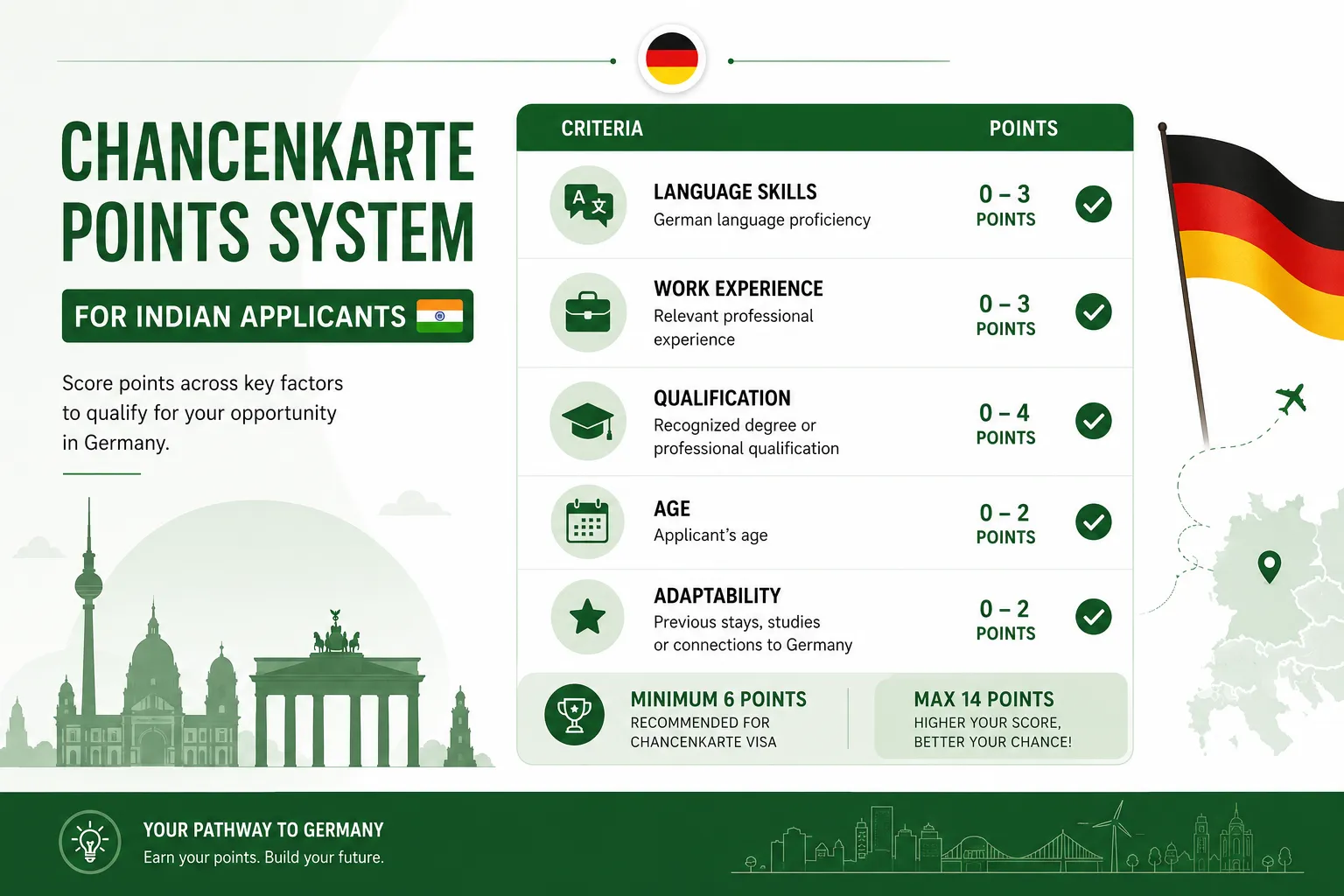
You can qualify for the Chancenkarte in one of two ways. The first is through a recognised degree or vocational qualification. The second is through a minimum of six points on the official scoring grid. Points are awarded roughly as follows:
- Partial recognition of your qualification — 4 points
- Five or more years of relevant work experience — 3 points
- German language at B2 level or higher — 3 points
- Two or more years of relevant work experience — 2 points
- German language at B1 level — 2 points
- Age under 35 — 2 points
- Working in an officially listed shortage occupation — 1 point
On top of the points, you must prove financial self-sufficiency. Current requirements sit around €1,091 a month, or roughly €13,092 for the full year. Most applicants show this through a blocked account.
Why Your German Level Decides Your Chancenkarte Outcome
Here is the detail most applicants underestimate. English alone will not carry you far on this points grid. A1 German is the bare legal minimum to apply. Plenty of applicants get by on A2. But B1 is where the real advantage starts. B2 hands you three full points on its own. That is often the difference between qualifying and falling short.
This is exactly why a structured German course from A1 to B2 matters more than most applicants realise. It is not a formality. It is points on the board, and points decide your Chancenkarte outcome.
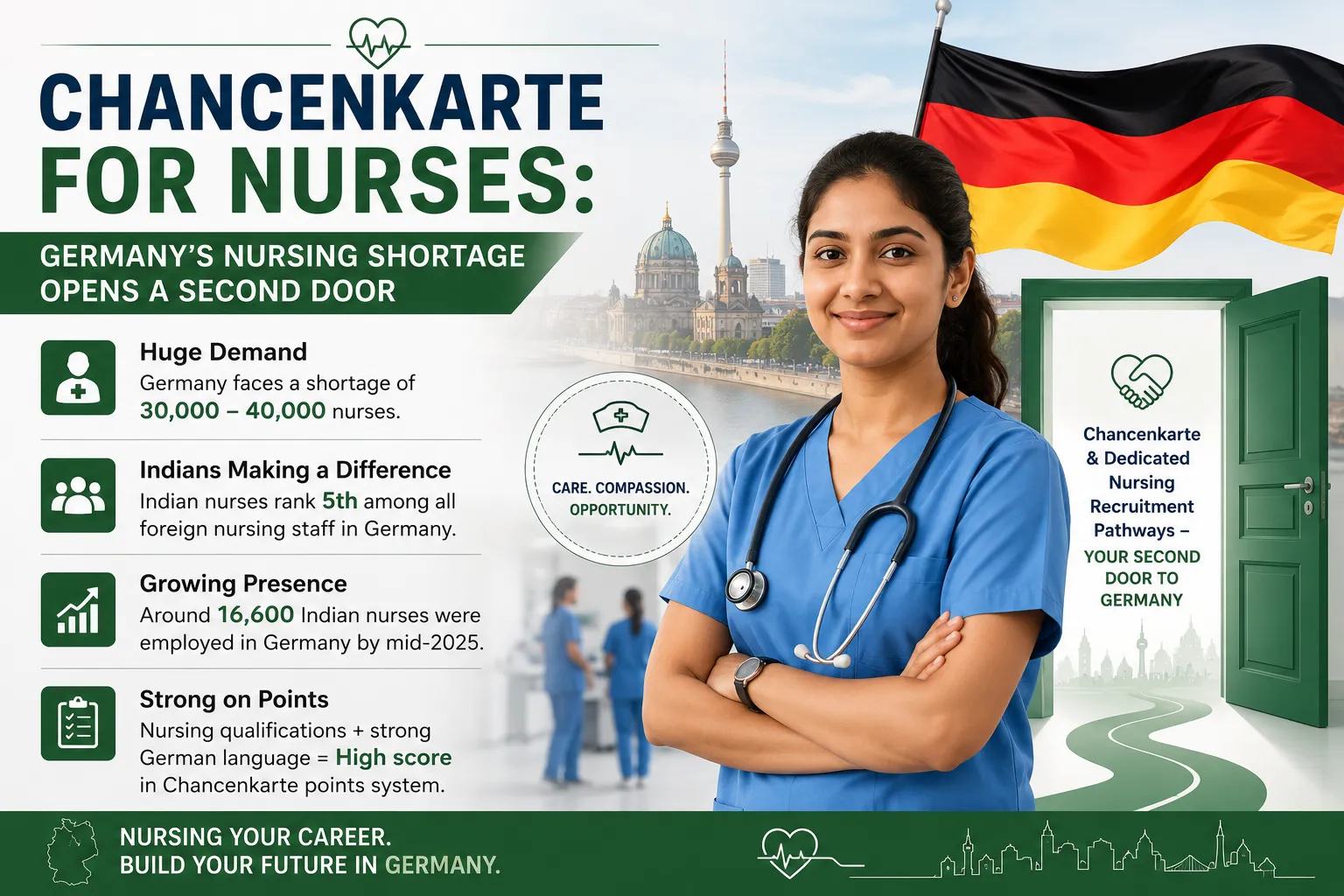
Chancenkarte for Nurses: Germany’s Nursing Shortage Opens a Second Door
There is a parallel story unfolding in healthcare. Germany’s hospitals and care homes are short of between 30,000 and 40,000 nurses right now. The country is actively recruiting abroad to close that gap. Indian nurses have climbed to fifth place among all foreign nursing staff in Germany. Around 16,600 were already employed as of mid-2025. Nursing qualifications combined with strong German ability score well under the Chancenkarte points grid.
Nurses can also explore Germany’s dedicated recruitment pathways for nursing jobs in Germany, which run alongside the Chancenkarte as a second door into the same destination.
Step-by-Step: Applying for the Chancenkarte from India
Start by calculating your points honestly against the official grid. Decide whether you qualify as a recognised skilled worker, or through the points route instead. Book a German language certificate exam and aim for at least B1, since A2 alone often leaves you short on points. Open a blocked account and deposit the required funds. Arrange German health insurance next, since it is mandatory even before you apply. Gather your degree certificates, experience letters, and vocational documents, and get your qualification checked on the anabin database in advance. Submit your application at the German consulate or a VFS Global centre serving your region. Once approved, fly out and register your address within two weeks. Begin your job search immediately, using trial employment as your fastest route to a real offer. This full sequence is what makes Chancenkarte for Indians a genuinely structured process rather than guesswork.
Common Mistakes That Get Chancenkarte Applications Rejected
Submitting an IELTS score with no German certificate at all is one of the most frequent rejection reasons. English alone rarely clears the points threshold on its own. Applying with a university that does not appear in the anabin database quietly kills otherwise strong applications, and so does a lower recognition rating on that database. Generic, vague experience letters that skip job titles and dates routinely get flagged too. Assuming your points total without checking the official calculator is another avoidable error, and it costs applicants months of delay.
Frequently Asked Questions
Do I need a job offer to apply for the Chancenkarte?
No. The entire point of the Chancenkarte is to let you enter Germany and search for work without a confirmed job offer in hand.
What is the minimum German level required?
A1 German or B2 English is the legal minimum. B1 or higher significantly improves both your points score and your real job prospects.
How much money do I need in my blocked account?
Current requirements are roughly €1,091 per month. That works out to about €13,092 for a full year of residence.
Can nurses apply for the Chancenkarte too?
Yes. Nurses qualify through the standard points grid. Many also use Germany’s dedicated nursing recruitment programmes alongside it.
How long is the Chancenkarte valid, and can it be extended?
It is issued for up to 12 months. Once you receive a qualifying job offer, you convert it into a long-term work or Blue Card permit instead of extending it as-is.
Conclusion
Chancenkarte for Indians is not a loophole or a shortcut. It is Germany’s structural response to a labour shortage it cannot solve on its own, and Indian applicants are already proving it works. What separates an 83% approval story from a rejected file usually comes down to two things. One is an honestly calculated points score. The other is a German level that actually earns points, not just one that meets the bare minimum. Whether your route in is IT, engineering, or nursing, the same rule applies across every pathway. The earlier you start building real German ability, the stronger your application becomes.

Logging in is a breeze and the account management is very straightforward. No complicated steps, just pure gaming. I really appreciate the efficiency of sz777asialogin.
Finally found a platform that actually delivers on its promises. The game variety is impressive and I had no issues with my registration. Check out idmuliajitu
I’ve tried a few platforms lately but this one really stands out. The games are smooth and the payouts are fair. Highly recommend checking out 311jiliparkcasino for a great experience.
Best betting experience I have had in a while. The payouts are fair and the process is transparent. Big shoutout to phjilikobet.
I really appreciate the transparency of this site. Everything is clear and the game options are diverse. Really enjoying my time here. vn32vin1
I had a great run last weekend! The platform is stable and the rewards are fair. I will be returning to phnustra for sure.