

German for Engineers Germany: 2026 Guide
German for Engineers: Do Mechanical/Civil/Electrical Engineers Need It? (2026 Guide)
German for engineers Germany doesn’t have one single answer. That’s exactly why so many mechanical, civil, and electrical engineers get confused. The visa doesn’t legally require it. Your actual job usually does, though the extent varies a lot by discipline and company type. This guide breaks down what the law says, what employers actually expect, and how much German each engineering branch realistically needs in 2026.

The Short Answer: Legally No, Practically Yes
Start with the visa itself. Neither the EU Blue Card nor the Opportunity Card (Chancenkarte) legally requires German for engineers to qualify. Both routes focus on your degree, your experience, and — for the Blue Card — a salary threshold.
That said, “not legally required” and “not needed” are very different things. Once you’re actually working, German becomes central to daily life on the job, especially outside large multinational teams.
What the Visa Actually Requires for German for Engineers Germany
The EU Blue Card asks for a recognised engineering degree and a job offer above the relevant salary threshold. That figure sits at €45,934.20 for shortage occupations in 2026. It covers mechanical, electrical, civil, chemical, and process engineering. No German test sits anywhere in that requirement list.
The Opportunity Card works differently. It’s points-based, and German does add points if you have it. However, strong scores in age, experience, and qualification can get you through even with little or no German. Either way, the legal bar for entry stays lower than most engineers assume.
Why Job Postings Still Ask for B1/B2 Anyway
Here’s where the practical reality kicks in. Most engineering job postings in Germany still list B1 or B2 German as a requirement. That’s true even though the visa itself doesn’t demand it. Employers care about workplace communication, safety instructions, and client interaction — none of which the immigration law regulates.
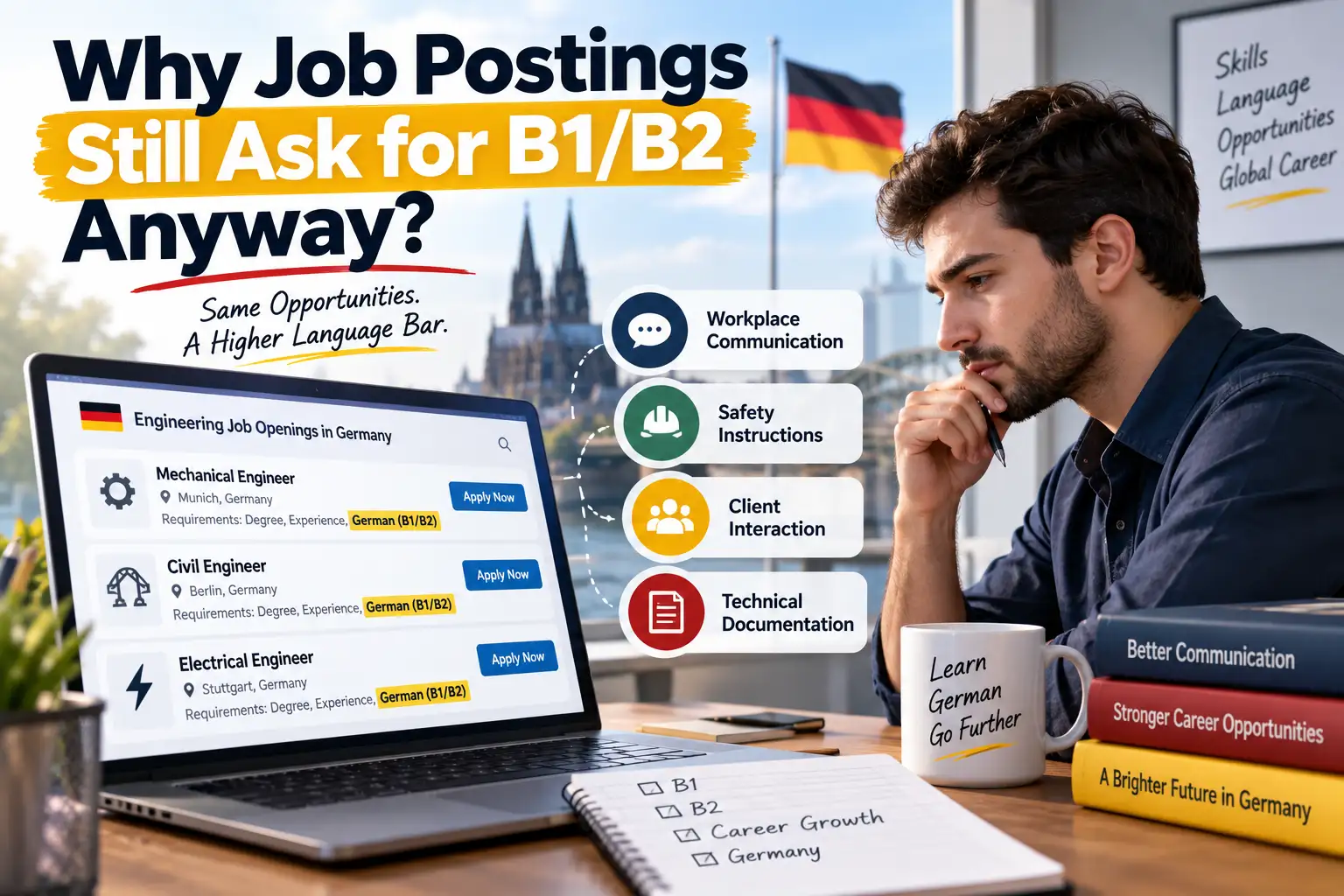
In short, the visa sets the legal floor. Your employer sets the real bar, and it’s usually higher.
German for Engineers Germany: Mechanical Engineers
Mechanical engineering roles vary widely by company. Large automotive and industrial groups sometimes run English-speaking R&D teams, particularly for international projects. Smaller manufacturing firms — Germany’s famous Mittelstand — operate almost entirely in German, from shop-floor communication to technical documentation.
Because of that split, mechanical engineers face the widest range of outcomes. A role at a global R&D centre might need only basic German. A role at a mid-sized manufacturer will likely expect B1 or B2 from day one.
Civil Engineers: The Most German-Heavy Discipline
Civil engineering sits at the German-heavy end of the spectrum, and for good reason. You’re dealing with local building codes, site visits, and contractor coordination. German building authorities rarely operate in English. German technical standards (DIN norms) are published in German, and construction-site communication rarely shifts to English for your convenience.
If you’re a civil engineer, treat strong German as a practical necessity. That holds true regardless of what the visa technically asks for.
Electrical Engineers: Somewhere in Between
Electrical engineering lands between the other two. Roles tied to product design or R&D at larger firms sometimes run closer to English. This mirrors mechanical engineering’s multinational side. Roles involving installation, maintenance, or client-facing technical support lean more German-heavy, closer to civil engineering’s reality.
Your specific sub-field matters more here than the job title “electrical engineer” alone.
Big Multinationals vs Mittelstand: Why Company Size Matters
Company size predicts your German requirement better than discipline alone, in many cases. Large multinationals with international teams often build in more English-friendly pockets — think global automotive or tech-adjacent engineering firms. Germany’s Mittelstand tells a different story. This network of small and mid-sized specialised manufacturers forms the backbone of the economy, and it tends to run almost entirely in German.

Before assuming your discipline decides your German needs, research the specific company. A mechanical engineering role at two different firms can sit at completely opposite ends of the language spectrum.
Permanent Residency Timeline and German Level
German also affects how fast you reach permanent residency, regardless of your discipline. EU Blue Card holders typically qualify after 27 months without German. With B1 German, that drops to 21 months. With just A1, it can be as early as 33 months. That gap alone makes a strong case for learning German early, even if your current job doesn’t strictly require it.
How Much German Do You Actually Need?
As a realistic target, aim for B1 at minimum. Push for B2 if you’re in civil engineering or a client-facing electrical role. B1 covers everyday workplace conversation and basic technical discussion. B2 gets you comfortable in meetings, site visits, and more complex technical exchanges.
Treat A1 or A2 as a starting point, not a destination. It won’t carry you far in most real engineering workplaces, even at English-friendly companies.
Common Mistakes Engineers Make About German
- Assuming “the visa doesn’t require it” means the job doesn’t either
- Treating all engineering disciplines as equally English-friendly, when civil engineering rarely is
- Choosing a company based on its industry reputation, without checking its actual working language
- Delaying German study until after arrival, instead of starting before the move
- Stopping at A1/A2 and assuming that’s enough for real workplace integration
FAQs on German for Engineers Germany
Do I legally need German to get an engineering visa for Germany?
No. Neither the EU Blue Card nor the Opportunity Card has a legal German language requirement. The Opportunity Card does, however, award extra points for it.
Which engineering discipline needs the least German?
Mechanical and electrical engineering roles at large multinational R&D teams often need the least. This varies significantly by specific employer, though.
Do civil engineers really need German more than other engineers?
Generally, yes. Site work, local building codes, and contractor coordination make German far more central to civil engineering. Most office-based engineering roles don’t face the same pressure.
What German level should I target before moving?
B1 as a realistic minimum. Push for B2 if you’re heading into civil engineering or client-facing electrical work.
Final Thoughts
German for engineers Germany comes down to one honest split. The law doesn’t ask for it, but your actual working life usually does. Mechanical and electrical engineers get more flexibility depending on company type. Civil engineers, on the other hand, should plan around German as a practical requirement from the start.
Whichever discipline you’re in, starting German early gives you more job options and a faster path to permanent residency. Explore Germanacharya’s B1/B2 German courses to build exactly the level real engineering workplaces expect. Book a free 1:1 consultation to plan your timeline, or browse more guides on our blog.
For official information, see the Federal Foreign Office’s EU Blue Card FAQ. The Make it in Germany EU Blue Card page covers current salary thresholds and eligibility.