
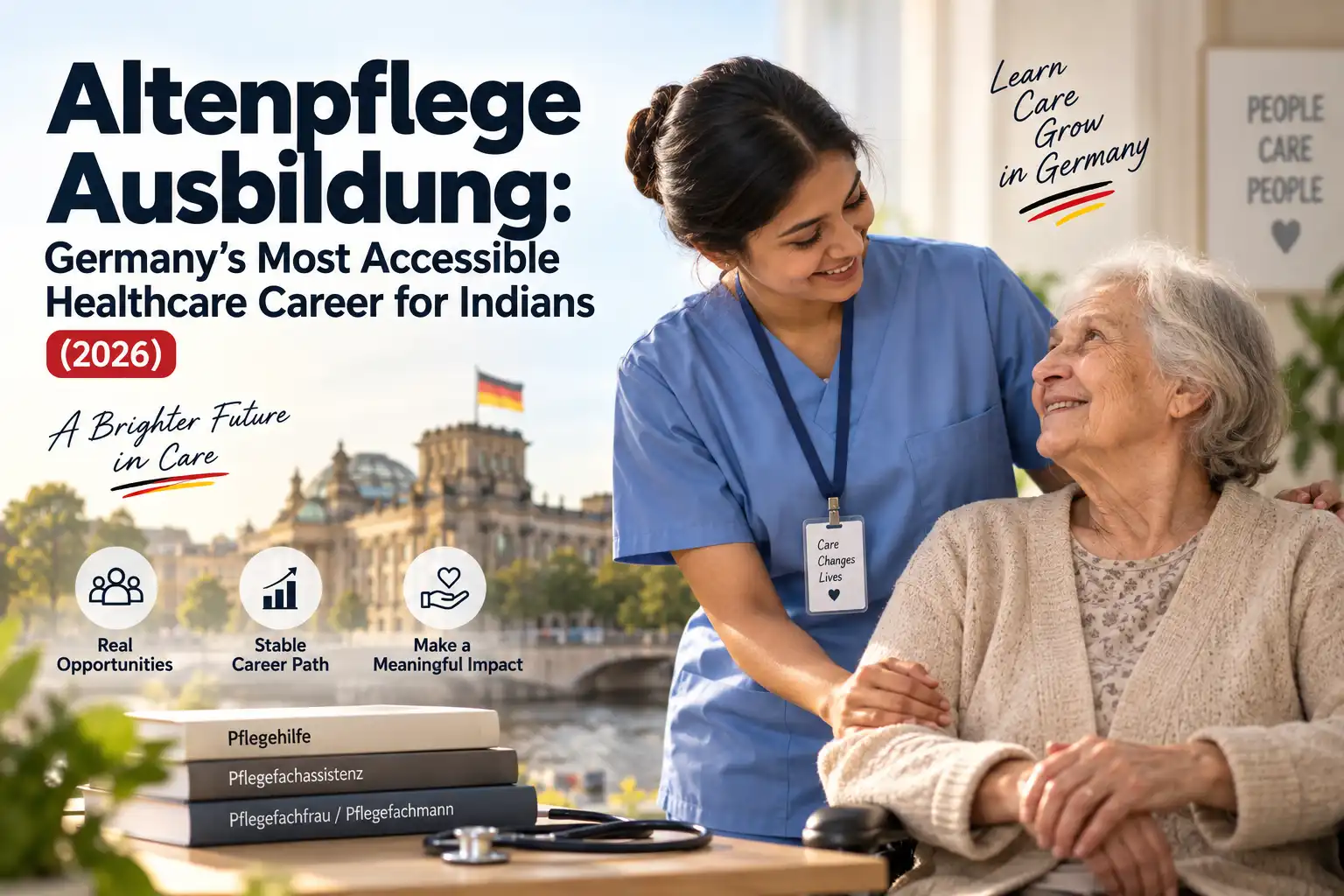
Altenpflege Ausbildung Germany: 2026 Accessible Guide
Altenpflege (Elderly Care) Ausbildung: Germany’s Most Accessible Healthcare Career for Indians (2026)
Altenpflege Ausbildung Germany is a search term that hides an outdated assumption. Standalone elderly-care training stopped existing as its own entry point back in 2020. That doesn’t mean the accessible route into German elder care disappeared, though. It just moved. This guide explains exactly what changed, and where the genuinely accessible pathway sits today.
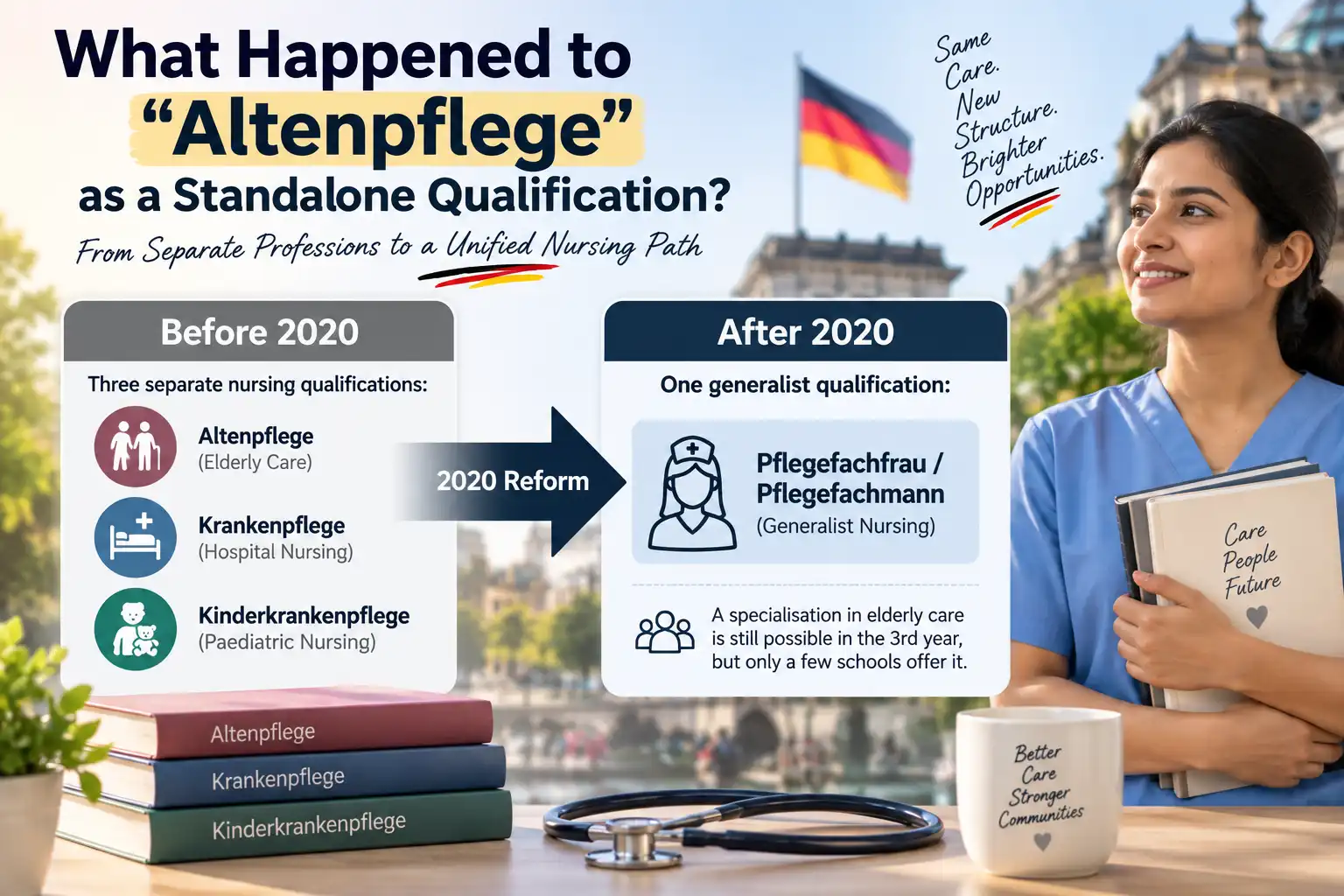
What Happened to “Altenpflege” as a Standalone Qualification
Until 2019, Germany trained elderly-care specialists, hospital nurses, and paediatric nurses as three separate professions. A 2020 reform merged all three into one generalist qualification: Pflegefachfrau/Pflegefachmann. The standalone Altenpflege training, as most people picture it, was formally abolished.
A narrow specialisation option technically survives. In the third year, trainees can choose an elderly-care focus instead of staying generalist. In practice, very few schools actually offer it, according to German medical trade press. Treat the old standalone Altenpflege qualification as functionally gone, not as a live entry route.
Altenpflege Ausbildung Germany: The Two Real Pathways Today
So where does “accessible” actually come from? Two real routes lead into German elderly care work now. They sit at very different entry levels.
The first is the full three-year Pflegefachfrau/Pflegefachmann training. It’s generalist by design, with elderly-care placements built in, but demanding in scope. The second is a shorter assistant-level qualification, commonly called Pflegefachassistenz or Pflegehilfe. It runs for roughly one to two years. That second route is where the real accessibility story lives.
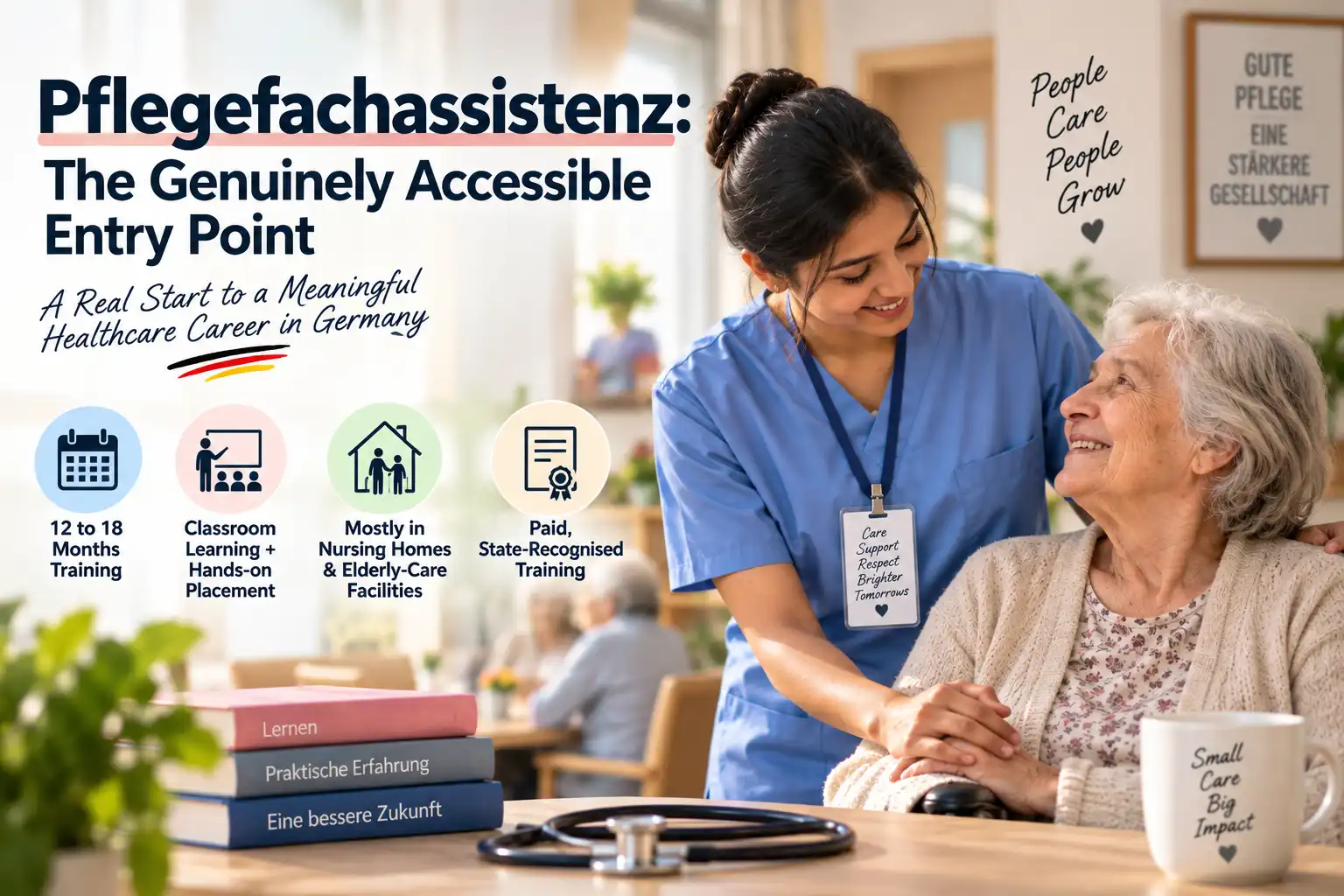
Pflegefachassistenz: The Genuinely Accessible Entry Point
This shorter assistant training typically runs 12 to 18 months. Recognised prior experience can compress it further. It combines classroom instruction with hands-on placement. Most placements happen in nursing homes and elderly-care facilities specifically, since that’s where demand for assistant-level staff concentrates.
Graduates take on daily-living support, basic care tasks, and close resident contact. They work under the supervision of a qualified Pflegefachkraft. It’s real, paid, state-recognised training, not an unofficial shortcut.
Eligibility and Language Requirement for the Assistant Route
- A secondary school leaving certificate, or a recognised equivalent
- German language ability, commonly around B1 to B2 depending on the specific school and state
- Genuine interest in hands-on, person-centred care work
- No prior nursing background required — this route is designed as a first step, not a bridge for already-qualified professionals
What You Actually Do and Earn as a Pflegehelfer/in
Day to day, you support residents with daily living activities. You monitor their wellbeing, and assist qualified staff with documented care tasks. You won’t handle the full clinical scope a Pflegefachkraft does. That said, the work is genuinely hands-on and resident-facing from early in the programme.
Training in this track is generally paid, following the same dual-system logic as the full Ausbildung. Exact stipend amounts vary meaningfully by school, state, and employer. Confirm the specific figure with any programme you’re considering, rather than assuming a fixed number.
Bridging Up: From Assistant to Full Pflegefachkraft
Most assistant-level graduates aren’t stuck at that level permanently. Many schools let you progress directly into the full three-year Pflegefachfrau/Pflegefachmann programme afterward. Sometimes your assistant training even counts toward it. This makes the assistant route a genuine stepping stone, not a dead end.
For many Indian applicants, this staged approach makes more sense than attempting the full three-year programme immediately. Starting from zero with limited German is a much harder climb.
The Full Three-Year Route, With an Elderly Care Focus
If you go straight for the full Pflegefachfrau/Pflegefachmann qualification, elderly-care placements still make up a real part of your practical training. This holds regardless of any final-year specialisation choice. Stipends under the 2026 TVAöD-P scale run roughly €1,340 in year one. Year two rises to €1,400, and year three reaches €1,503, gross.
Given Germany’s ageing population, a large share of generalist graduates end up working in elderly care anyway. This happens whether or not they formally specialised in it.
Altenpflege Ausbildung Germany: Why Elderly Care Has Lower Barriers
Care homes and elderly-care providers face some of Germany’s most acute staffing shortages. That translates into real practical advantages for international applicants. Expect more willingness to sponsor training visas, faster placement into open positions, and less competition than hospital-based nursing roles.
None of this means lower standards. It means genuine, structural demand working in your favour. This is especially true at the assistant level, where the entry bar is already lower to begin with.
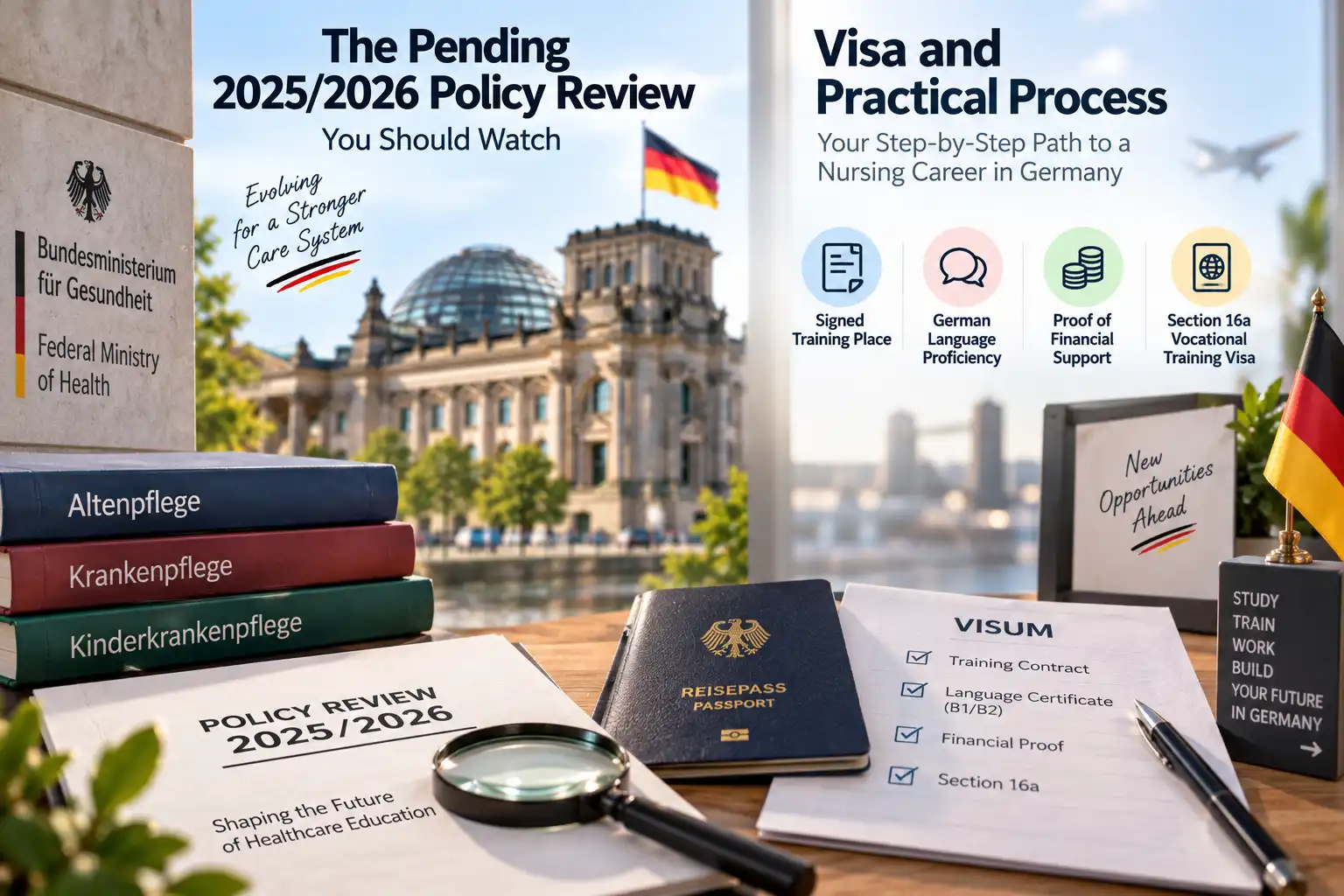
The Pending 2025/2026 Policy Review You Should Watch
Germany’s health ministry committed to a review by the end of 2025. The question: whether the separate Altenpflege and paediatric-nursing specialisations still serve a purpose within the generalist system. As of early 2026, industry groups have been pushing to reintroduce a fully independent Altenpflege qualification. They argue the current specialisation option isn’t working well in practice.
No final decision had been confirmed at the time of writing. If you’re planning years ahead, keep an eye on this. The structure could shift again before you finish your own training.
Visa and Practical Process
Both the assistant-level and full generalist routes use the same vocational training visa category, under Section 16a of the Residence Act. The core requirements stay consistent across both. You’ll need a signed training place, proof of German language ability, and proof that you can support yourself. Your training income typically covers that last part once you have a contract.
Common Mistakes and Misconceptions
- Searching for a standalone “Altenpflege Ausbildung” that no longer exists as an entry route
- Assuming the assistant-level route is a lesser or unofficial qualification, when it’s genuinely state-recognised
- Jumping straight into the full three-year programme when the assistant route might fit your current German level better
- Ignoring the pending 2025/2026 policy review, which could affect long-term planning
- Overlooking how much elderly-care demand favours international applicants specifically
FAQs on Altenpflege Ausbildung Germany
Does a standalone Altenpflege qualification still exist in Germany?
Not really, as an entry-level training. It was folded into the generalist Pflegefachfrau/Pflegefachmann qualification in 2020. Only a rarely offered third-year specialisation option remains.
What’s the most accessible way into German elderly care right now?
The Pflegefachassistenz or Pflegehilfe route. It’s a shorter, one-to-two-year assistant qualification focused heavily on elderly-care settings, with a lower entry bar than the full three-year programme.
Can I move from the assistant route into full nursing training later?
Yes, in most cases. Many schools allow direct progression into the full Pflegefachfrau/Pflegefachmann programme. Sometimes they even credit your assistant training toward it.
Why does elderly care specifically offer better chances for international applicants?
Care homes face particularly acute staffing shortages in Germany. That generally means more visa sponsorship willingness and faster placement than more competitive hospital-based roles.
Final Thoughts
Altenpflege Ausbildung Germany, as a standalone qualification, belongs to the past. The genuinely accessible route into German elderly care today runs through the shorter Pflegefachassistenz pathway. From there, you can bridge into full nursing training once you’re ready. For many first-time applicants, that’s a better-structured route than jumping straight into the full three-year programme.
If you’re preparing for either route, explore Germanacharya’s B1/B2 German courses to build the language level these programmes expect. Visit our Nursing careers page for related guidance. Or book a free 1:1 consultation, or browse more guides on our blog.
For official background, see the Federal Ministry of Health’s page on the Nursing Professions Act. The Federal Employment Agency’s vocational training guidance covers the broader system.

The odds and the variety here are just insane. I feel like this is exactly what I was searching for to level up my game. vnj88bet
Super impressed with the mobile version. I can play anywhere without any glitches. If you are on the move just use braposta1.
The app version is a game changer! I can play anywhere and it doesn’t lag at all. So glad I downloaded jilidayapp.
Finally a login page that actually works without any glitches. Very clean design and very responsive. I suggest using pkbajiapplogin for a better experience.
Really impressed with the variety of games available here. It feels very secure and the customer support team is actually helpful. I’m having a great time so far. Highly recommend bdtk999win
I’ve been playing here for a while and the payouts are surprisingly fast. Definitely one of my favorite spots lately. Check out bb444
I love how everything is organized on this site. It makes finding my favorite games so much easier. A solid five stars for playtimept.
Love how easy it is to access this on my phone. The app is lightweight and the slots are super addictive. slotphpapp is my go-to mobile spot.