

German Language for Nursing in Germany: A Complete Guide
German Language for Nursing in Germany
German Language for Nursing in Germany is an important requirement for Indian nurses planning to work in Germany. B2 German is generally the key language target for nursing recognition, while A1, A2 and B1 build the foundation for professional communication.
For many internationally trained nurses, B2 German is an important target for professional recognition. Germany’s official information portal states that nursing is a regulated profession and that sufficient German language knowledge at B2 level is generally required for recognition.
However, reaching B2 does not happen in one step. A strong learning plan usually starts at A1, progresses through A2 and B1, and then builds the advanced communication skills needed at B2.
In this guide, you will learn what German level nurses need, what to study at each stage, which exams may be relevant, and how to prepare for professional communication in Germany.
Why German Language Is Important for Nursing in Germany
Nursing is a communication-heavy profession. Nurses interact with patients, relatives, doctors, therapists and other healthcare professionals every day.
For this reason, German language for nurses in Germany needs to go beyond basic everyday conversation.
You may need German to:
- Speak with patients about their symptoms
- Ask questions about pain and discomfort
- Explain basic care procedures
- Understand instructions from doctors and senior nurses
- Participate in shift handovers
- Read healthcare-related information
- Write nursing documentation
- Communicate with patients’ relatives
- Handle routine conversations with colleagues
- Respond clearly in urgent situations
German language knowledge is therefore an important part of preparing for a nursing career in Germany.
This is why learning German should be treated as part of your professional preparation, not simply as an exam or visa requirement.
What Level of German Do Nurses Need in Germany?
For nurses seeking professional recognition in Germany, B2 is generally the key language target. The exact process and requirements can depend on the competent authority and the route you are following.
A simple roadmap looks like this:
| German Level | Main Purpose for a Nurse |
|---|---|
| A1 | Basic German and simple communication |
| A2 | Everyday communication |
| B1 | Independent communication and work preparation |
| B2 | Advanced professional communication and recognition target |
If you are starting from zero, do not worry about B2 immediately. Build your language foundation step by step.
Is B1 Enough for Nurses?
B1 is an important milestone, but it should not automatically be treated as the final goal for a nurse seeking full professional recognition.
Some pathways or stages may involve B1-level German, and specific requirements can differ according to the situation. However, official German guidance identifies B2 as the language level required for recognition of nursing professionals.
Therefore, nurses planning a long-term professional career should generally plan their learning journey toward B2.
Why B2 Is Important for Nursing Recognition
At B2, learners are expected to understand more complex communication and express themselves with greater fluency.
This matters in nursing because workplace communication can involve:
- Technical vocabulary
- Detailed patient information
- Medical instructions
- Professional discussions
- Written documentation
- Structured handovers
- Discussions with healthcare teams
The professional environment requires nurses to communicate information clearly and accurately. This makes advanced German particularly important for international nursing professionals.
For official information about working as a nurse in Germany, you can refer to Make it in Germany – Nursing Professionals.
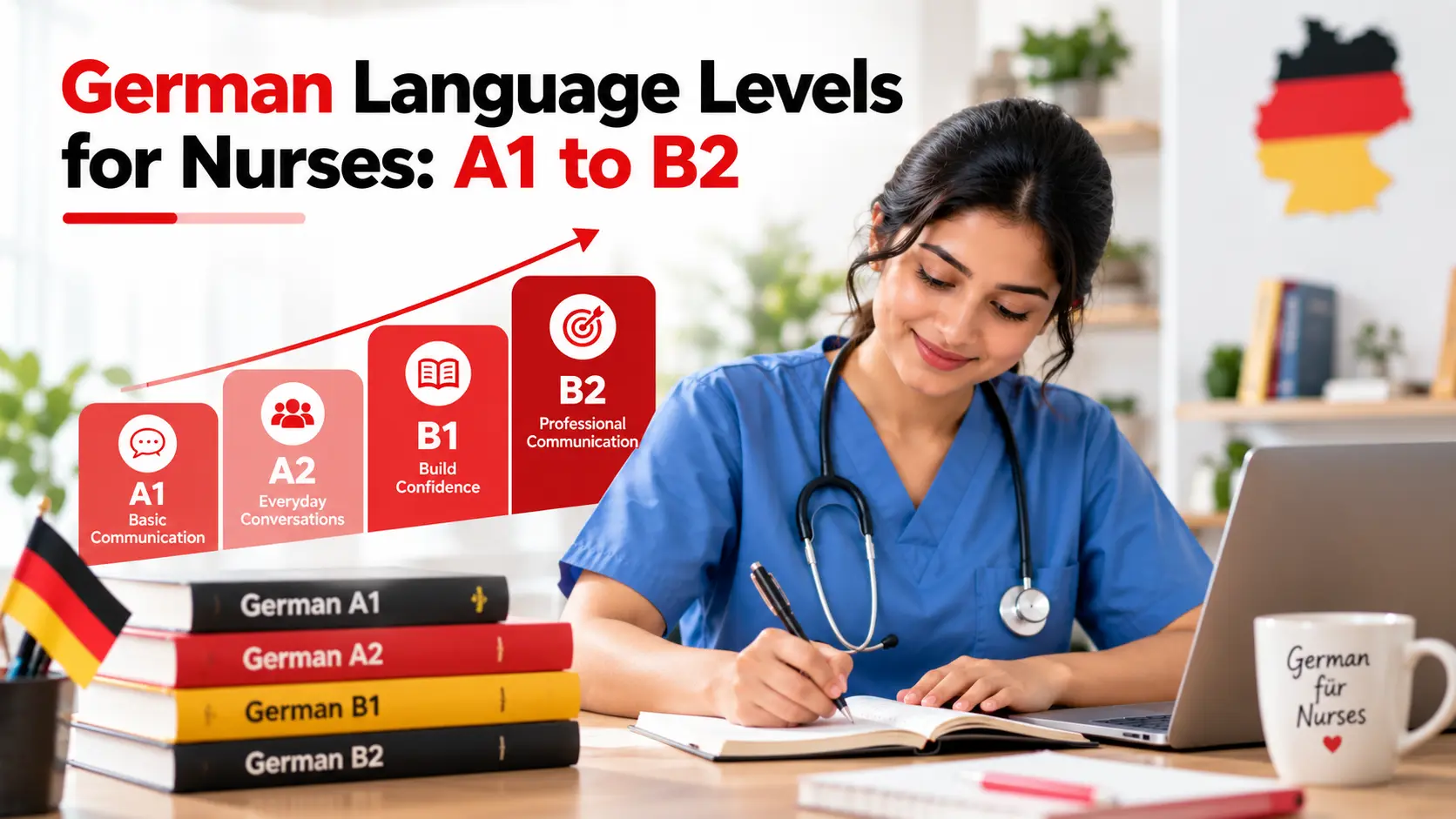
German Language Levels for Nurses: A1 to B2
A1 German
A1 is the starting point for beginners.
At this stage, nurses should focus on:
- Greetings
- Self-introduction
- Numbers and dates
- Basic questions
- Family and personal information
- Basic workplace vocabulary
- Simple sentence structure
- Pronunciation
If you have never studied German before, you can start with the German A1 Course to build your foundation.
A2 German
At A2, communication becomes more practical.
You can start working on conversations related to:
- Daily routines
- Appointments
- Food
- Travel
- Accommodation
- Health
- Work
- Simple patient interactions
For nurses, A2 is also a good stage to start introducing healthcare vocabulary rather than waiting until B2.
If you want to continue your German learning journey after A1, the German A2 Course can help you develop stronger everyday communication skills.
B1 German
B1 is where learners begin to communicate more independently.
Nurses should focus on:
- Longer conversations
- Explaining situations
- Asking follow-up questions
- Writing simple professional messages
- Understanding workplace conversations
- Describing symptoms
- Talking about previous experiences
This is also the stage where you should increase your speaking practice.
If you are moving from A2 to B1, the A2 + B1 German Course can provide a structured learning progression.
B2 German
B2 is the major target for many nurses planning professional recognition in Germany.
At this level, your German should become more precise and flexible.
You should be able to:
- Understand complex conversations
- Explain information clearly
- Discuss professional topics
- Understand workplace instructions
- Participate in team discussions
- Write structured texts
- Understand technical information
- Communicate more confidently with patients and colleagues
B2 German is especially important because nursing involves frequent professional communication and interaction with different healthcare professionals.
For learners progressing from B1, the B1 + B2 German Course is a relevant next step.
German Language for Nurses in Germany: What Should You Learn?
Learning general German grammar is important, but nurses need additional professional communication skills.
Patient Communication
A nurse may need to ask:
- Where does it hurt?
- How severe is the pain?
- When did the symptoms start?
- Do you have any allergies?
- Have you taken your medication?
- Are you feeling better?
- Do you need assistance?
These conversations require both vocabulary and confidence.
Nursing Vocabulary
Your vocabulary should gradually include topics such as:
- Körper — Body
- Schmerz — Pain
- Wunde — Wound
- Blutdruck — Blood pressure
- Temperatur — Temperature
- Medikament — Medication
- Verband — Dressing
- Pflege — Care
- Patient — Patient
- Untersuchung — Examination
- Behandlung — Treatment
- Bewegung — Movement
The goal is not to memorise hundreds of isolated words.
Instead, learn vocabulary inside sentences and real nursing situations. This makes it easier to remember and use the words naturally.
Medical Communication
Professional German also involves understanding how information is communicated in healthcare settings.
For example, you may need to understand:
- Patient history
- Symptoms
- Medication instructions
- Treatment plans
- Vital signs
- Allergies
- Care instructions
- Follow-up requirements
This is one reason why Learn German for nursing in Germany should involve practical speaking and listening practice, not only grammar exercises.
Documentation and Handover
Documentation and handovers are important parts of nursing communication.
You should practise how to:
- Describe a patient’s condition
- Report changes
- Record relevant information
- Explain what care has been provided
- Communicate important observations to another nurse
These skills are different from ordinary conversational German.
Learn German for Nursing in Germany: A Practical Roadmap
Step 1: Build Your A1 Foundation
Start with pronunciation, basic grammar and everyday vocabulary.
Do not rush through A1 just because your final goal is B2.
A weak foundation can create problems later when grammar becomes more complex.
Step 2: Strengthen A2 Communication
At A2, focus on building sentence patterns and everyday speaking confidence.
Start listening to simple German conversations every day.
You can also begin learning basic healthcare vocabulary alongside general German.
Step 3: Develop B1 Fluency
At B1, increase your speaking practice.
Try to:
- Speak without translating every sentence
- Describe nursing situations
- Explain symptoms
- Ask follow-up questions
- Write short professional texts
- Listen to German conversations regularly
If you already have A1 and A2, an A2 + B1 German course can provide a structured progression.
Step 4: Reach B2 Professional German
At B2, combine general German with professional nursing communication.
Your study plan should include:
- Advanced grammar
- Professional vocabulary
- Reading
- Listening
- Speaking
- Writing
- Nursing scenarios
- Mock exams
- Patient communication
- Handover practice
A structured B1 + B2 German course can help learners progress toward advanced German with a clear study plan.
German B1 and B2 for Nurses: What Is the Difference?
The difference is important.
| Area | B1 | B2 |
|---|---|---|
| Everyday conversation | Good | Strong |
| Professional communication | Developing | More confident |
| Complex discussions | Limited | Better |
| Technical communication | Basic | More advanced |
| Reading professional texts | Moderate | Stronger |
| Speaking fluency | Intermediate | Upper-intermediate |
| Nursing recognition target | May apply to certain stages/routes | Generally important for recognition |
At B2, learners are expected to understand more complex texts and communicate with greater fluency and spontaneity.
For nurses, the practical goal should therefore be more than simply passing B2. You should aim to use German comfortably in professional situations.
German Exams for Nurses
There is no single exam that every nurse must take in exactly the same way. Requirements can depend on the recognition authority and your individual pathway.
Two important names that nurses may encounter are Goethe-Zertifikat B2 and telc Deutsch B1·B2 Pflege.
Goethe-Zertifikat B2
The Goethe-Zertifikat B2 is an internationally recognised German examination.
It tests:
- Reading
- Listening
- Writing
- Speaking
B2 demonstrates advanced German skills and can be relevant for people preparing for professional work, including the medical field.
You can check the official Goethe-Zertifikat B2 information before selecting your examination pathway.
telc Deutsch B1·B2 Pflege
The telc Deutsch B1·B2 Pflege exam is specifically designed for nursing professionals.
Unlike a purely general-language exam, its content reflects professional nursing situations.
The examination assesses skills including:
- Reading
- Listening
- Writing
- Speaking
Its professional focus makes it particularly relevant to candidates preparing for nursing-related work in Germany.
You can review the official telc Deutsch B1·B2 Pflege examination information.
Before registering for any exam, check which certificate or examination route is accepted for your specific recognition procedure.
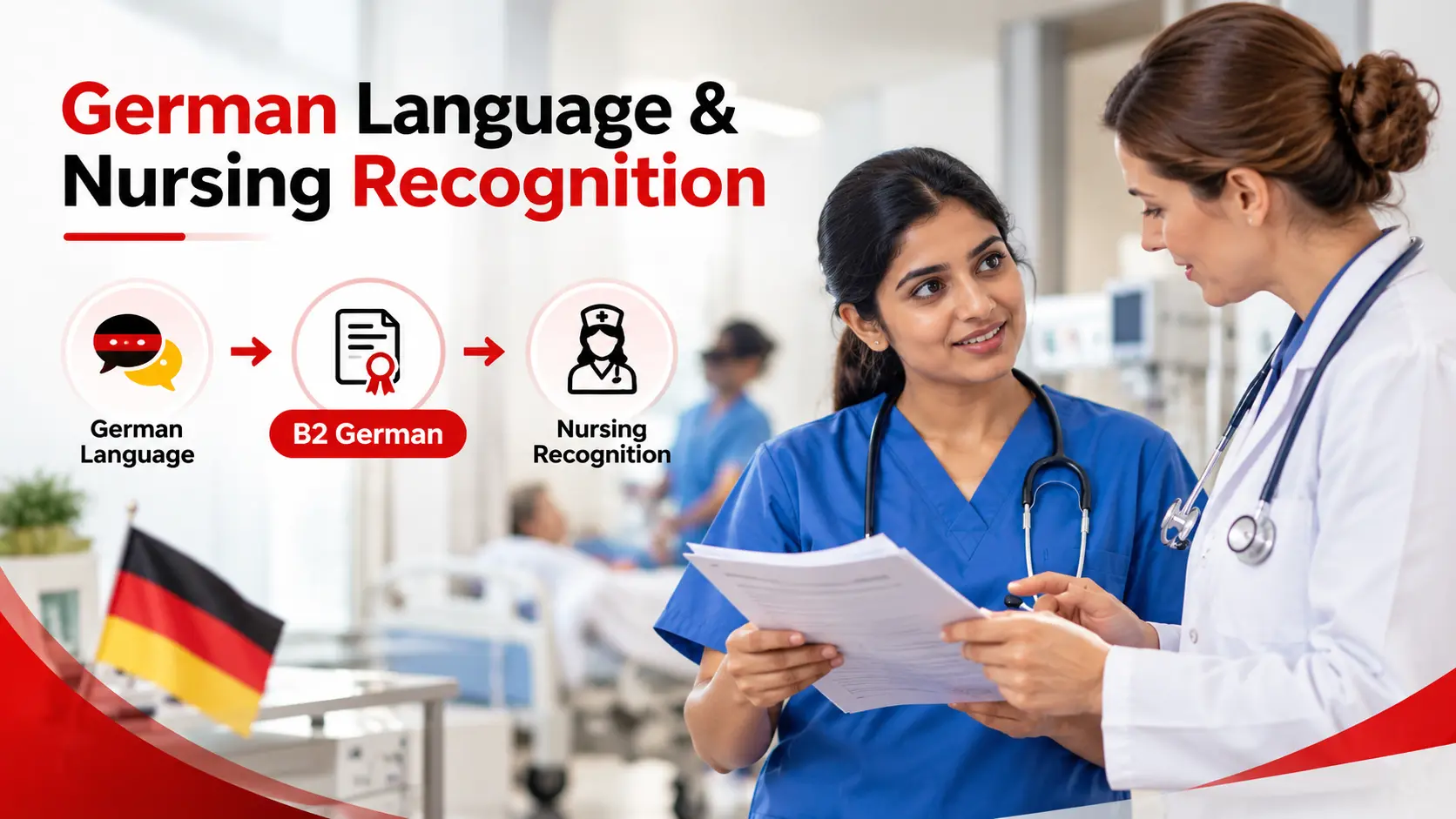
German Language and Nursing Recognition in Germany
Language is only one part of the nursing recognition process.
Nurses trained outside Germany may also need to deal with:
- Qualification recognition
- Professional documentation
- Medical fitness
- Personal suitability
- German language proof
- Additional compensation measures where applicable
The official Recognition in Germany portal provides information about recognition procedures for foreign professional qualifications.
The recognition process can vary depending on your qualification, profession and responsible authority.
Important: Do not assume that passing B2 alone automatically gives you professional recognition. Recognition is a separate process, and the responsible authority assesses the professional qualification and other requirements.
Common German Mistakes Indian Nurses Should Avoid
1. Focusing Only on Grammar
Grammar matters, but nursing is highly interactive.
You should practise speaking and listening from the beginning.
2. Waiting Until B2 to Learn Nursing Vocabulary
Start professional vocabulary early.
Even at A2 or B1, you can learn simple healthcare words and phrases.
3. Memorising Words Without Context
Instead of memorising:
Schmerz = Pain
learn the word inside a useful sentence.
This makes it easier to remember and use naturally.
4. Ignoring Listening Practice
Classroom German and real spoken German can feel very different.
Regular listening practice can help you become comfortable with natural speed and pronunciation.
5. Preparing Only for the Exam
An exam certificate is important, but your ultimate goal is effective communication at work.
Practise real nursing situations alongside exam preparation.
How to Prepare for German While Studying Nursing
If you are still studying nursing in India, you can start German before graduation.
A practical routine could look like this:
| Activity | Suggested Focus |
|---|---|
| Grammar | 30–45 minutes |
| Vocabulary | 20–30 minutes |
| Listening | 20 minutes |
| Speaking | 20–30 minutes |
| Nursing vocabulary | 15–20 minutes |
| Revision | 15 minutes |
Consistency matters more than studying for a very long time once a week.
For beginners who want a structured progression, the A1 + A2 + B1 German Course can be considered before moving toward B2.
How Germanacharya Can Help You Prepare
Germanacharya provides structured German courses from beginner to advanced levels, including A1, A2, B1 and B2 options.
For nurses planning Germany, the B1 + B2 pathway can be particularly relevant when you have already built your foundation and want to progress toward the B2 level.
Germanacharya also provides a dedicated nursing pathway covering German language preparation and nursing-focused training.
You can explore the Nursing Program to understand the available nursing-focused pathway.
You can also explore all available German Courses and choose the level that matches your current German knowledge.
If you are not sure which level to start from, you can contact Germanacharya for guidance.
Frequently Asked Questions
What German level do nurses need in Germany?
For professional recognition as a nurse, B2 German is generally the key language requirement. Specific procedures can vary by authority and individual pathway.
Is B1 German enough to work as a nurse in Germany?
B1 may be relevant for certain stages or pathways, but B2 is generally the important target for professional nursing recognition.
Is B2 German compulsory for nursing recognition?
German government guidance states that B2-level German is required for recognition of nursing professionals. The exact proof and procedure should be confirmed with the responsible recognition authority.
Which German exam is best for nurses?
It depends on your recognition pathway. Options may include Goethe-Zertifikat B2, while telc Deutsch B1·B2 Pflege is specifically designed for nursing professionals. Always check which proof your competent authority accepts.
Can Indian nurses learn German in India?
Yes. Nurses can begin their German preparation in India through online or classroom courses and progress from A1 toward B2 before moving to Germany.
How long does it take to learn German from A1 to B2?
There is no fixed timeline. It depends on your starting level, study hours, practice routine and learning method.
Should nurses learn medical German separately?
Yes. General German provides the foundation, while nursing-specific vocabulary and communication practice help you handle workplace situations more effectively.
Can I prepare for a German exam and nursing communication together?
Yes. A strong preparation plan should combine exam skills with practical speaking, listening, patient communication, documentation and nursing vocabulary.
Conclusion
German Language for Nursing in Germany should be approached as a professional skill, not simply as an exam requirement.
If you are starting from zero, build your foundation through A1 and A2. At B1, focus on independent communication and start using more healthcare-related vocabulary. At B2, develop advanced communication, professional vocabulary, exam skills and nursing-specific language.
For Indian nurses, the most practical roadmap is:
A1 → A2 → B1 → B2 → Professional Nursing German → Exam → Recognition
The earlier you start building your German communication skills, the easier it becomes to prepare for the professional environment in Germany.