

Best German Language Institute in India: 7 Things to Check Before You Pay
Best German Language Institute in India
The best German language institute in India is the one that fits your goal, prepares you for a recognised exam, has qualified teachers and shows its full fees. Check seven things before you pay. This guide explains each one in simple words.
Almost every institute calls itself number one, so choosing is hard. Your goal decides what you need. A student who wants to study in Germany needs a different course from a nurse who plans to work there.
What Makes the Best German Language Institute in India?
The best German language institute in India is not the one with the loudest ads. It is the one that fits your goal, teaches well and is honest about cost. Here are the seven checks:
- Exam and certificate recognition
- Teacher quality
- Batch size, class hours and mode
- Course structure and practice
- Fit with your goal
- Full fee and refund terms
- Proof, not promises
Let us go through each one.

1. Check the Exam and Certificate
German levels follow a scale called the CEFR. It runs from A1 (beginner) to C2 (near native). Your certificate will show one of these levels.
Many students join a course without asking one simple question: which exam will I take at the end? Common options are the Goethe-Zertifikat, telc, ÖSD and TestDaF.
You will often hear that only one institute’s certificate is valid abroad. That is not true. Universities, employers and visa offices accept different exams. So first ask the university, employer or authority which certificates they accept. Then pick an institute that trains you for that exact exam.
Ask these questions:
- Which exam does this course prepare me for?
- Do you give mock tests in the real exam format?
- Will you help me with exam registration?
2. Ask Who Will Actually Teach You
A good teacher matters more than a fancy classroom. German grammar is hard at the start. A weak teacher can leave gaps that show up later at B1 and B2.
Ask about these points:
- The teacher’s own German level. It should be at least C1.
- Formal training in teaching German to non-native speakers.
- Whether the same teacher will take you through the full level.
A teacher who has lived or studied in Germany can also explain real-life German, not just textbook German. That is a bonus, but not a must.
3. Compare Batch Size, Class Hours and Mode
Language learning needs speaking time. In a huge batch, you may speak for only two minutes in a whole class. That is a poor use of your fee.
You can now learn online from anywhere in India. So your city matters less than it used to. Live speaking time matters more. Use this table when you compare options:
| Question | Good sign | Red flag |
|---|---|---|
| Batch size | Small group where everyone speaks | Very large batch, little talking |
| Weekly hours | Clear hours and schedule for each level | “Finish a level in two weeks” |
| Online classes | Live classes with recordings for missed days | Only pre-recorded videos |
| Missed class | Backup class or recording | No backup |
Reaching a new level usually takes a few months of regular study. Be careful with anyone who promises much faster results.
4. Look at the Course Structure and Practice
A good course covers four skills: reading, listening, writing and speaking. Some institutes teach only grammar and skip speaking. Then students freeze in the exam or the interview.
Ask for the syllabus of one level. Then check these points:
- Does it cover all four skills?
- Are books and study material included?
- Is there homework with feedback?
- Are there doubt-clearing sessions?
- Is there a clear path from A1 up to B2?
You can see how a level-wise plan looks on the German language courses page.
5. Match the Best German Language Institute in India to Your Goal
No single institute is best for everyone. Your goal decides what you need from the course.
Best German Language Institute in India for Study Abroad Students
Many German universities ask for B2 or C1 for degree courses. Rules differ by university and course. Some English-taught programs ask for less German. So read the admission page of your target program first. Then look for an institute that offers exam practice at that level and supports you until the exam.
Best German Language Institute in India for Nursing and Physiotherapy Learners
Healthcare workers have extra needs. Jobs in Germany usually ask for B2-level German. You also need your qualification recognised. Rules change, so read the official guidance on Make it in Germany before you plan.
Also ask whether the course teaches medical words and patient conversation. Textbook German alone is not enough in a hospital. If this is your path, see our pages for nursing and physiotherapy learners.
6. Understand the Full Fee Before You Pay
Two courses with the same price can include very different things. So ask for a written list of costs:
- Course fee for each level, or for the full path
- Books and study material
- Exam fee (usually paid separately to the exam body)
- Mock tests and extra doubt classes
- Refund and batch-change policy
Compare the total cost, not just the monthly fee. A very low price is also a warning sign if the teacher or batch is weak.
Walk away from pressure such as “pay today or lose your seat.” Also walk away from “guaranteed pass.” No institute can guarantee your exam result or your visa.
7. Ask for Proof, Not Promises
Reviews can be faked, so look deeper. First, join a demo class. Watch how the teacher explains, how many students speak and whether doubts get answered.
Next, read reviews on more than one platform. If possible, talk to a former student. Finally, ask how many students move on to the next level. An honest institute gives a real answer or admits it does not track this. A suspicious one promises 100%.
Common Mistakes When Choosing the Best German Language Institute in India
Students repeat the same errors again and again:
- Choosing only by price
- Joining before checking which exam they need
- Skipping the demo class
- Paying the full course fee without reading refund terms
- Starting at the wrong level instead of taking a level test
One wrong choice can cost you months. A short check now saves a lot of money later.
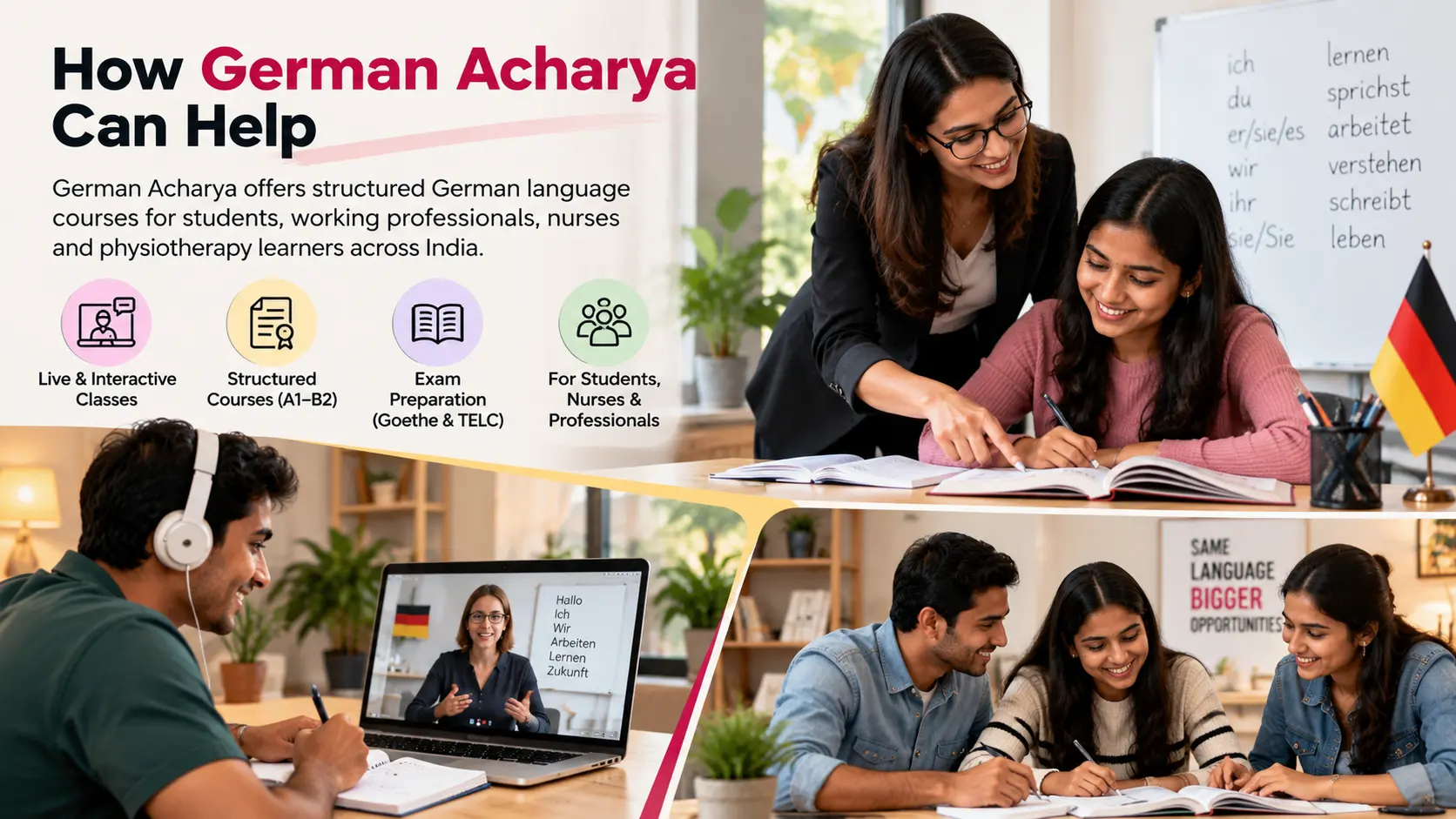
How German Acharya Can Help
German Acharya offers German language courses for learners across India. It also has dedicated pages for nursing and physiotherapy learners. You can read about us, browse the courses or check the FAQ page for common questions.
Have a question before you decide? Reach out through the contact page. Use the same seven checks on us too. For more tips, see our German language articles.
FAQs About the Best German Language Institute in India
How do I choose a German language institute?
Check the exam it prepares you for, the teacher’s level, the batch size, the full fee and the refund policy. Then attend a demo class before you pay.
Is the Goethe-Institut the only valid choice for a German certificate?
No. Goethe is widely known, but telc, ÖSD and TestDaF are also accepted in many cases. Always confirm with the university, employer or authority that asks for your certificate.
Which German level do I need to study or work in Germany?
It depends. Degree courses often ask for B2 or C1. Healthcare jobs usually ask for B2. Rules change, so check the official source for your case.
How long does it take to learn German?
It depends on your weekly hours and practice. Many learners need about one to one and a half years to go from beginner to B2 with steady study.
Are online German classes as good as offline classes?
They can be, if the classes are live, the batch is small and you get regular speaking practice. Pre-recorded videos alone are not enough.
Can I learn German without joining an institute?
You can start with self-study. But speaking feedback and exam training are hard to get alone. Most learners do better with a teacher by the time they reach A2 or B1.
Final Word: Choose on Proof, Not Promises
The best German language institute in India for you is the one that matches your exam, your goal and your budget, and proves it in a demo class. Shortlist three institutes. Ask each the same questions. Then compare the answers side by side.