
German Language Requirements for Ausbildung in Germany
German Language Requirements for Ausbildung in Germany: B1, B2 and What to Expect
The German language requirements for Ausbildung decide two things: whether a company signs a training contract with you, and whether you get your visa. For most Indian applicants, the short answer is simple. B1 is the minimum, but B2 is what most employers actually want.
This guide explains which level you need, how it changes by profession, which certificates are accepted, and how to plan your preparation from India.
Quick Answer: German Language Requirements for Ausbildung
- Minimum level: B1 in most cases for the Ausbildung visa.
- Preferred level: B2, especially for nursing, healthcare and technical roles.
- Certificate: Must come from a recognised provider such as the Goethe-Institut, telc or ÖSD.
- Time needed: Around 9 to 12 months from zero to B1 with regular classes.
- Important: Employers and German authorities can ask for more than the minimum, so always confirm before you apply.
Why German Matters So Much in Ausbildung
Ausbildung is a dual training system. You work in a company and also attend a vocational school (Berufsschule). Both are in German. Your final exam, usually held by chambers like IHK or HWK, is also in German.
So the language is not just a visa paper. It is how you will understand your trainer, read safety rules, follow classes and pass exams. Applicants who treat it only as a document usually struggle in the first months.
B1 vs B2: Which German Level Do You Really Need?
German levels follow the Common European Framework of Reference (CEFR). Both B1 and B2 sit in the “independent user” range, but the gap between them is big.
When B1 is enough
At B1 you can handle everyday situations, understand clear standard speech and explain your opinions in simple terms. This is the usual minimum for the visa under the German residence law for training (§ 16a AufenthG). Some trades and service jobs accept B1 at the application stage.
Why B2 is the safer target
At B2 you can follow longer texts, understand technical talk and speak with more confidence. Classroom German, written reports and workplace talk are much easier at this level.
The honest view: you can start an Ausbildung with B1, but it is hard. Many candidates who just pass B1 find the first semester difficult. If you can reach B2, your chances of getting selected also improve.

German Language Requirements for Ausbildung by Profession
The level you need depends on the job. This table shows the common pattern. It is a general guide, not a legal rule.
| Field | Usual German level | Why |
|---|---|---|
| Nursing and healthcare | B2 | Patient talk, medical notes, teamwork |
| Technical and IT roles | B1 minimum, B2 preferred | Manuals, theory classes, written tests |
| Skilled trades | B1 minimum, B2 preferred | Safety instructions, vocational school |
| Hotel, retail, logistics | B1 often accepted, B2 helps | Daily customer and team contact |
Nursing and healthcare Ausbildung
Healthcare has the strictest German language requirements for Ausbildung. Employers usually ask for B2 because you will speak with patients and write care notes. Some hospital groups also add a medical German test before clinical work.
If this is your goal, look at our nursing and physiotherapy pages for the language path that fits these careers.
Accepted German Language Certificates
Your certificate must come from a recognised exam provider. The most common ones are:
- Goethe-Institut: Widely accepted, with exam centres in India.
- telc: Popular for job-related and healthcare German.
- ÖSD: Accepted by many employers and offices.
Before you book an exam, check the certificate rule with the employer and the German embassy or consulate that will handle your visa. You can also read the official guidance on Make it in Germany and the BAMF website.
How Long Does It Take to Reach the Required German Level?
These are general estimates for regular, serious study:
- Zero to B1: About 9 to 12 months.
- A2 to B1: Around 3 to 5 months.
- B1 to B2: Needs a lot more effort, often close to the time you spent reaching B1.
Start at least 12 months before your target application period. This gives you time for exam booking, a possible retake and CV preparation.
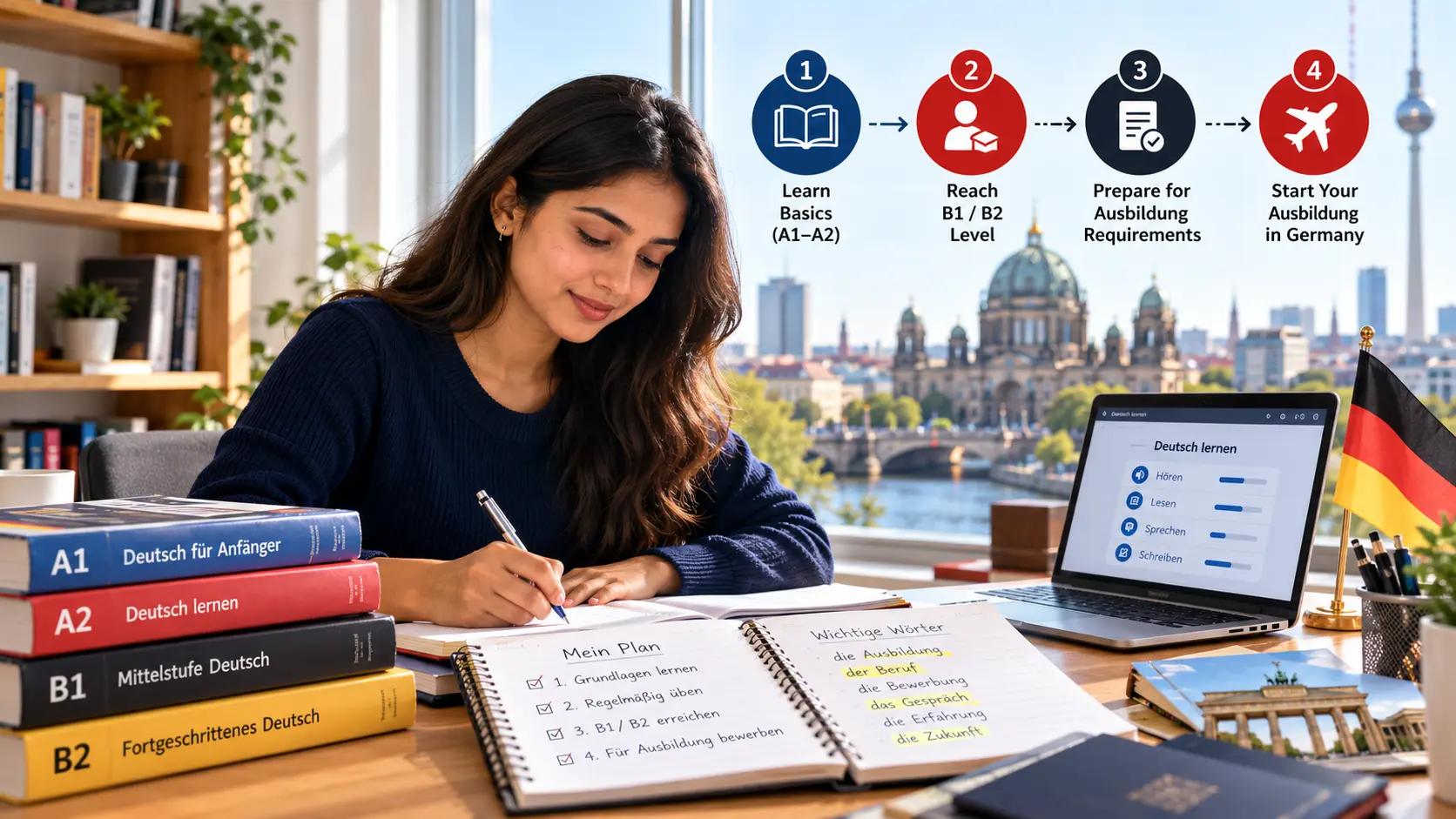
Step-by-Step Plan to Meet the German Language Requirements for Ausbildung
- Pick your profession first. This tells you if B1 or B2 is your real target.
- Start from A1 with a structured course. Self-study alone rarely builds speaking skills.
- Practise all four skills. Reading, writing, listening and speaking are all tested.
- Take mock tests in the last 6 to 8 weeks before the exam.
- Book the exam early. Slots in India can fill up.
- Learn job vocabulary for your field after you pass.
- Apply with your certificate and a German CV.
If you want guided preparation, explore our German language courses and pick the level that matches your start point.
Common Mistakes Applicants Make
- Treating B1 as “good enough”. It may get the visa, but vocational school is demanding.
- Ignoring speaking practice. Interviews with employers are usually in German.
- Choosing an unrecognised certificate. This can cause visa problems.
- Starting too late. Rushing leads to weak language and failed exams.
- Not checking the employer’s rule. One company may ask for B2 even if the visa needs only B1.
Frequently Asked Questions
What is the minimum German level for Ausbildung?
In most cases, B1 is the minimum level needed for an Ausbildung visa. Many employers prefer B2, so check the company’s requirement before you apply.
Is B1 enough for Ausbildung in Germany?
B1 can be enough for the visa and for some trades. In practice, many trainees find vocational school and workplace German hard at B1, so B2 is a safer target.
Do I need B2 for nursing Ausbildung?
Usually yes. Healthcare employers commonly ask for B2 because of patient communication and medical documentation. Some employers also add a medical German test.
Which German certificates are accepted for Ausbildung?
Certificates from recognised providers such as the Goethe-Institut, telc and ÖSD are commonly accepted. Confirm with your employer and the embassy before booking an exam.
Can I do Ausbildung without knowing German?
Almost never. Training and vocational school are in German, and the visa normally needs a language certificate. Some employers offer language support, but you should plan to reach B1 first.
How long does it take to learn German for Ausbildung from zero?
With regular classes, most learners need around 9 to 12 months to reach B1. B2 takes longer, so start early.
Can I prepare for the German language requirements for Ausbildung from India?
Yes. You can take classes in India, online or offline, and write recognised exams at approved centres in the country. Many applicants complete their language level before moving to Germany.
Have more questions? Check our FAQ page.
Your Next Step Towards Ausbildung in Germany
Your language level is the one part of the process that is fully in your control. Decide your profession, choose B1 or B2 as your target, and build a study plan around it.
Read more guides in our German language category, or contact our team to get help choosing the right course level.