

How to Learn German A1 to B2? 2026 Guide | Germanacharya
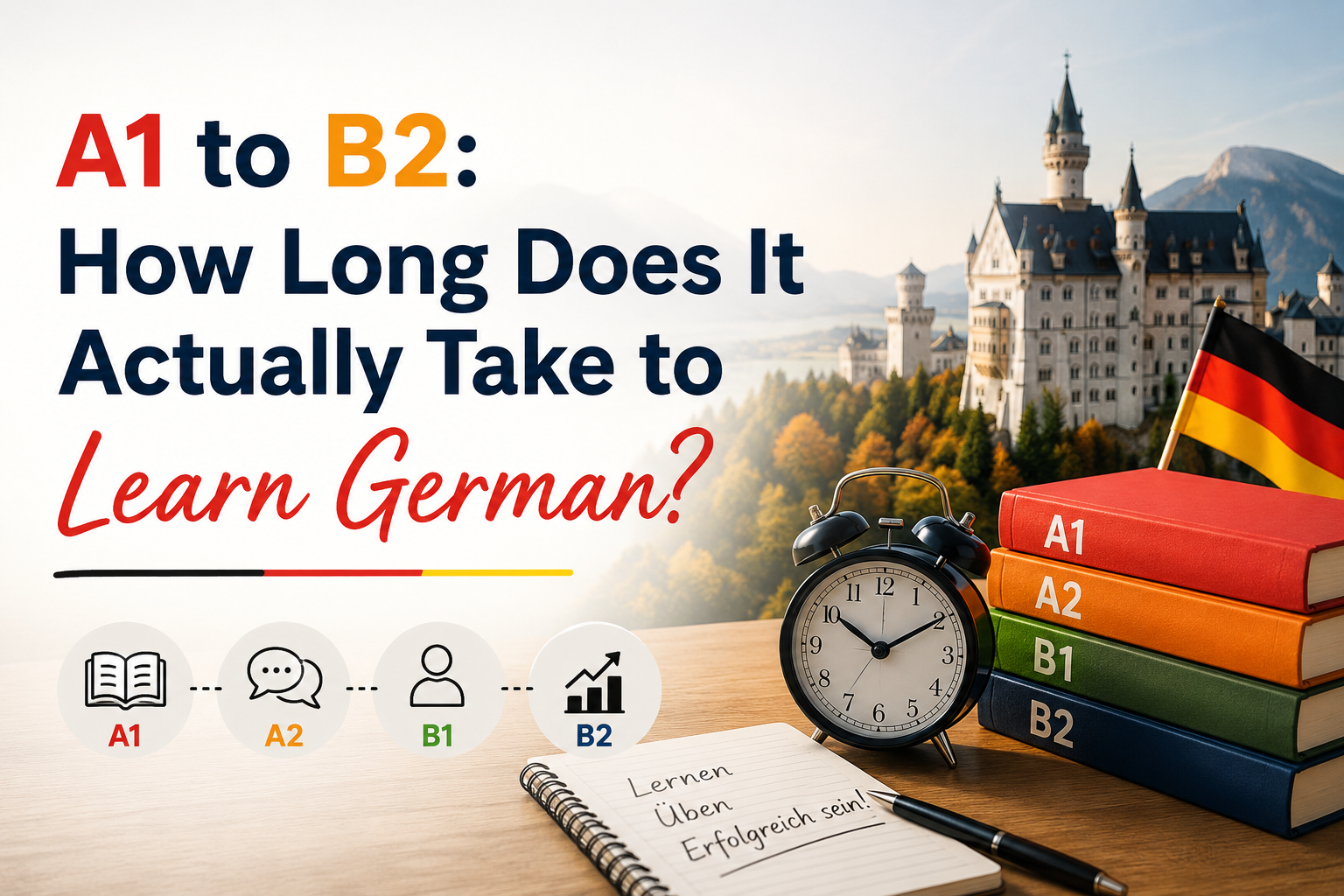
A1 to B2: How Long Does It Actually Take to Learn German?
If you have been thinking about learning German, one question has probably crossed your mind more than once — how long is this actually going to take? Whether you want to learn German A1 to B2 for a job in Germany, a nursing career abroad, or simply to challenge yourself, the honest answer is: it depends. But in this guide, we break it down level by level so you know exactly what to expect before you even open your first textbook.
Understanding the German Language Levels First
Before talking about timelines, it is important to understand what these levels actually mean in real life. German proficiency is measured using the CEFR framework — Common European Framework of Reference — which divides language ability into six stages: A1, A2, B1, B2, C1, and C2.
For most students in India who want to study, work, or settle in Germany, the journey from A1 to B2 is the most important stretch. B2 is what most German employers and universities ask for, especially in fields like nursing and physiotherapy.
What Each Level Actually Means in Plain Language
Here is a simple way to understand what you can do at each level:
A1 — You can introduce yourself, ask basic questions, and understand very simple sentences.
A2 — You can handle everyday situations like shopping, travel, or short conversations.
B1 — You can hold a real conversation on familiar topics and express opinions in simple language.
B2 — You can understand complex texts, argue your point clearly, and function professionally in German.
How Long Does It Take to Learn German A1 to B2?
The most realistic estimate to learn German A1 to B2 from scratch is 8 to 9 months for the average Indian learner. However, this number changes a lot based on how you study, how consistently you practice, and whether you join a structured course or try to do it alone.
Let us break it down level by level.
A1 Level — Your First Month
A1 is where everyone begins. At this stage, you are learning alphabets, pronunciation, simple sentences, and basic grammar like articles and present tense verbs. For most Indian students, A1 takes about 1 month if you are studying regularly for an hour or two every day.
This level usually covers around 60 to 80 class hours. It is the most exciting phase because everything is new and progress feels fast. Many students also prepare for the Goethe A1 exam at this stage, which is required for German student visa applications.
A2 Level — Month 2 to 3
Once you cross A1, A2 starts to feel slightly more challenging. Grammar becomes more layered — cases, modal verbs, past tense — and vocabulary grows quickly. Most learners take about 2 months to complete A2 with regular practice.
A2 gives you the ability to handle everyday situations with some confidence. You can book appointments, write short emails, and follow simple conversations. For healthcare professionals, A2 is usually where medical vocabulary introduction begins.
How Many Hours Does A2 Require?
On average, A2 needs around 80 to 100 structured class hours. But the real progress happens outside class — through daily revision, practice exercises, and speaking practice with fellow learners.
B1 Level — Month 3 to 5
B1 is where the real shift happens. This is the level where many Indian students feel the jump most sharply. Grammar gets more complex, conversations get longer, and reading comprehension tests become a regular part of preparation.
Most learners complete B1 in 2 months, especially when they are also preparing for the Goethe B1 or TELC B1 exam. This level needs around 150 to 200 class hours in total.
Why B1 Feels the Hardest
At B1, you are no longer just memorizing words and patterns — you are expected to think in German. Subordinate clauses, Konjunktiv II, and passive voice all arrive at this stage. Students who rush through A1 and A2 without building a strong base often struggle here. Slowing down and revising previous levels before pushing forward makes a real difference.
B2 Level — Month 5 to 9
B2 is the final target for most Indian students and healthcare professionals. At this level, you can read professional texts, participate in meetings, and express yourself clearly even on complex topics. It is also the minimum requirement for most German hospitals and physiotherapy clinics when hiring international professionals.
Reaching B2 from B1 takes another 3 to 4 months with consistent effort. Students who practice daily and attend live sessions regularly tend to finish closer to 3 months, while those balancing work alongside studies may take the full 4 months.
A Realistic Total Timeline
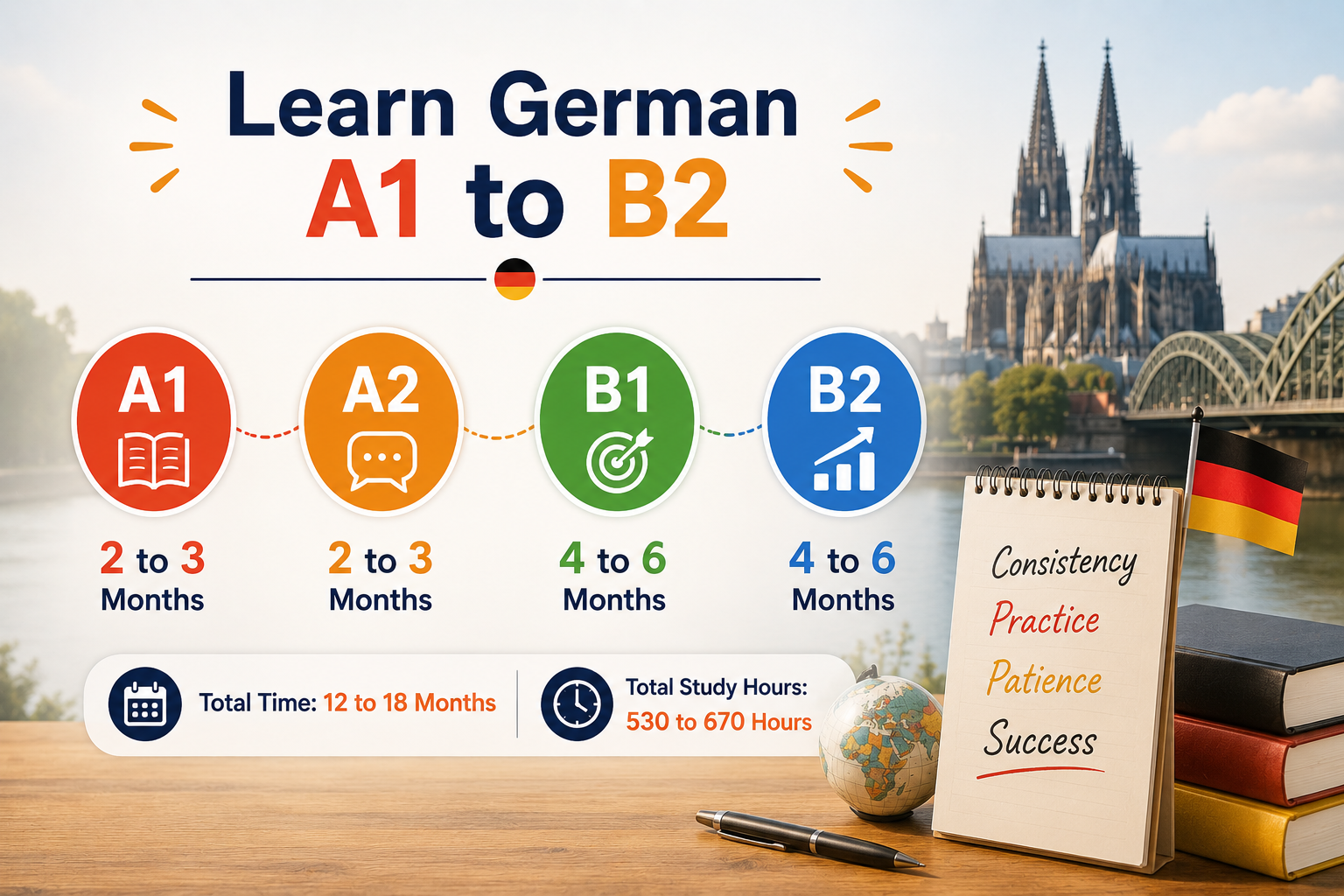
| Level | Duration | Study Hours |
|---|---|---|
| A1 | 1 month | 60 to 80 hours |
| A2 | 2 months | 80 to 100 hours |
| B1 | 2 months | 150 to 200 hours |
| B2 | 3 to 4 months | 200 to 250 hours |
| A1 to B2 Total | 8 to 9 months | 490 to 630 hours |
Factors That Decide How Fast You Actually Progress
Two students can join the same course on the same day and reach B2 at completely different times. That is not unusual — it is expected. Here are the real factors that shape your journey.
Your Daily Study Routine
Students who study for 1 to 2 hours every single day without breaks progress almost twice as fast as those who study for 5 hours once a week. German is a language that needs regular exposure. Even 30 minutes of daily revision keeps the vocabulary and grammar fresh in your memory.
Quality of Coaching You Choose
Self-study through apps and YouTube videos can get you to A2 with effort. But from B1 onwards, having a structured course with experienced teachers makes a significant difference. Live sessions where you speak, get corrected, and practice in real time speed up your progress in ways that recorded content simply cannot.
How Much You Practice Outside Class
The students who reach B2 fastest are rarely the ones who only attend classes. They watch German news, speak with classmates, maintain a vocabulary notebook, and attempt past exam papers regularly. Passive learning inside the classroom needs to be backed by active practice outside it.
Can You Learn German A1 to B2 Faster Than 12 Months?
Yes, it is possible — but only with the right structure. Some fastrack combo courses condense A1 to B1 into 6 to 8 months by running more frequent sessions and covering grammar more intensively. If you are fully committed and not juggling too many other responsibilities, reaching B2 in 10 to 12 months is achievable.
However, chasing speed without building a solid foundation usually backfires at the exam stage. A certificate from Goethe or TELC requires real command over the language — not just completion of syllabus.
Conclusion
Learning German from A1 to B2 is a commitment of roughly 8 to 9 months for most Indian learners. It is not a short journey, but it is absolutely worth it — whether your goal is to work in Germany, pass a university entrance exam, or build a career in healthcare abroad.
The most important thing is not how fast you start — it is how consistently you keep going. Start with a clear plan, choose quality coaching, practice every day, and the B2 certificate will come sooner than you expect.
If you are ready to begin your German learning journey, explore the structured A1 to B2 courses at Germanacharya — designed specifically for Indian learners who want results, not just lessons.

Wish you happiness
Every day is a new beginning
Hahahaha You are so good
Good a blog toper
Really impressed with the fast payouts here. The interface is smooth and I had a great run last night. Definitely checking out krwinbet30 again soon!
This app is a game changer! I really like the variety of slots available and the graphics are top notch. jili1985app is definitely my new favorite way to unwind.
The login process is quick and the game variety is amazing. I always have a great time whenever I visit 777barlogin