

German Language Levels Explained (A1–C2)
Learning German is one of the most rewarding things you can do — whether you want to study in Germany, work for a German company, or simply enjoy a holiday in Berlin without feeling lost. But before you jump into grammar books and vocabulary lists, it helps to understand how German language levels are structured and what each stage actually means for you as a learner.
In this guide, we break down all six German language levels — from complete beginner to near-native speaker — so you know exactly where you stand and where you are headed.
What Are the German Language Levels?
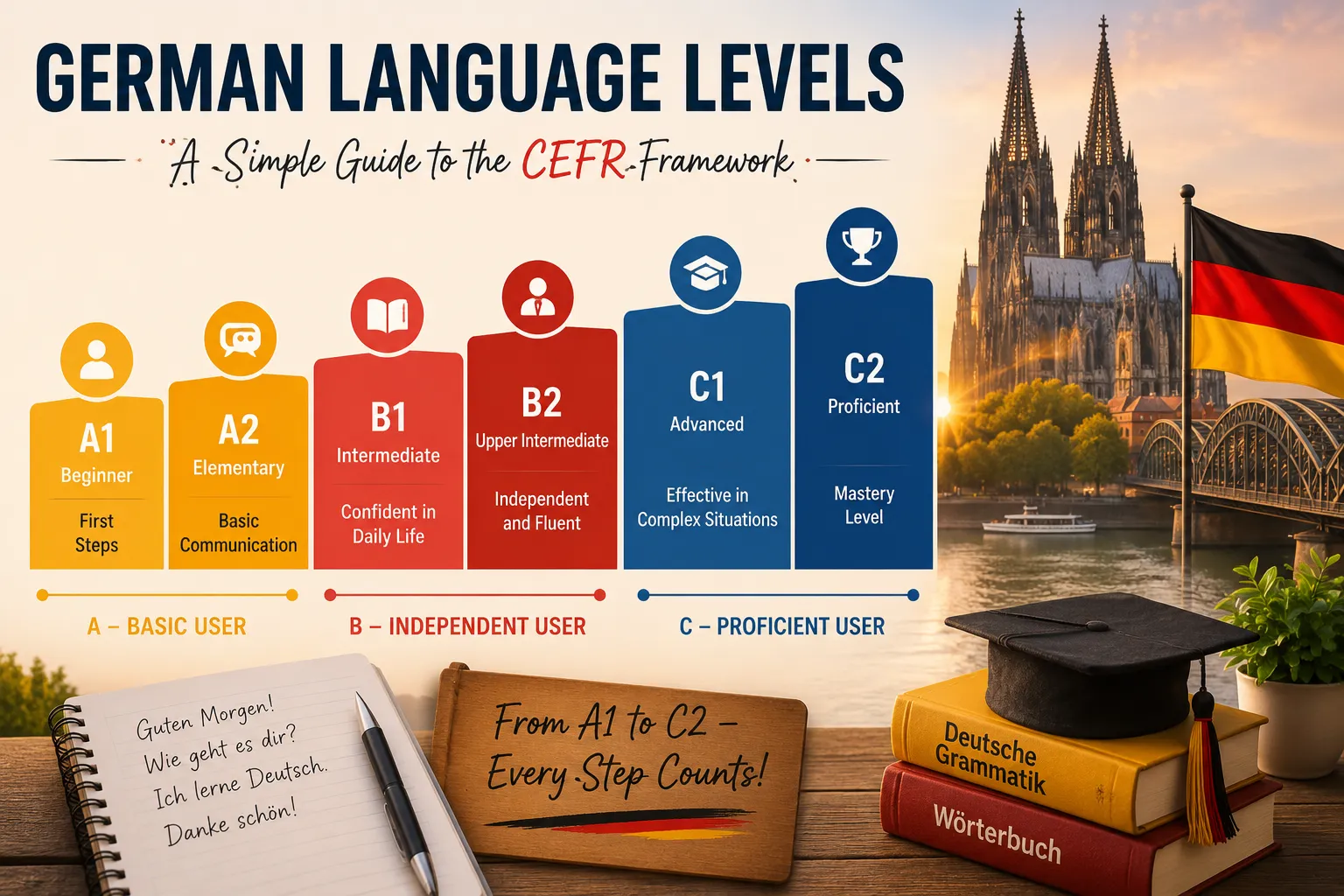
The German language levels follow a framework called the CEFR, or the Common European Framework of Reference for Languages. This system divides language ability into six clear stages: A1, A2, B1, B2, C1, and C2. Each level builds on the previous one, and together they cover everything from saying “Guten Morgen” for the first time to debating politics in fluent, nuanced German.
These levels are not just theoretical labels — they are recognized by universities, employers, and immigration offices across Germany, Austria, and Switzerland. So knowing your current German language level can genuinely open doors in the real world.
The CEFR Framework and How It Works
The CEFR framework was developed by the Council of Europe to create a universal, internationally accepted standard for measuring language skills. Germany, Austria, and Switzerland all use it as the official benchmark for German proficiency exams like the Goethe-Zertifikat and the TestDaF.
The six German language levels are grouped into three broad categories:
- A (Basic User): A1 and A2
- B (Independent User): B1 and B2
- C (Proficient User): C1 and C2
Why the CEFR Matters for German Learners
If you are planning to apply for a German student visa, most universities require at least B2 or C1 level. For a work visa in skilled professions, B1 is often the minimum. And if you are aiming for permanent residency, the German integration test requires B1 as well. Knowing which German language level you need for your specific goal saves you months of unnecessary studying.
A1 — Absolute Beginner
At A1, you are just starting out. You can introduce yourself, ask simple questions, and handle very basic conversations — like ordering a coffee or asking for directions. Your vocabulary is small, and you rely heavily on slow, clear speech to understand anyone.
Sentences at this stage are short and formulaic. Think: “Ich heiße Maria. Ich komme aus Indien. Wie heißen Sie?”
A1 is the first of the German language levels, and it is the foundation everything else is built on. Do not rush through it — getting your pronunciation and basic grammar right here makes every level easier later.
Typical time to reach A1: 60–80 hours of study
A2 — Elementary
At A2, you can hold short, everyday conversations on familiar topics — family, shopping, your job, local geography. You understand frequently used expressions and can communicate in simple, routine tasks.
This is where many learners start feeling the first real sense of progress. You begin recognizing words in real German around you — on signs, menus, and in simple conversations.
Typical time to reach A2 from A1: 80–100 additional hours
B1 — Intermediate
The Most Important Milestone in German Language Levels
B1 is arguably the most important of all German language levels for practical purposes. At this stage, you can handle most situations you would encounter while traveling in a German-speaking country. You can write simple connected text on familiar or personal topics and describe experiences, events, and ambitions.
More importantly, B1 is the minimum requirement for German citizenship and for many integration-related visa processes. If you have one goal in your German learning journey, reaching B1 is the one that unlocks the most doors.
Typical time to reach B1 from A2: 150–200 additional hours
B2 — Upper Intermediate
At B2, things get genuinely interesting. You can understand the main ideas of complex texts on both concrete and abstract topics — including technical discussions in your field of expertise. You can interact with native speakers fluently enough that conversation becomes natural rather than stressful.
B2 is the standard requirement for most German university programs and for many professional job roles. It is the level where German starts to feel less like “studying” and more like actual communication.
Typical time to reach B2 from B1: 150–200 additional hours
C1 — Advanced
Thinking and Speaking Like a Near-Native
C1 is where German learners genuinely start to sound impressive. You can express ideas fluently and spontaneously without much obvious searching for the right word. You can use language flexibly for social, academic, and professional purposes.
At C1, you understand a wide range of demanding texts and recognize implicit meaning. German television, podcasts, and newspapers become fully accessible to you at this stage.
C1 is typically required for highly skilled work visas (the German “Fachkraft” visa in competitive fields), academic research positions, and top-tier university programs like medicine and law.
Typical time to reach C1 from B2: 200–250 additional hours
C2 — Mastery
The Final Frontier of German Language Levels
C2 is the highest of all German language levels and represents near-native mastery. At this stage, you can understand virtually everything you hear or read — including idioms, subtle cultural references, and regional dialects. You can summarize information from different sources, reconstruct arguments in a coherent presentation, and express yourself spontaneously with great precision.
Very few people actually need C2 for practical purposes. It is mainly relevant for professional translators, interpreters, German literature academics, and those who want to be truly indistinguishable from native speakers.
Typical time to reach C2 from C1: 250–300+ additional hours
How Long Does It Take to Learn German Overall?
The honest answer depends on your native language, your study method, and how consistently you practice. For an English speaker starting from zero, reaching B2 typically takes between 600 and 750 hours of focused study. Reaching C1 adds another 200–250 hours on top of that.
The good news is that consistent daily practice of even 30–45 minutes accelerates progress significantly more than long, infrequent study sessions. Quality matters more than quantity.
Tips to Level Up Faster Through the German Language Levels
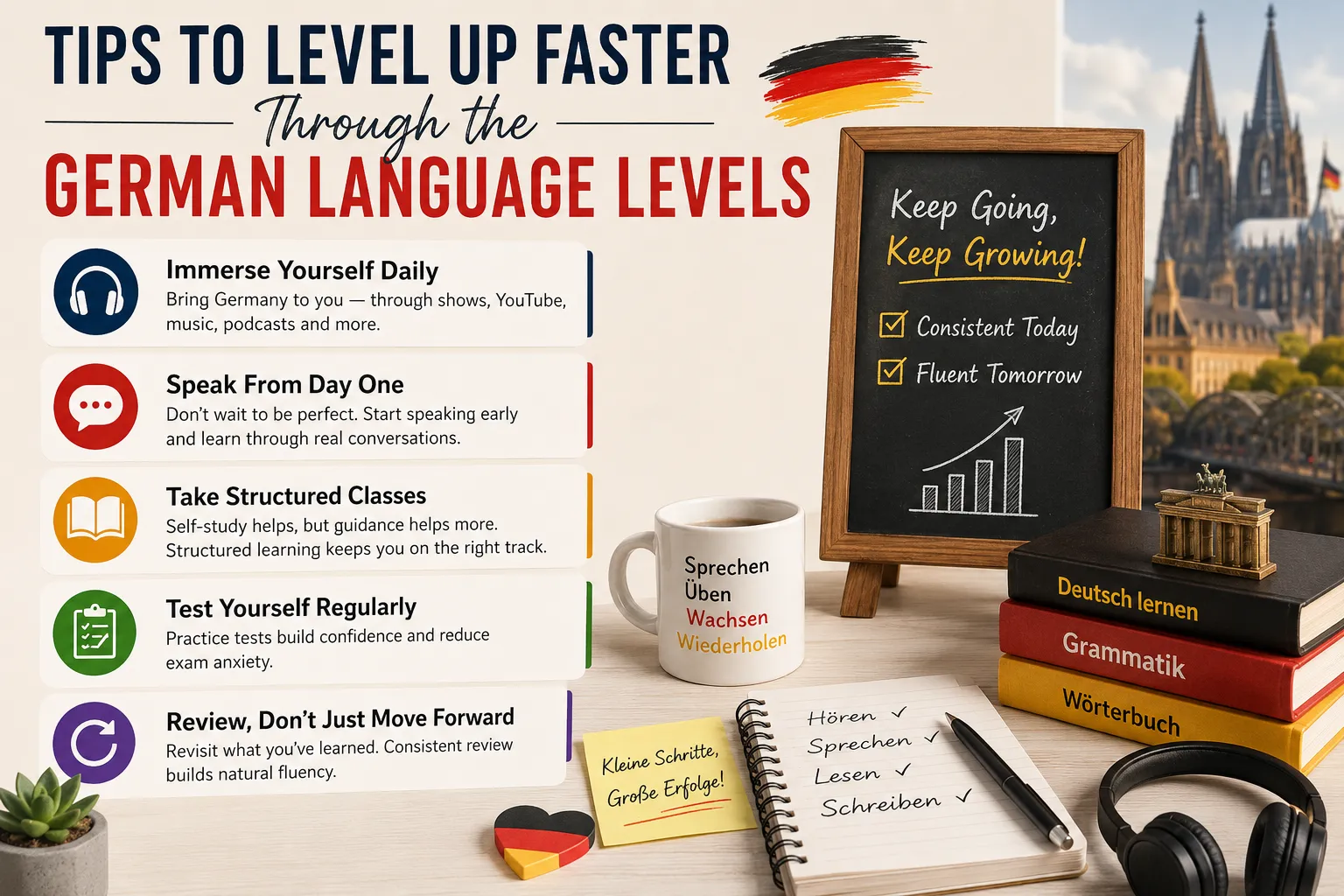
No matter which of the German language levels you are currently at, the following habits consistently help learners move faster:
Immerse yourself daily. Even if you cannot travel to Germany, you can bring Germany to you — German Netflix shows, YouTube channels, music, and podcasts all count.
Speak from day one. Many learners spend months studying before they try speaking. This is a mistake. Even broken, imperfect conversation at A1 trains your brain to process German in real time.
Take structured classes. Self-study works, but a good teacher catches errors before they become bad habits. At Germanacharya, our structured courses are aligned with CEFR German language levels so you always know your progress.
Test yourself regularly. Take official practice tests — the Goethe-Institute offers sample papers for each level online. Regular testing reduces exam anxiety and shows you exactly what to work on.
Review, do not just move forward. Every new level introduces new grammar, but old grammar still matters. Regular review of earlier material builds the kind of automatic fluency that makes German feel natural.
Conclusion
Understanding the German language levels is not just about labels — it is about having a clear map for your learning journey. Each level from A1 to C2 represents a real, meaningful shift in what you can do with the language. Whether your goal is travel, work, study, or simply the joy of speaking another language well, knowing where you are headed makes the journey far less overwhelming.
If you are just starting out or looking to take your German to the next level, explore our courses at Germanacharya — designed to take you from your current level to your target level, step by step.

[…] lost. But before you jump into grammar books and vocabulary lists, it helps to understand how German language levels are structured and what each stage actually means for you as a […]
[1217]Samson88 | Login Resmi Link Alternatif & Slot Gacor Terpercaya,Samson88 menyediakan link alternatif terbaru untuk akses mudah. Nikmati daftar slot gacor hari ini dan kemudahan deposit via Dana. Daftar sekarang juga! visit: samson88
[2239]jililive Official Login | সেরা অনলাইন স্লট গেম ও বিকাশ ডিপোজিট,jililive অফিশিয়াল লগইন করে সেরা স্লট গেমগুলো উপভোগ করুন। অ্যাপ ডাউনলোড করুন এবং বিকাশ দিয়ে দ্রুত ডিপোজিট করে লাইভ ক্যাসিনো খেলা শুরু করুন। visit: jililive
[8054]bajibetting Official Login | সেরা অনলাইন ক্যাসিনো ও অ্যাপ ডাউনলোড,bajibetting-এ লগইন করে সেরা অনলাইন ক্যাসিনো গেম উপভোগ করুন। বিকাশ দিয়ে টাকা জমা এবং অ্যাপ ডাউনলোড করে আজই খেলা শুরু করুন। visit: bajibetting
Everything is very professional and the customer support team is helpful. I feel safe playing on bd8777but knowing the site is secure.
[4793]Coldbet · অনলাইন ক্যাসিনো সাইট · coldbet লগইন এবং অ্যাকাউন্ট খোলার নিয়ম,অনলাইনে ক্যাসিনো গেম খেলার জন্য Coldbet একটি গেমিং সাইট যেখানে আপনি সাইন ইন বা রেজিস্টার করতে পারেন এবং ক্যাসিনো গেম খেলার পাশাপাশি পেমেন্ট সংক্রান্ত নিয়মাবলী পড়তে পারেন। visit: coldbet
Quick and easy access to my account every time. The login process is seamless at ggg777login, which is exactly what I need.