
Approbation FSP Indian Doctors:
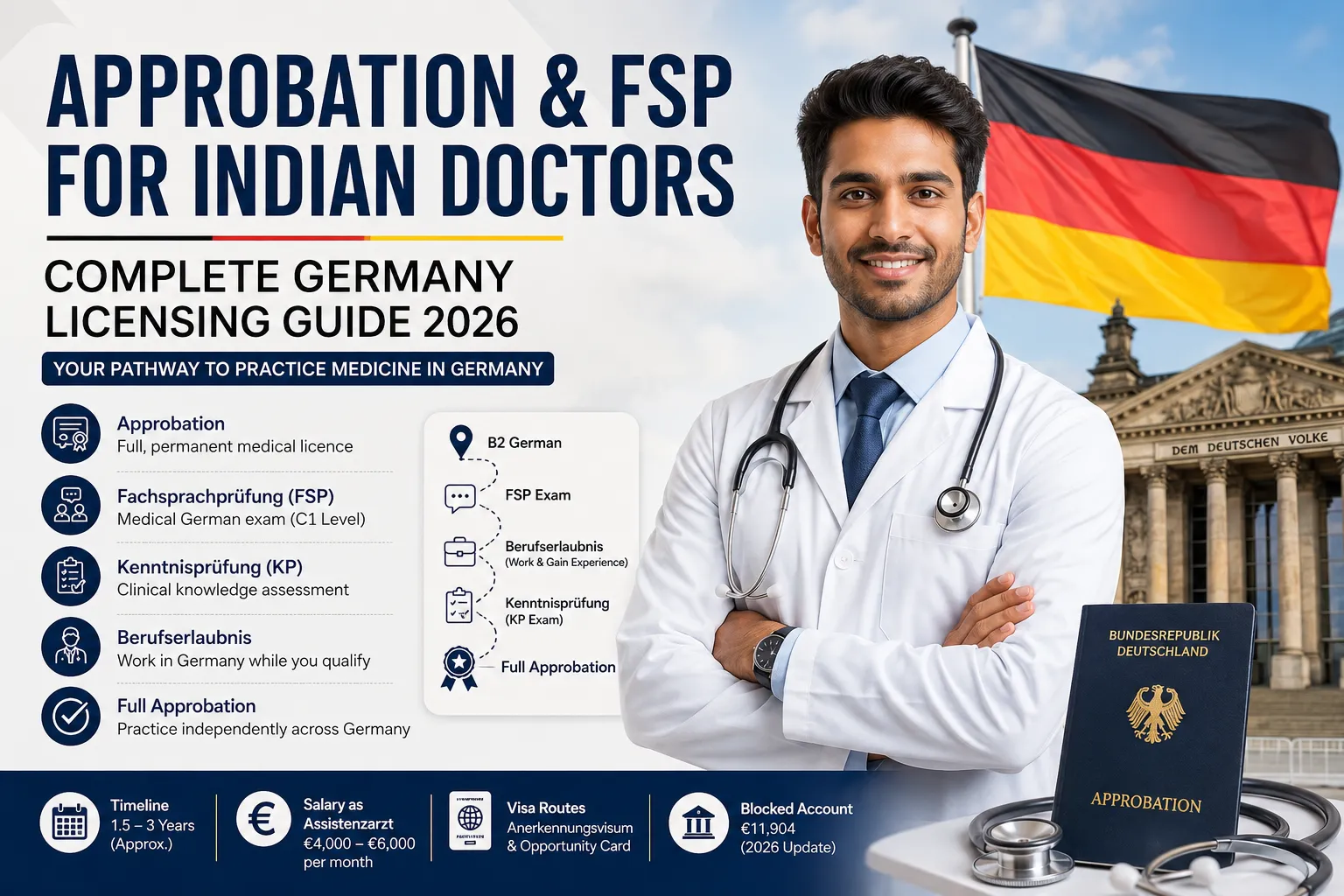
Approbation & FSP for Indian Doctors: Complete Germany Licensing Guide 2026
Approbation FSP Indian doctors must clear can sound like two separate hurdles. In reality, they’re one connected pathway. Approbation is the full, permanent medical licence. The FSP is the medical German exam that sits inside that pathway. This guide walks through both, plus the Kenntnisprüfung, Berufserlaubnis, visa route, timeline, and realistic salary for 2026.
What Is Approbation?
Approbation is Germany’s full, unconditional medical licence. Once granted, it’s valid across the entire country, and it doesn’t expire or require renewal. You need it to practise medicine independently, in any German state.
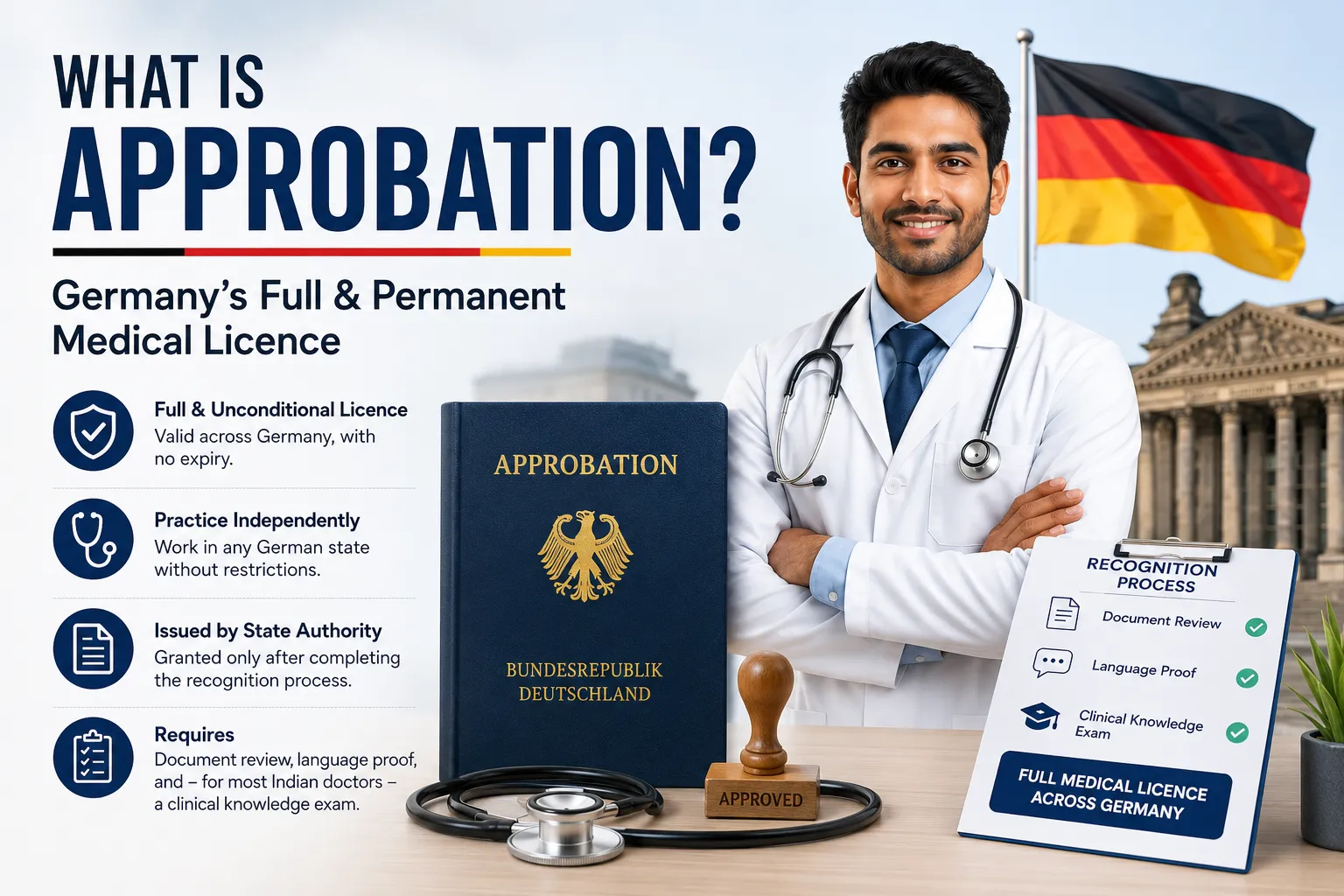
A state authority issues Approbation only after you clear every stage of the recognition process. That includes document review, language proof, and — for most Indian graduates — a clinical knowledge exam as well.
What Is the FSP (Fachsprachprüfung)?
The Fachsprachprüfung tests your medical German at C1 level, not your medical knowledge. Every foreign-trained doctor must pass it, regardless of how experienced they are. The regional medical chamber (Landesärztekammer) in your target state conducts the exam.
It runs in three parts. First, a patient conversation and history-taking exercise (Anamnesegespräch), typically around 20 minutes. Second, written documentation, where you summarise the case as a doctor’s letter (Arztbrief). Third, a doctor-to-doctor case presentation, testing how you communicate clinically with colleagues.
Approbation FSP Indian Doctors: Why the Kenntnisprüfung Is Almost Always Required
Here’s the part many applicants underestimate. Indian MBBS training differs structurally from the German medical curriculum — not in quality, but in structure and hour distribution. Because of that, state authorities almost always issue a Defizitbescheid (deficiency notice) to Indian applicants, rather than granting direct equivalence.
That notice triggers the Kenntnisprüfung (KP), a separate oral-practical exam. It typically runs 60 to 90 minutes. It covers internal medicine, surgery, and one additional subject, often pharmacology or emergency medicine. In short, nearly every Indian MBBS graduate ends up taking both the FSP and the KP — not just one or the other.
Eligibility and Documents for Approbation FSP Indian Doctors
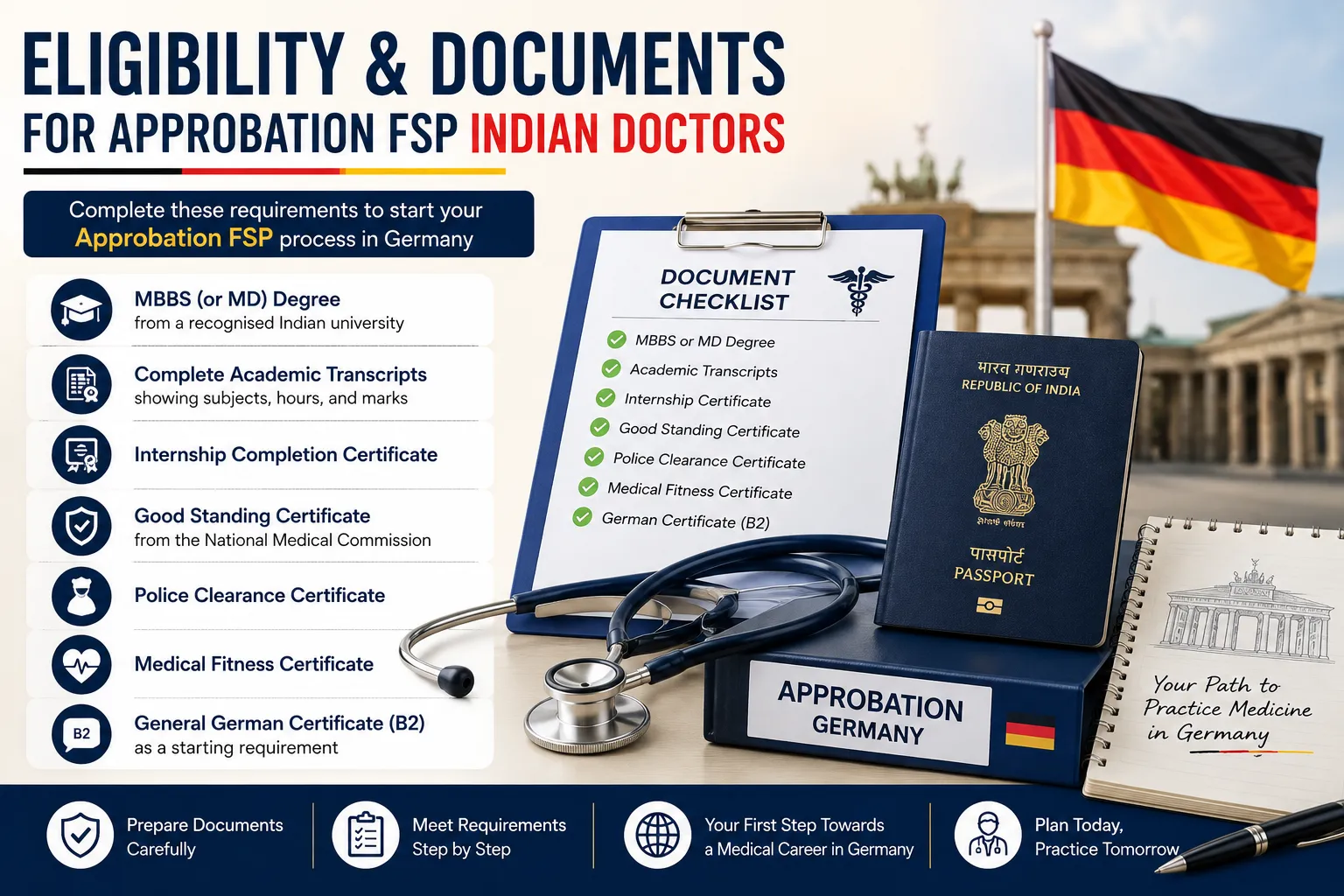
- MBBS (or MD) degree from a recognised Indian university
- Complete academic transcripts, showing subjects, hours, and marks
- Internship completion certificate
- Good Standing Certificate from the National Medical Commission
- Police clearance certificate
- Medical fitness certificate
- General German certificate (B2) as a starting requirement
Language Requirement: B2 General, C1 for FSP
You need a general B2 German certificate simply to begin the application. That’s the baseline the authorities check first. Passing the FSP itself, however, demands medical German closer to C1. Everyday B2 conversation isn’t enough for patient history-taking or clinical documentation.
Most successful candidates treat these as two separate stages. They reach B2 first, then move into dedicated medical-German (Fachsprache) preparation before attempting the FSP.
The Berufserlaubnis: Working While You Finish the Rest
A Berufserlaubnis is a temporary, state-specific medical licence, valid for up to two years. It lets you work under supervision — usually as an Assistenzarzt or Arzt in Weiterbildung. During this time, you complete your FSP and Kenntnisprüfung requirements.
This is the pathway most Indian doctors actually use. Instead of waiting outside Germany to clear every exam first, you enter on a Berufserlaubnis and earn a salary. You then prepare for your remaining exams from inside a real hospital environment.
Step-by-Step: The Approbation FSP Indian Doctors Pathway
- Reach B2 German, ideally starting in India before you apply anywhere.
- Apply to your target state’s authority for equivalence assessment, submitting your full document set.
- Receive your equivalence result. Most Indian applicants get a Defizitbescheid, confirming the Kenntnisprüfung is required.
- Complete medical-German preparation and pass the Fachsprachprüfung at your state medical chamber.
- Apply for a Berufserlaubnis and start working under supervision in a German hospital.
- Prepare for and pass the Kenntnisprüfung, usually while already working.
- Receive full Approbation, and begin practising independently.
Visa Route: Anerkennungsvisum and the Opportunity Card
Most Indian doctors enter Germany on either the Recognition Visa (Anerkennungsvisum, Section 16d) or the newer Opportunity Card (Chancenkarte). Both allow you to stay in Germany while sitting your FSP and KP exams. Both also permit limited work alongside your preparation.
Either route eventually transitions into your Berufserlaubnis or full Approbation once your exams are behind you.
Approbation FSP Indian Doctors: Cost and Blocked Account
If you’re not yet working, you’ll typically need a blocked account holding around €11,904 for 2026. This proves you can support yourself during language study, or while waiting for exam dates. Once you secure a Berufserlaubnis position, your hospital salary generally replaces this requirement.
Timeline: How Long It Realistically Takes
Multiple sources converge on a similar range: roughly 1.5 to 3 years from starting German to receiving full Approbation. Candidates starting from zero German tend to land toward the longer end. Those who already speak some German, or who move quickly into a Berufserlaubnis position, often finish faster.
Treat any timeline you’re given as a rough estimate, not a guarantee. Your own pace with the language, plus exam scheduling in your chosen state, both move the number meaningfully.
Salary Expectations as an Assistenzarzt
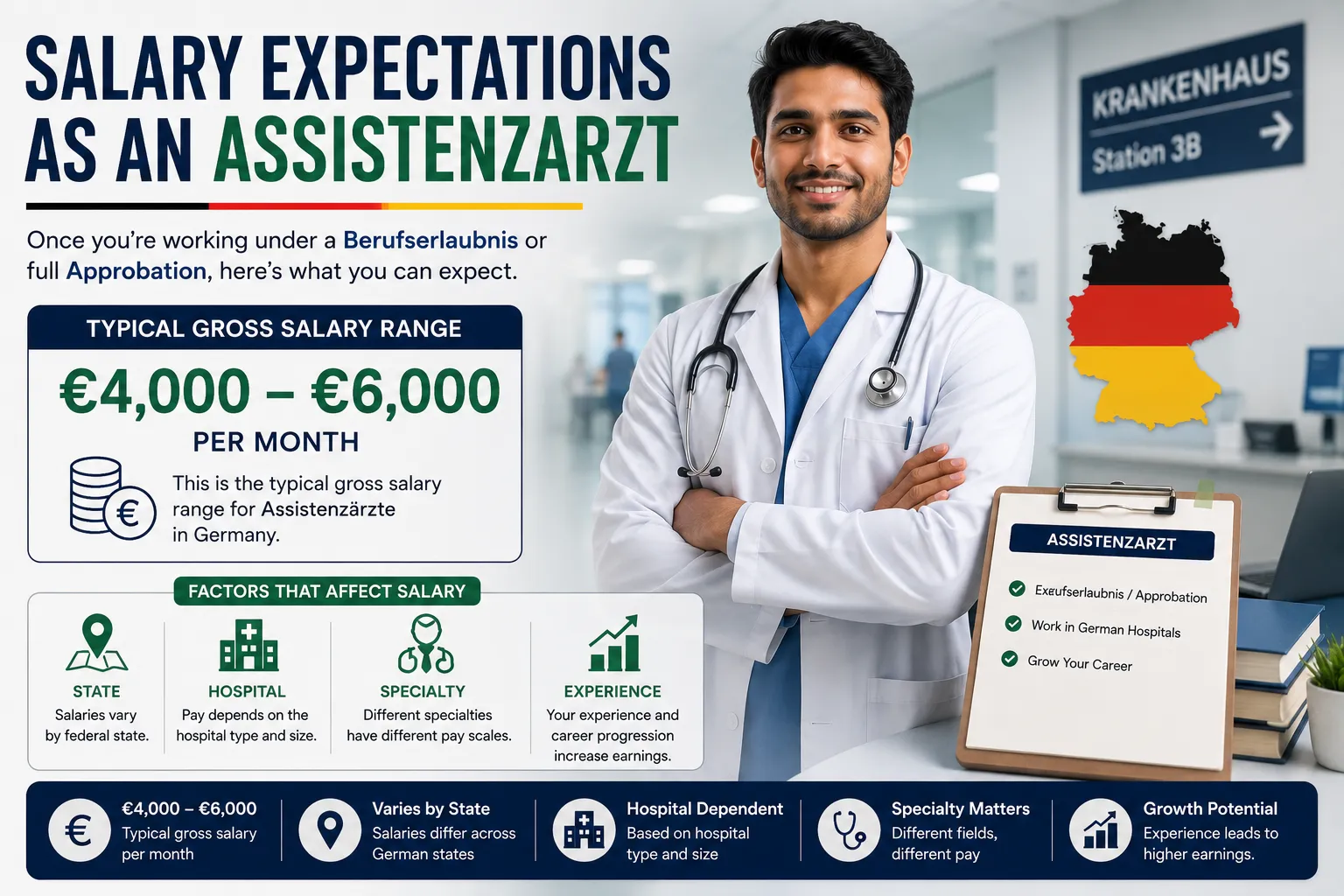
Once you’re working under a Berufserlaubnis or full Approbation, salaries commonly fall in a certain range. Assistenzarzt pay typically runs €4,000 to €6,000 gross per month. Exact pay depends heavily on the state, the hospital, and your specialty. Salary figures like this vary by source, so treat them as a starting benchmark rather than a fixed number.
Exam Attempts: What Happens If You Fail
Most states allow two to three attempts each for the FSP and the Kenntnisprüfung. Failing your final permitted attempt can block you from Approbation in that state. Depending on the specific state’s rules, it can sometimes block you from Approbation in Germany altogether. Because of that, treat exam preparation seriously the first time — don’t plan around a retake as a safety net.
Common Mistakes Indian Doctors Make
- Assuming general B2 German is enough to pass the FSP, without separate medical-German preparation
- Waiting for full equivalence instead of planning for the Kenntnisprüfung from the start
- Delaying document collection — transcripts and Good Standing Certificates take time to process
- Treating exam attempts casually, given the strict cap most states enforce
- Underestimating how much the Berufserlaubnis pathway can shorten the overall timeline
FAQs on Approbation FSP Indian Doctors
Do all Indian doctors need the Kenntnisprüfung?
Not by law, but in practice, yes. The vast majority receive a Defizitbescheid and must pass it, because Indian MBBS training structurally differs from the German curriculum.
Is the FSP the same as a general German exam?
No. The FSP tests medical German specifically — patient conversations, clinical documentation, and doctor-to-doctor communication. It’s set at C1 level, separate from any general language certificate.
Can I work in Germany before I finish my Approbation?
Yes, through a Berufserlaubnis. It lets you work under supervision, usually as an Assistenzarzt, while you complete your remaining exams.
How long does the whole process take?
Most candidates take roughly 1.5 to 3 years from starting German to full Approbation. Individual pace and state processing times both affect this significantly.
Final Thoughts
Approbation FSP Indian doctors deal with can look intimidating on paper. That’s mostly because it involves several unfamiliar German terms at once. Broken into stages, though, it’s a predictable sequence: B2, FSP, Berufserlaubnis, Kenntnisprüfung, Approbation. Start your German early, and treat the Kenntnisprüfung as expected rather than a surprise.
If you’re preparing for this route, explore Germanacharya’s medical German courses, built around exam-focused preparation rather than general conversation practice. Book a free 1:1 consultation to map your specific timeline, or browse more guides on our blog.
For official information, refer to the Bundesärztekammer’s orientation guide for foreign-trained doctors. The Ärztekammer Berlin’s Fachsprachprüfung page is a useful worked example of one state’s process, and the German Missions in India page on qualification recognition covers the India-specific angle.

Quick tangent, hope that’s OK. Whenever someone I know is job hunting, I point them to https://aspx.zn-app-lanjingsports.com/. It’s a job board where you find real openings fast — narrow down by salary and title without the hassle. Cheers.
For folks hunting right now, the trick was consolidating the search — I settled on https://xtep.global-wanbosport.com/. It shows jobs by city and company with a search that’s genuinely fast. Would love to hear if others have used it too.
Thanks, this cleared things up. More on the subject at employernest.shop for those curious.
Really impressed with the interface here. Everything is laid out perfectly and the loading speeds are impressive. Great spot for anyone looking for a reliable site. c333com
Best platform for local players in my opinion. It feels reliable and the game selection is just perfect. phperabet
[8722]bet188 Login Oficial | Mejores Slots Online y Depósitos Coppel,Accede a bet188 para disfrutar de las mejores slots y aprender las reglas de blackjack. Descarga la apk oficial y recarga fácil con Coppel. ¡Regístrate ahora! visit: bet188
Finally found an app that doesn’t lag during big wins. The bonus offers are actually fair and easy to claim. Give pkb9app a try guys, it’s a game changer.
I love the local vibe of this site. It feels tailor-made for us and the bonuses are actually generous. jilione1 is definitely a winner in my book.
I’ve been looking for a reliable spot like this for a while. The interface is super smooth and the payouts are fast. Definitely worth checking out idsenopati2
Love the atmosphere and the way the promotions are set up. It feels like they actually care about the players. xbajeecasino is top notch.
The game selection is top notch and the graphics are crisp. It is honestly such a vibe playing on yoyoslot after a long day of work.
If you are looking for a secure and fair platform this is it. No issues with deposits or withdrawals so far. Check out ole99login.