

How to Learn German for Ausbildung in Germany?
How to Learn German for Ausbildung in Germany: A Practical Guide for Indian Students and Nurses
If you want to learn German for Ausbildung, start with one fact: your training, your vocational school and your exams will all be in German. There is no English-only route for most programs. So your German level is one of the main things a training company looks at.
This guide is for Indian students, nurses and medical students who are thinking about vocational training in Germany. It explains the level you need, whether B1 is enough, a step-by-step study plan, free resources, and which route actually suits nurses and medical students. Rules below were checked against official German sources in October 2026.
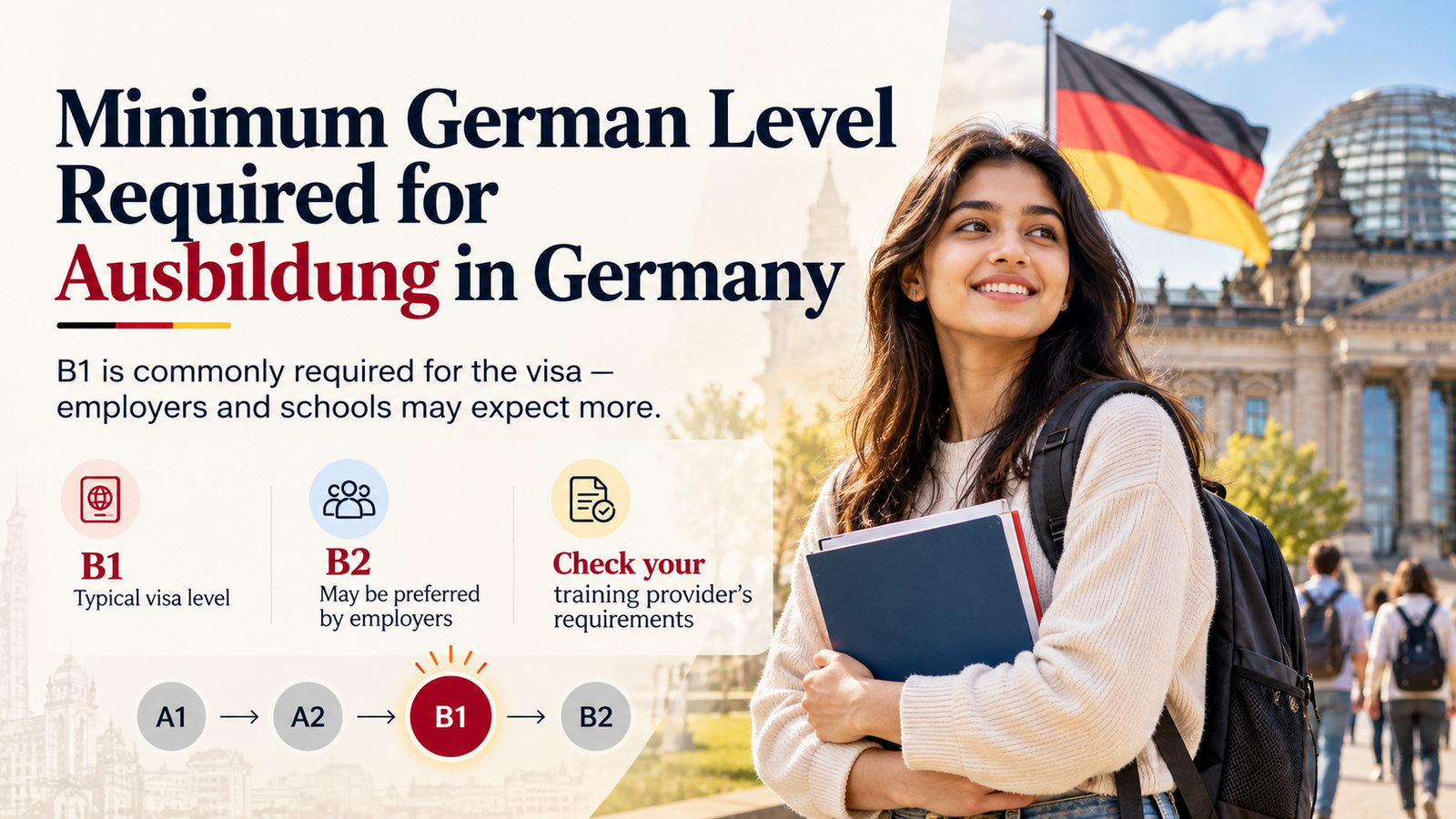
Quick answer: For the Ausbildung visa, Germany normally asks for B1. For nursing and other healthcare training, schools and employers commonly ask for B2. Plan to reach B1 first, then aim for B2, and always confirm the exact level with your training school or employer.
Minimum German Level Required for Ausbildung in Germany
There are two different answers here: what the law asks for, and what schools and employers ask for. They are not always the same.
What Germany’s visa rules say
According to the Make it in Germany portal, you will normally need German at level B1 for the vocational training visa. German embassy guidance says B1 applies to qualified vocational training, and that A2 is usually the minimum for other cases. If your German is weaker, you can take a preparatory language course first. A training company can also confirm in writing that your German is good enough, but do not plan around that.
The same government guidance on vocational training requirements explains why language matters: lessons at the company, at the vocational school and in the exams all happen in German.
Why healthcare Ausbildung usually needs B2
Nursing training (Pflegefachfrau or Pflegefachmann) is a three-year course. You split your time between a nursing school and real work in hospitals, care homes or home care. The school side covers subjects like anatomy, medicines and documentation, and you write and speak about patients in German.
Because of this, many schools and employers ask for B2. Some German hospitals list B2 as the requirement for recognition as a nurse, while allowing you to enter with B1 and finish B2 on the job. The rule differs by school and state, so ask before you apply. For a deeper look at nurses, read our guide on how much German nurses need.
| Training area | Level usually asked | What to remember |
|---|---|---|
| Visa (qualified vocational training) | B1 | This is the official floor. A2 can apply in some cases with a preparatory course. |
| Nursing and other patient-facing roles | B2 is common | Some schools accept B1 with a plan to reach B2. Confirm with each school. |
| Technical trades, hospitality, IT-type roles | B1 is often accepted | B2 improves your chances and your first year. |
Is B1 German Enough for Ausbildung?
B1 is enough to meet the legal minimum for the visa. It is often not enough to feel comfortable in class or at work.
At B1 you can handle everyday conversations and simple emails. Ausbildung adds subject vocabulary, trainers who speak fast, written reports and exams. That jump is where many learners struggle.
- B1 can work when the field is not patient-facing, the employer accepts it, and you commit to reaching B2 within the first year.
- B1 is risky when you will care for patients, write care notes, or study at a Pflegeschule.
Our advice: treat B1 as the door and B2 as your safety net. If you can, finish your B2 preparation before you leave India, not after. If your real goal is university, see our guide on learning German for university study instead, because the level requirements are different.
Learn German for Ausbildung: Which Route Fits Nurses and Medical Students?
This is the part most guides skip. Ausbildung is not the only way into German healthcare, and for many nurses it is not the best one.
- You are already a registered nurse (B.Sc Nursing or GNM). Most nurses in this position go through recognition of their qualification and then work as a nurse, not through Ausbildung. That route needs your nursing qualification, your registration and a B1 or B2 German certificate. We explain the full path on our nursing pathway page. Doing Ausbildung would usually mean repeating years of training you have already done.
- You finished school or are still a nursing or allied-health student. Ausbildung can be a practical way in, because training is paid and you earn while you learn. Check whether your school certificates are accepted for the course you want.
- You are an MBBS or other medical student. Ausbildung is a different career from becoming a doctor. Doctors usually need B2 plus a separate medical language exam to get a licence. Decide on purpose, not by default.
Not sure where you fit? Book a free 1:1 consultation with Germanacharya. The team gives you a German evaluation test first, so you know your real level before you plan anything.
How to Learn German for Ausbildung in Germany: A 6-Step Plan
- Set your target and your date. Pick B1 or B2, then count backwards from the application window. Many programs start in late summer.
- Test your current level. A placement test stops you from repeating what you already know.
- Build A1 and A2 properly. Spend time on sentence order and German cases, because mistakes here follow you to B1.
- Add job vocabulary early. Healthcare learners should start medical and workplace phrases at A2, not after B1.
- Speak every week. Reading and apps do not fix speaking. You need a teacher or partner who corrects you.
- Take the exam and keep going. Sit the B1 exam, apply, then continue towards B2 while you wait for offers.
Learning German for Ausbildung from zero: a realistic timeline
Training providers commonly quote 6 to 8 months of intensive study, around 20 to 25 hours a week, to reach B1 from zero. B2 usually takes 3 to 4 more months. If you study part-time next to college or work, plan for roughly 10 to 14 months to B1. These are planning estimates, not promises. Pace, practice time and teaching quality change the result.
Add healthcare German early
If you are a nurse or medical student, general German is not enough. You also need to explain symptoms, ask patients questions, take instructions from a senior nurse and understand handover talk. Our A1 to B2 roadmap for nurses shows how to fit this into each level.
Fix speaking early
Many Indian learners read well but freeze when they speak. Join live classes where everyone gets a turn to talk. Record yourself. Practise short answers to common interview questions, like why you chose this training and what you did in your last job or course.
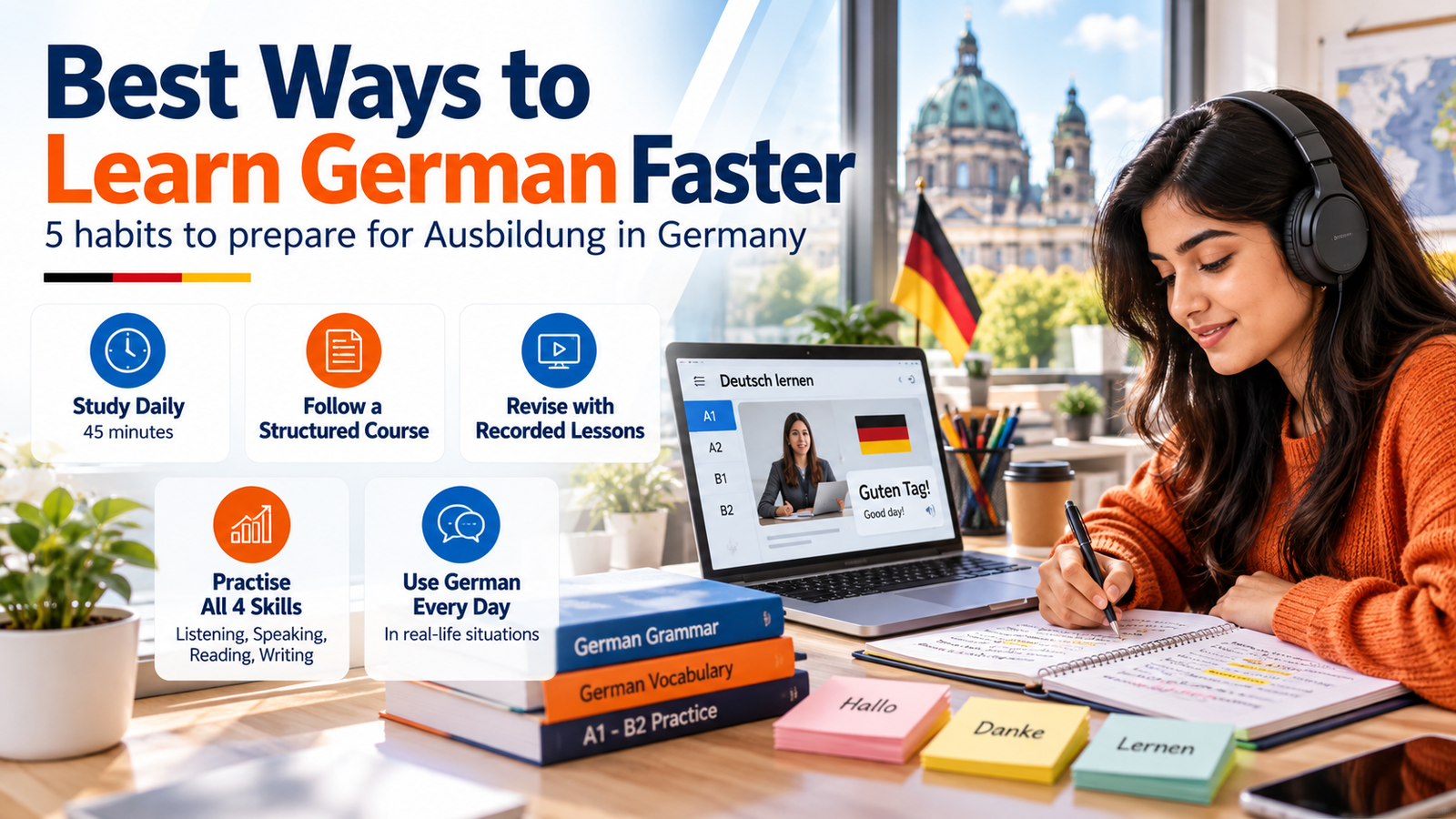
Best Ways to Learn German for Ausbildung Fast
Nobody should promise you a shortcut. But if you want to learn German for Ausbildung quickly, some habits clearly save time.
- Study daily, even for 45 minutes. Short daily practice beats one long weekend session.
- Learn with a structured course. A clear A1 to B2 path avoids gaps. Compare options like our German courses from A1 to B2.
- Use recorded classes to revise. Re-watching a hard grammar topic costs nothing.
- Train for the exam format. Goethe and telc exams test listening, reading, writing and speaking. Practise all four, not only grammar.
- Use German outside class. Change your phone language, read short news, and write a few lines in German each day.
Free German Language Courses for Ausbildung in Germany
You can start to learn German for Ausbildung for free, and you should. Two official options are worth your time.
- Nicos Weg by Deutsche Welle (DW) is a free video course that covers A1, A2 and B1.
- The vhs-Lernportal offers free online courses from A1 to B2, with an online tutor who checks your tasks.
Where free resources work
They are good for building vocabulary, basic grammar and listening habits. They cost nothing, so they are a safe way to test how serious you are.
Where free resources stop working
Self-study rarely gives you spoken feedback or exam practice. Most learners hit a wall around A2 to B1 because nobody corrects their speaking or writing. That is when a live, teacher-led course becomes worth the money.
What Learners at Germanacharya Say
We do not have an Ausbildung-specific success story to publish yet, and we will not invent one. What we can share are experiences from learners on our own courses, taken from their Google reviews. Individual results vary.
- Palak Tripathi works with native German-speaking patients every day. A month into the A1+A2+B1 batch, she said she felt heard and was understanding German step by step. Her stated goal is to talk with her patients confidently by the end of the course.
- Melvin Stephen was three months into his course when he reviewed it. He said trainers explain doubts in English when needed and that everyone gets a chance to speak in class.
- Rutvik Parekh joined at A2+B1 level. After one month he said he could already hold a basic conversation in German.
Common Mistakes When You Learn German for Ausbildung
- Stopping at B1. You pass the visa check, then struggle in class.
- Choosing Ausbildung when recognition fits better. This is the most expensive mistake for qualified nurses.
- Studying only grammar. Speaking and listening decide interviews.
- Booking the wrong exam. Check the accepted certificate before you pay.
- Starting too late. Beginners need a year or more, and applications open early.
- Trusting vague promises. If anyone guarantees a job or a level, ask for details in writing.
How Germanacharya Helps You Learn German for Ausbildung
Germanacharya is an online German school in Delhi, founded by Ishant Rathore. According to the team, he went to Germany on a DAAD scholarship, completed a Master’s in German Studies and became a certified DaF teacher there. The team says it has trained more than 10,000 students from over 27 countries.
Our Germanacharya courses run from A1 to B2. They include live online sessions, recordings of missed classes, lifetime access to the learning portal and exam training for Goethe and telc. You can start with a free 1:1 consultation and a German level test, then choose the course that fits your target. This way you learn German for Ausbildung with a clear plan, not guesswork.
Nurses can also read our nursing pathway page to see how language training connects to recognition and job interviews.
Next step: Not sure whether you need B1 or B2, or whether Ausbildung is the right route? Book a free 1:1 consultation or contact our team.
Exam notes: you can take certificates from the Goethe-Institut and telc, among others. Always check which one your school or employer accepts.
Frequently Asked Questions About Learning German for Ausbildung
What is the minimum German level required for Ausbildung in Germany?
The German government says you will normally need B1 for the vocational training visa. In some cases A2 is accepted, for example if you attend a preparatory German course. Individual training companies and schools can ask for more, and healthcare training often asks for B2.
Is B1 German enough for Ausbildung?
B1 meets the usual legal minimum for the visa, and many non-medical programs accept it. For nursing and other patient-facing training, B1 is often not enough in practice, because classes, exams and documentation are all in German. Aim for B2 and confirm the requirement with your school or employer.
How long does it take to learn German for Ausbildung?
Training providers commonly quote 6 to 8 months of intensive study (20 to 25 hours a week) to reach B1 from zero, and 3 to 4 more months for B2. If you study part-time alongside college or work, plan for roughly 10 to 14 months to B1. These are planning estimates, and your own pace may differ.
Can I do Ausbildung in Germany with A2 German?
Sometimes. The visa rules allow A2 in some cases, usually together with a preparatory German course. But the training company still has to accept you, and most expect B1 or higher. If you start at A2, be ready to study hard both before and during the training.
Do nurses need Ausbildung to work in Germany?
Not always. Nurses who already hold a nursing degree or diploma and are registered usually go through recognition of their qualification, which needs B1 or B2 German depending on the employer and state. Ausbildung is more common for school leavers or students who do not yet have a recognised nursing qualification. Check your own case before you choose.
Are there free German language courses for Ausbildung in Germany?
Yes. DW’s Nicos Weg covers A1 to B1 for free, and the vhs-Lernportal offers free online courses from A1 to B2 with an online tutor. They are good for grammar and vocabulary. Most learners still need live speaking practice and exam preparation, which usually means a teacher-led course.
Which exam should I take for Ausbildung: Goethe, telc or ÖSD?
Goethe, telc and ÖSD certificates are widely accepted, but you should check which one your training company, school or embassy asks for before you book. For healthcare, telc also offers job-focused exams such as B2 Pflege, so ask your school if it prefers a specific one.
When should I start learning German for Ausbildung?
If you are a beginner, start at least 12 months before your target start date. Many Ausbildung programs begin in late summer and applications often open months earlier, so you want your certificate ready before you apply.