
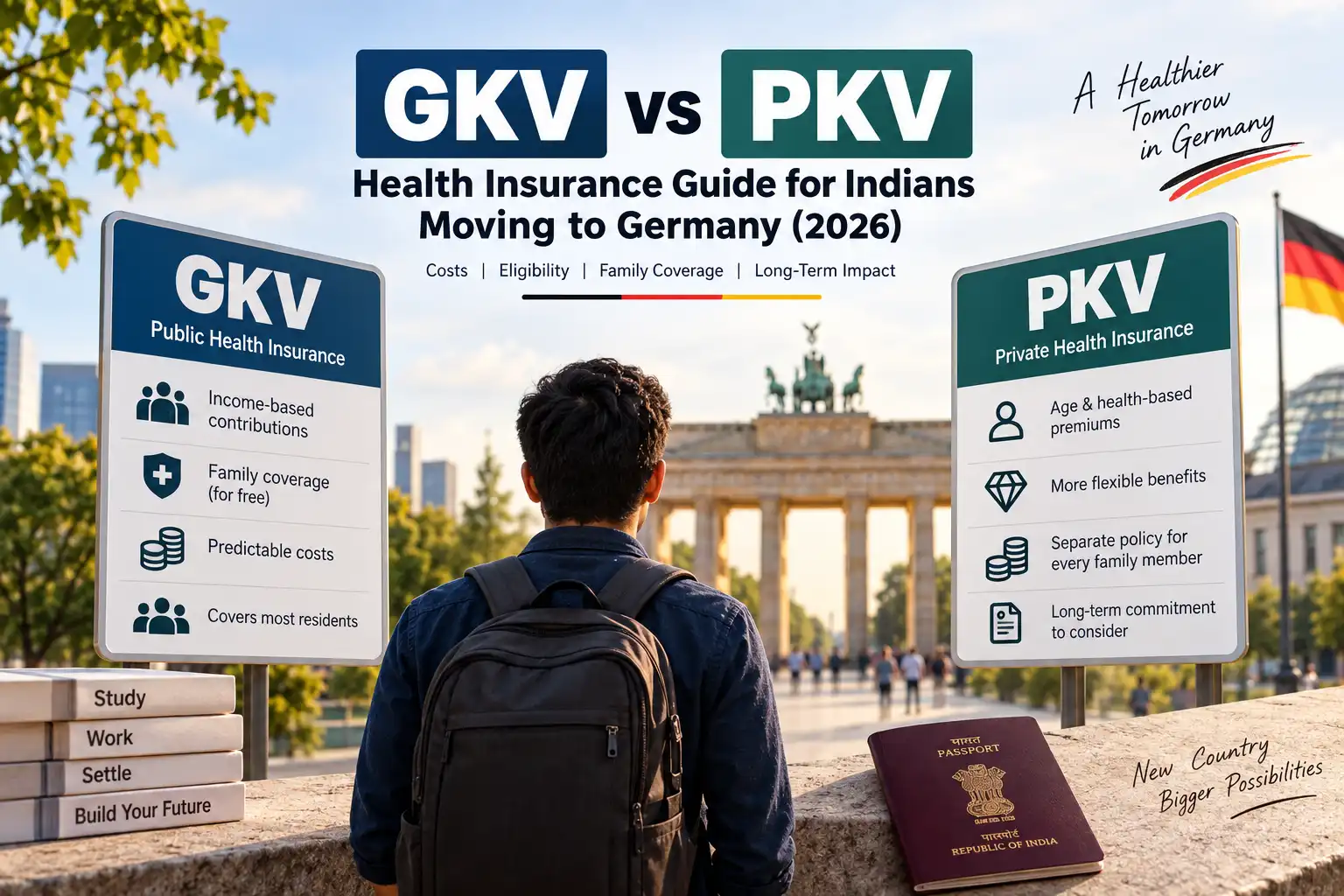
GKV vs PKV Germany: 2026 Insurance Guide
GKV vs PKV: Health Insurance Guide for Indians Moving to Germany (2026)
GKV vs PKV Germany is one of the first real financial decisions you’ll face after your visa comes through. Health insurance isn’t optional here. Every resident needs it, by law, from day one. This guide breaks down the two systems, who actually gets to choose, real 2026 costs, and the one decision that’s genuinely hard to reverse later.
What Is GKV, and What Is PKV?
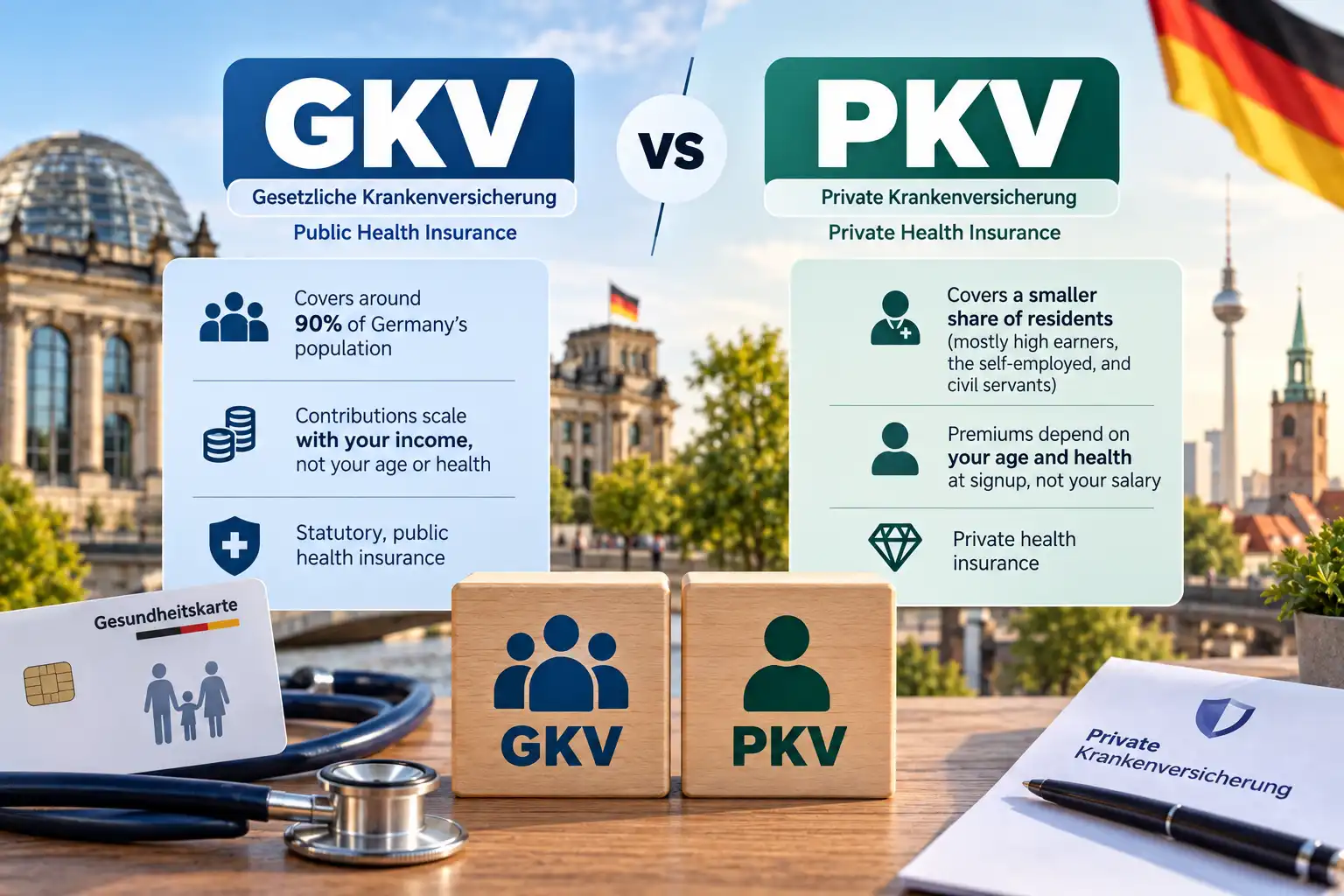
GKV stands for Gesetzliche Krankenversicherung — statutory, public health insurance. It covers roughly 90% of Germany’s population. Contributions scale with your income, not your age or health.
PKV stands for Private Krankenversicherung — private health insurance. Premiums depend on your age and health at signup, not your salary. It covers a smaller share of residents, mostly high earners, the self-employed, and civil servants.
GKV vs PKV Germany: Who Must Use Which
The key number here is the Jahresarbeitsentgeltgrenze (JAEG), Germany’s compulsory insurance threshold. For 2026, it sits at €77,400 a year. Earn below that as an employee, and GKV isn’t optional — it’s mandatory.
Cross above €77,400, and voluntary insurance opens up. You can stay on GKV or switch to PKV. One catch matters here: crossing the threshold once, for a single year, usually isn’t enough. Most sources point to a sustained period above the limit before you actually qualify to switch, so don’t assume one good year unlocks PKV immediately.
How Much GKV Actually Costs
GKV runs on a fixed formula. The general contribution rate is 14.6% of your gross income, split between you and your employer. On top of that, each fund adds its own Zusatzbeitrag, averaging around 2.9% officially, though real rates often run a bit higher.
There’s also a ceiling. Contributions only apply up to the Beitragsbemessungsgrenze, set at €69,750 a year for 2026. Earn more than that, and your GKV contribution stops rising with your salary.
How Much PKV Actually Costs
PKV works completely differently. Your premium depends on your age and health when you sign up, not your income. That can make it genuinely cheaper for a young, healthy applicant.
Your employer still contributes, though, up to 50% of your premium, capped at €508.59 a month in 2026. The catch is that premiums climb as you age, and pre-existing conditions can raise your rate or get excluded entirely at signup.
The Big Difference: Family Coverage
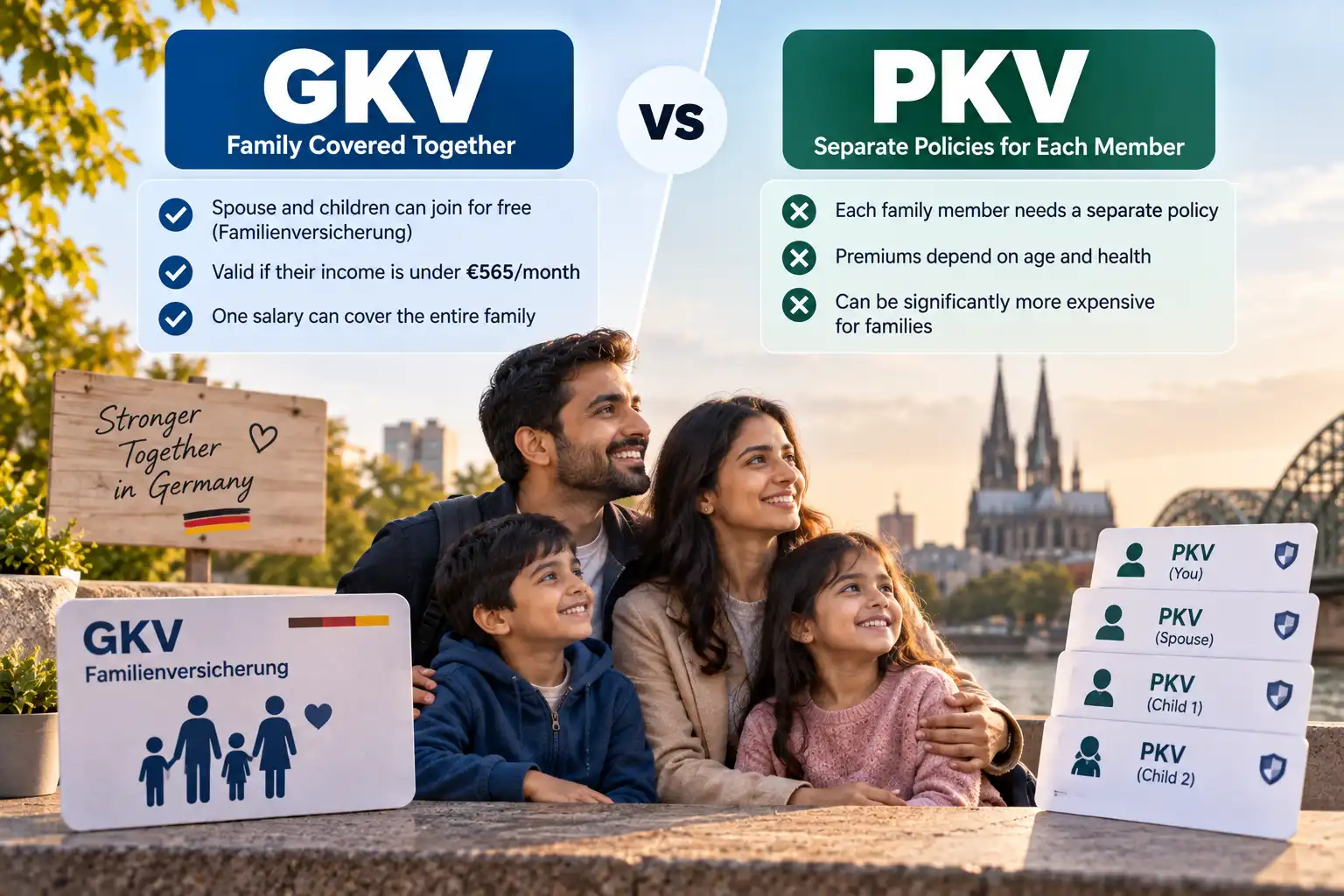
This is where the two systems diverge most for Indian families. Under GKV, your spouse and children can join for free through Familienversicherung, as long as their own income stays under €565 a month. One salary can cover an entire family.
PKV doesn’t work that way. Every family member needs their own separate policy, each priced individually by age and health. If you’re planning to bring a spouse or children to Germany, this difference alone can be decisive.
Students: A Different Set of Rules
International students under 30 generally qualify for the standardised student GKV rate. Expect somewhere around €110 to €160 a month, depending on your fund and exact age bracket. You can also opt into PKV instead, within three months of enrolling — after that window closes, switching gets harder.
Past 30, or once you’ve studied beyond a certain number of semesters, the student rate stops applying. You’ll move to voluntary GKV at the standard rate, or stay on PKV if that’s where you already are.
Ausbildung Trainees and Blue Card Workers: Which Applies to You
If you’re doing an Ausbildung, your training stipend almost always falls below the JAEG threshold. That makes GKV compulsory, not a choice. Most Ausbildung trainees end up here by default.
Blue Card holders and other skilled workers depend entirely on salary. Below €77,400, you’re on GKV. Above it, and sustained there, PKV becomes a genuine option worth weighing.
The PKV Lock-In Risk
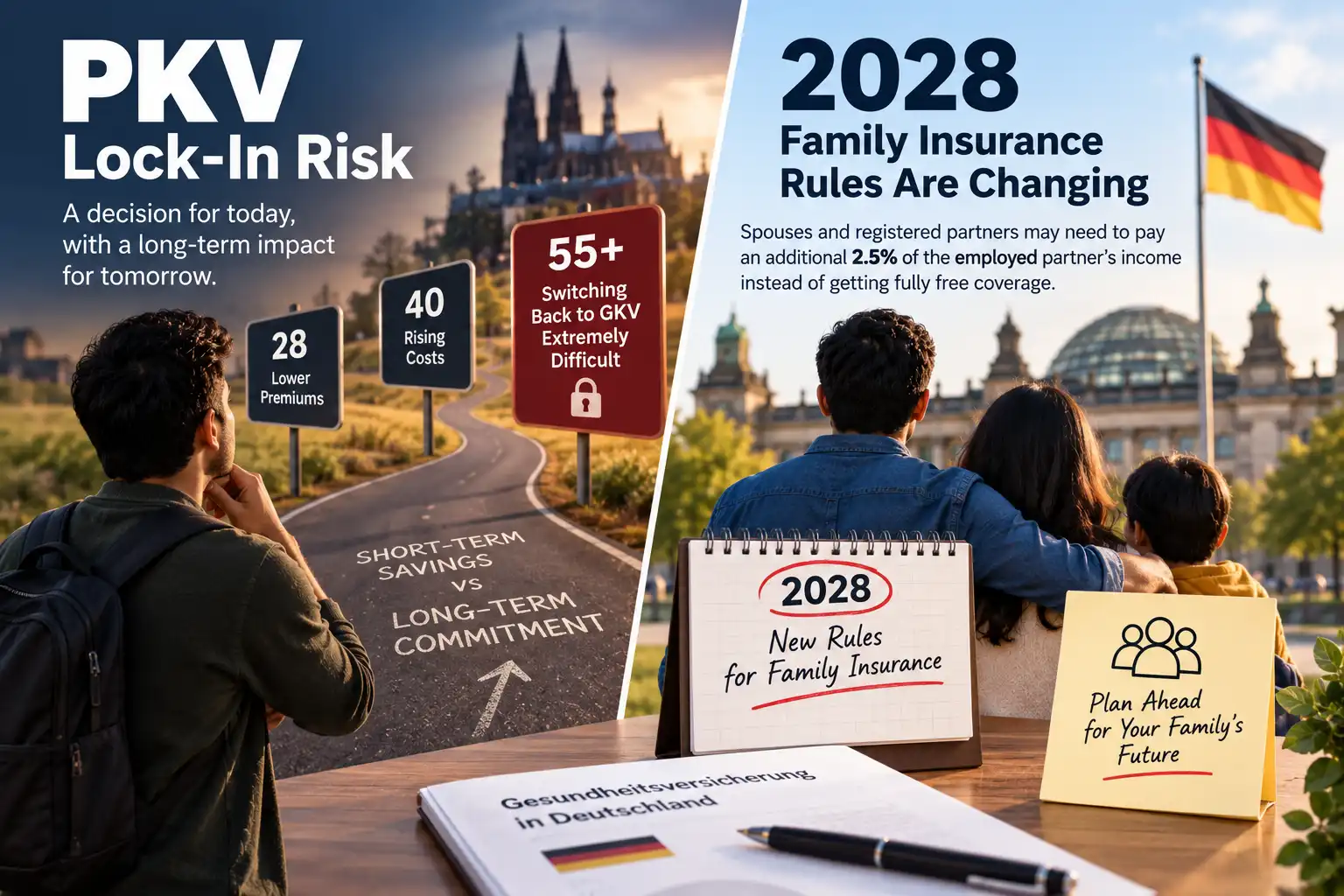
Here’s the part that catches people off guard years later. Switching back from PKV to GKV gets extremely difficult once you’re over 55. For most people past that age, it’s treated as practically impossible under normal circumstances.
Treat PKV as a long-term commitment, not a short-term discount. A cheaper premium at 28 can turn into a much more expensive, harder-to-exit position by 50.
A 2028 Change Worth Knowing About
Germany has already passed a law that will tighten family insurance rules starting in 2028. Spouses and registered partners who don’t qualify for a specific exemption will pay an additional contribution, equal to 2.5% of the employed partner’s income, instead of getting fully free coverage.
If you’re planning a longer-term move with a spouse, this change is worth factoring into your timeline now, even though it’s still a couple of years out.
GKV vs PKV Germany: A Quick Decision Framework
- Earning below €77,400, or on an Ausbildung stipend? GKV is your only real option, and that’s fine — it’s solid, predictable coverage.
- Planning to bring a spouse or children? GKV’s free family coverage is hard to beat financially.
- Young, healthy, single, and earning well above the threshold? PKV might genuinely cost less right now.
- Thinking long-term, past your 40s and 50s? Weigh PKV’s lock-in risk carefully before committing.
Common Mistakes Indians Make
- Assuming PKV is always “better” because it’s private, without checking the family-coverage math
- Not realising GKV is mandatory below the JAEG threshold, regardless of personal preference
- Choosing PKV in your 20s without considering the switching-back difficulty after 55
- Missing the three-month window to opt into PKV as a student, then getting stuck on GKV terms
- Ignoring the 2028 family-insurance change if you’re planning to relocate with a spouse
FAQs on GKV vs PKV Germany
Can I just choose PKV because I prefer private insurance?
Only if you qualify — either by earning above the €77,400 threshold, being self-employed, or holding civil servant status. Most employees below that threshold must use GKV.
Is PKV cheaper than GKV?
It can be, especially when you’re young and healthy. Costs rise with age, though, and family members need separate policies, which often flips the maths for anyone with dependents.
Can I switch from PKV back to GKV later?
It’s possible in some circumstances, but it becomes practically very difficult once you’re over 55. Treat the decision as largely permanent past that age.
What should Ausbildung trainees expect?
Almost all Ausbildung stipends fall under the JAEG threshold, so GKV is compulsory. This isn’t a choice you’ll need to make.
Final Thoughts
GKV vs PKV Germany isn’t really about which system is “better” in the abstract. It’s about your income, your family plans, and how far ahead you’re willing to think. For most Indians moving to Germany on a student visa, Ausbildung, or a salary below the threshold, GKV decides itself. For higher earners, the real question is whether short-term savings are worth the long-term lock-in risk.
If you’re preparing your move, explore Germanacharya’s German courses to get comfortable navigating exactly these kinds of official processes in German. Book a free 1:1 consultation to talk through your specific situation, or browse more guides on our blog.
For official information, see the Federal Ministry of Health’s page on GKV contributions and thresholds, which confirms the current JAEG and Beitragsbemessungsgrenze figures, and the government’s general health insurance overview for a plain-language explanation of both systems. Consult a licensed insurance advisor before making a final GKV or PKV decision, since individual circumstances vary significantly.

Really impressed with the interface here. It is very user friendly and the response time is incredibly fast. Definitely my new go to spot, check out br1658com.
A very clean site with no annoying pop-ups. It makes the whole experience much more relaxing and enjoyable. Great job 80wimcom