
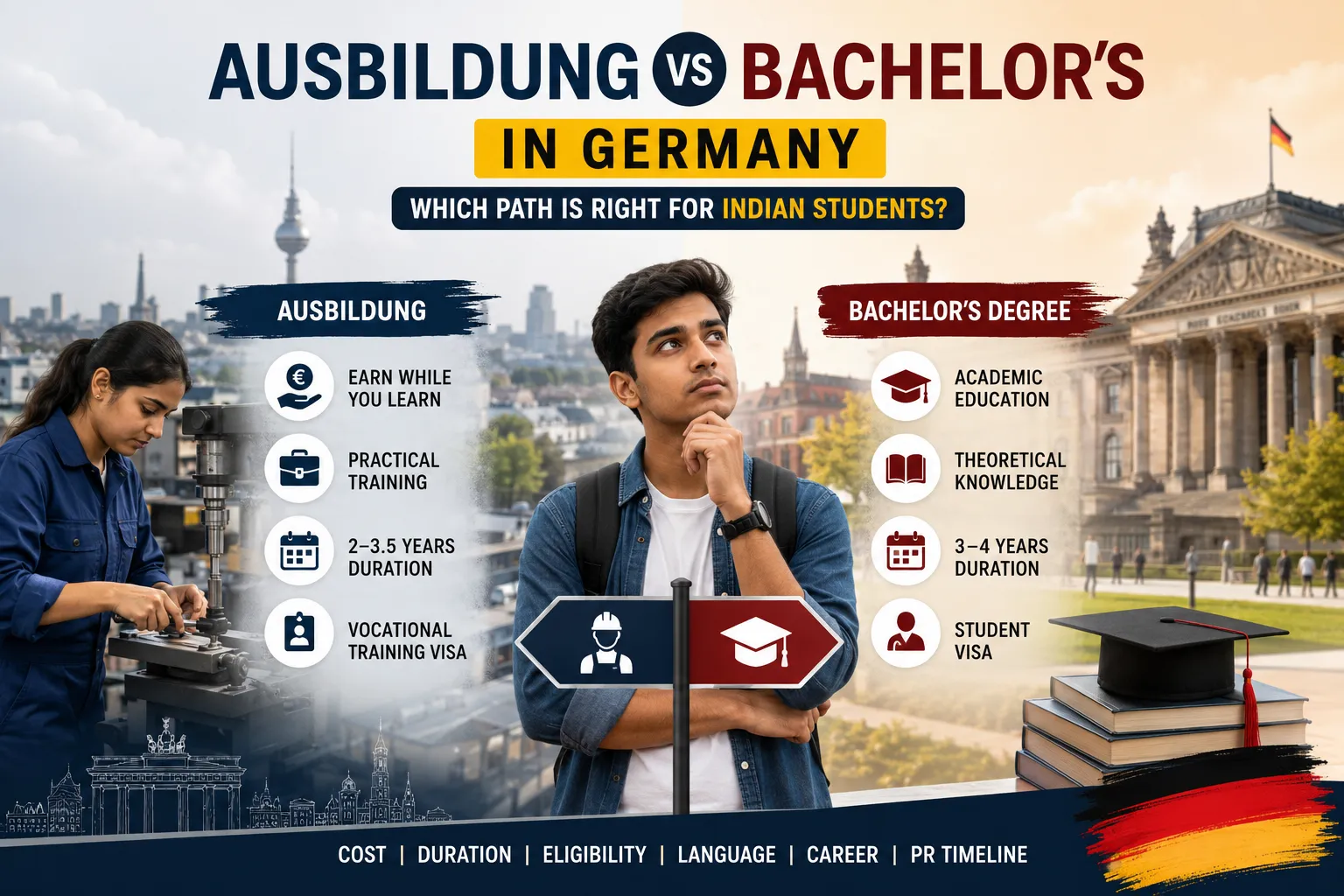
Ausbildung vs Bachelors
Ausbildung vs Bachelors in Germany: Which Path Is Right for Indian Students?
Ausbildung vs Bachelors Germany is the first real decision most Indian students face when planning to move to Germany. Both routes lead to a strong outcome. However, they differ sharply in cost, timeline, and daily life along the way. This guide compares eligibility, cost, language level, visa category, and career outcomes side by side. By the end, you’ll know which path actually fits your situation — not just which one sounds more prestigious.
What Is Ausbildung?
Ausbildung is Germany’s dual vocational training system. Trainees split time between a vocational school and a real workplace. Programs typically run two to three-and-a-half years, depending on the profession. Crucially, you earn a wage throughout — this is paid training, not unpaid education.
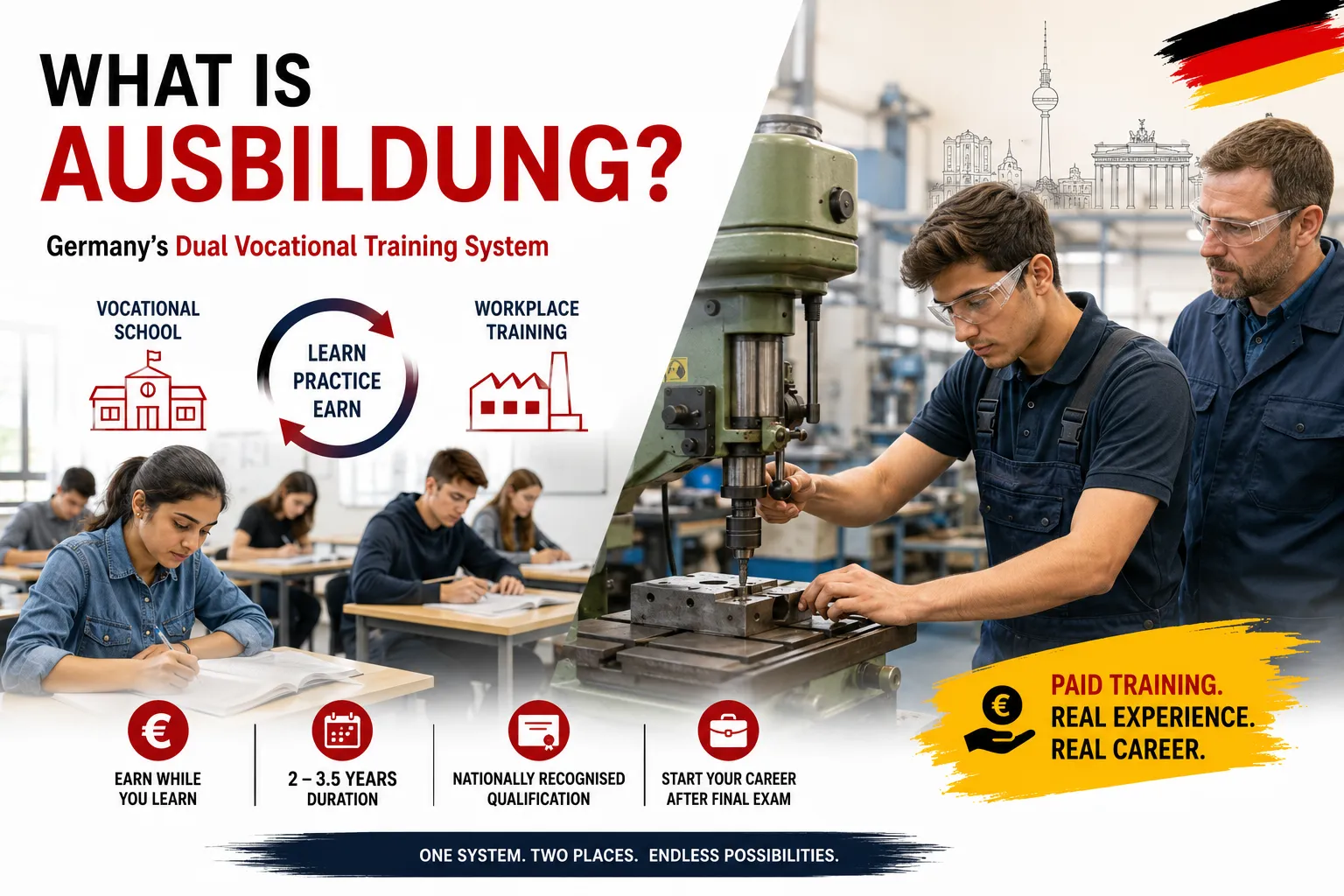
Germany recognises the qualification nationally once you pass the final exam. You can then work directly in that trade — nursing, IT, hospitality, and hundreds of other recognised professions all qualify.
What Is a Bachelor’s Degree in Germany?
A Bachelor’s degree follows the traditional university route. You study one subject in depth over three to four years. Learning happens mostly in classrooms and labs, not on the job.
Public universities in Germany remain largely tuition-free for a Bachelor’s degree. That said, you still pay a modest per-semester contribution. Baden-Württemberg is an exception — it charges separate tuition for non-EU students. Most programs run in German. However, a growing number of English-taught Bachelor’s programs now exist, especially in engineering and business.
Ausbildung vs Bachelors Germany: Key Differences at a Glance
Here’s the short version, before we go section by section:
| Factor | Ausbildung | Bachelor’s Degree |
|---|---|---|
| Duration | 2–3.5 years | 3–4 years |
| Cost to you | Paid — you earn a wage | Mostly free tuition + blocked account (~€11,904/year) |
| Entry requirement | Class 10/12 leaving certificate | Class 12 (70%+) + APS certificate |
| Language level | Usually B1/B2 | Often C1 (German-taught) or IELTS/TOEFL (English-taught) |
| Visa category | Vocational training visa (§16a) | Student visa |
| Outcome | Licensed trade qualification | Academic degree, broader career options |
Eligibility for Ausbildung vs Bachelors Germany
Ausbildung sets a lower entry bar on paper. Most programs accept a Class 10 pass, though many hospitals and companies prefer Class 12. You don’t need strong academic scores — motivation and basic German matter more.
A Bachelor’s degree is stricter. Indian applicants generally need at least 70% in Class 12. They also need an APS certificate confirming their documents are genuine. Some students need a Studienkolleg foundation year first, if their schooling doesn’t directly qualify them for German university entry.
Cost Comparison: What You Actually Pay
This is where the two routes look completely different. Ausbildung pays you. Germany’s 2026 statutory minimum training wage starts around €724 in year one. It rises to about €1,014 by year four, and many sectors pay well above that. You rarely need a blocked account, since your training contract itself proves you can support yourself.
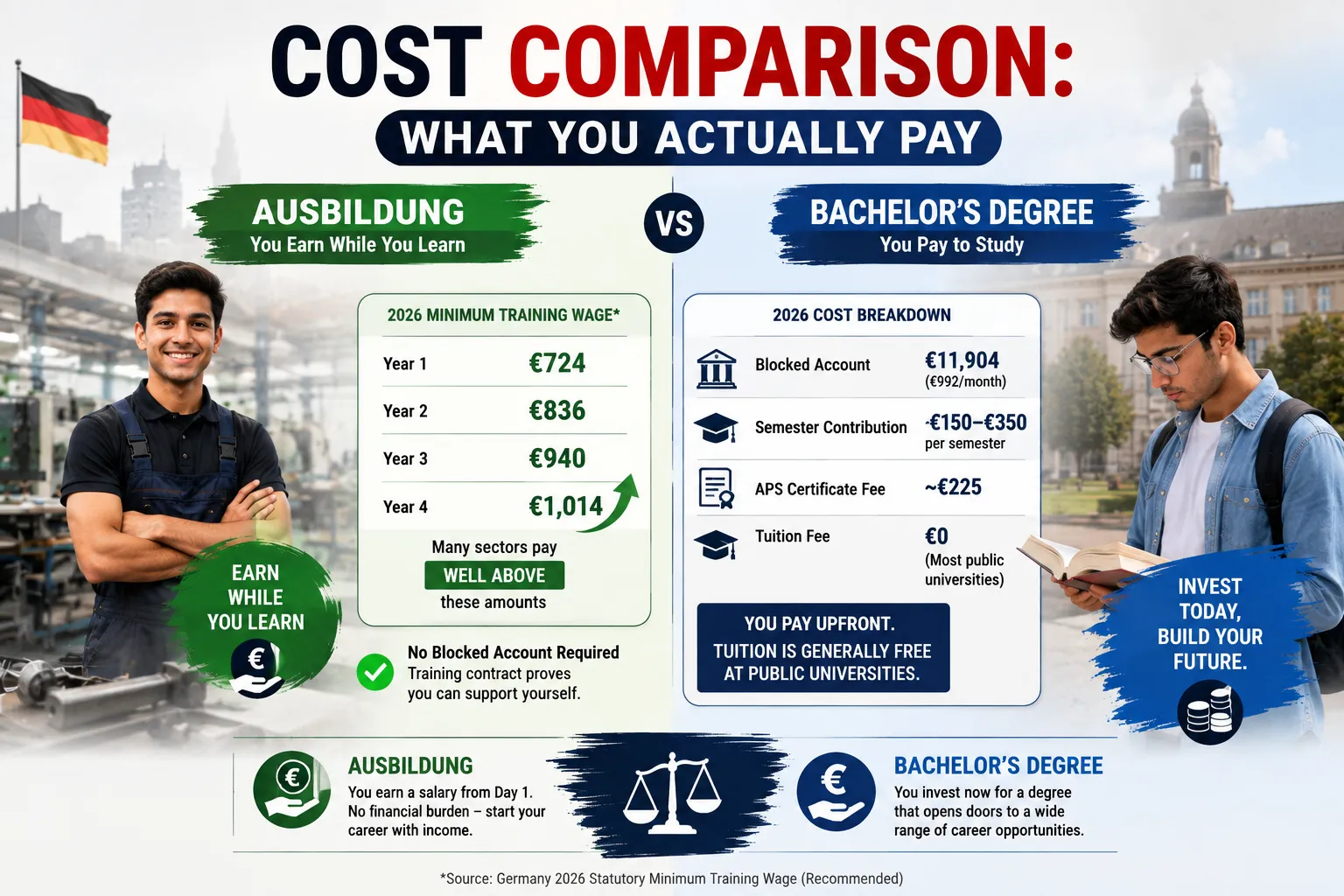
A Bachelor’s degree flips that arrangement. You need a blocked account holding €11,904 for 2026, released at roughly €992 a month, plus a modest semester contribution. On top of that, add an APS certificate fee of roughly €225. Tuition itself stays free at most public universities, which is genuinely rare worldwide.
Language Requirement Compared
Ausbildung generally asks for B1 German, with B2 preferred by many employers for stronger placements. Bachelor’s programs split by teaching language. German-taught programs typically expect C1 German, proven through TestDaF or DSH. English-taught programs instead ask for IELTS 6.5+ or TOEFL 90+, alongside basic German for daily life.
In short, Ausbildung asks for less German upfront, while a Bachelor’s degree asks for either much stronger German or strong English.
Visa Route Compared
Ausbildung uses the vocational training visa under Section 16a of the Residence Act. A Bachelor’s degree uses the separate German student visa, tied to your university admission letter.
Both eventually lead toward long-term residence. That said, the paperwork, processing time, and required proof of funds differ meaningfully between the two.
Ausbildung vs Bachelors Germany: Career Outcomes
Ausbildung gets you working fast, in a specific, licensed trade. That’s ideal if you already know the field you want — nursing, IT systems, hospitality management, or similar. Progression usually happens through experience, and sometimes through a Meister qualification later.
A Bachelor’s degree opens a wider door. It works well if you want flexibility across roles, plan to pursue a Master’s later, or aim for research and management-track careers. The trade-off is a longer runway before your first real paycheck.
Permanent Residency Timeline Compared
Both routes can lead to permanent residency, but the clock starts differently. Ausbildung graduates typically qualify for a settlement permit within a few years of continuous, qualifying employment after training. Bachelor’s graduates get an 18-month post-study job-seeker visa, then start their own residency clock once they find qualifying work.
In practice, timelines end up fairly similar for most applicants. The real difference is what happens before you start earning a full salary, not after.
Which Path Fits You? A Quick Decision Guide
- Choose Ausbildung if you want to start earning quickly, already know your trade, and prefer hands-on learning.
- Choose a Bachelor’s degree if you want broader career flexibility, plan further study, and don’t mind a longer, unpaid runway.
- Either way, start your German early — that’s the one variable that speeds up both routes equally.
Common Mistakes When Choosing Between Ausbildung and a Bachelor’s
- Picking a Bachelor’s degree purely for prestige, without checking the blocked-account math first
- Assuming Ausbildung is a “lesser” option — Germany treats it as a fully licensed career path
- Starting German lessons only after the visa decision, instead of before
- Skipping the APS certificate timeline for Bachelor’s applicants and missing an intake
- Not checking whether a specific trade needs B1 or B2 before committing
FAQs on Ausbildung vs Bachelors Germany
Is Ausbildung easier to get into than a Bachelor’s degree?
Generally, yes. Ausbildung accepts a Class 10 or 12 leaving certificate, while a Bachelor’s degree needs stronger grades, an APS certificate, and sometimes a foundation year.
Which route is cheaper?
Ausbildung pays you a wage from day one. A Bachelor’s degree needs a blocked account of €11,904 for 2026, even though tuition itself is largely free.
Can I switch from Ausbildung to a Bachelor’s degree later, or the other way round?
Yes, both directions are possible. Many Ausbildung graduates later study part-time, and some Bachelor’s students switch into vocational training if the academic route isn’t the right fit.
Do both routes lead to permanent residency?
Yes. Timelines vary by individual case, but both routes offer a realistic path toward long-term residence once you’re working in Germany.
Final Thoughts
Ausbildung vs Bachelors Germany isn’t really a question of which path is “better.” It’s a question of which path fits your timeline, your finances, and your career goals right now. If you want to start earning immediately, Ausbildung wins. If you want broader long-term flexibility and don’t mind the upfront cost, a Bachelor’s degree wins.
Either way, your German level is the one thing you control early. Start there.
If you’re weighing both options, explore Germanacharya’s B1/B2 German courses — the same language foundation supports both routes. You can also check our Nursing and Physiotherapy pages for real Ausbildung examples. Or book a free 1:1 consultation to map your specific path, or browse more guides on our blog.
For official information, see DAAD’s study in Germany portal for the Bachelor’s route, the Federal Employment Agency’s vocational training guide for Ausbildung, and APS India for certificate requirements.

I’ve learned so much from this blog and have implemented many of the tips and advice into my daily routine Thank you for sharing your knowledge!
Your words have the power to change lives and I am grateful for the positive impact you have had on mine Thank you
Nội dung hay và thực tế. Letco là đơn vị du học Hàn Quốc giàu kinh nghiệm, đồng hành cùng học viên từ A-Z. Ghé letco.vn để được tư vấn miễn phí.
[462531]supplies professional anti-violence equipments and solutions for the whole world with strong and perfect production capacity. anti-violence.org
[1376]baji99 Official Login | অনলাইন ক্যাসিনো বোনাস ও অ্যাপ ডাউনলোড,baji99-এ যোগ দিয়ে সেরা অনলাইন ক্যাসিনো বোনাস বুঝে নিন। বিকাশ দিয়ে টাকা জমা এবং সহজ স্লট গেম খেলার অভিজ্ঞতা পেতে আজই আমাদের সাথে যুক্ত হন। visit: baji99
[7656]bosdeal88: Login Resmi Link Alternatif Slot Gacor Terpercaya,bosdeal88 menyediakan akses judi casino online terpercaya dengan pilihan slot gacor hari ini. Nikmati kemudahan deposit pulsa tanpa potongan. Daftar sekarang juga! visit: bosdeal88
Everything about this site is professional and user friendly. The games are fair and the rewards are real. Check out jilibet178casinologin
Been spending a lot of time here lately and the rewards are actually legit. It is a great place to unwind and have some fun. Love everything about inzioplay.
I hit a decent jackpot here last week and the money hit my account almost instantly. This is where the real action is. Visit ph777richjili
I love how easy it is to navigate through the different categories. It feels professional and secure. I will be sticking with idbatavia1 for a long time.
If you are looking for a platform that actually pays out on time then this is it. Everything is transparent and fair. Big wins at br333win!