
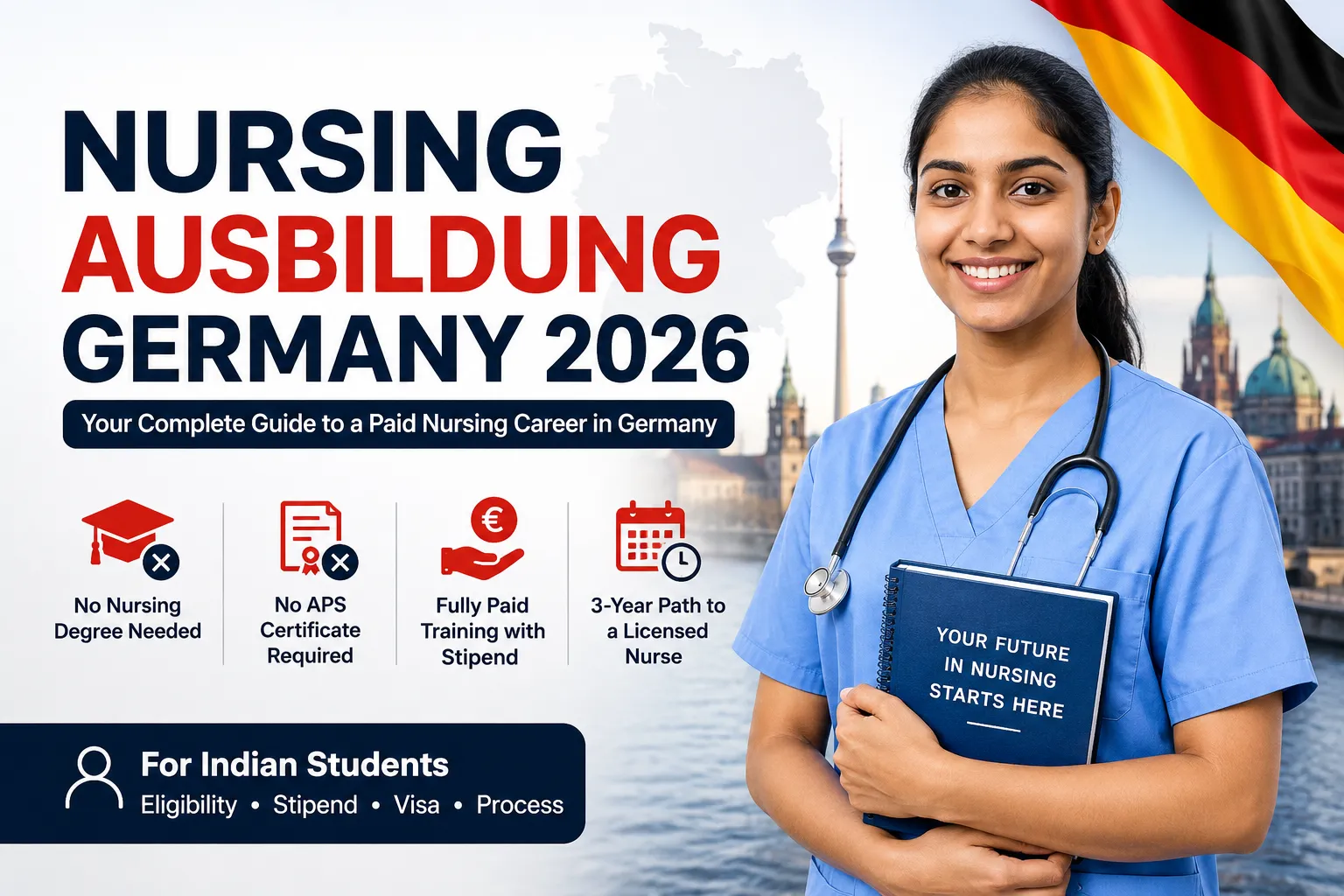
Nursing Ausbildung Germany 2026:
Nursing Ausbildung Germany 2026: Paid Training Route Even Without a Nursing Degree
Nursing Ausbildung Germany 2026** is the training route most Indian students overlook. It’s a fully paid, three-year vocational program that lets you train as a licensed nurse without needing a prior nursing degree or a BSc Nursing background. Unlike Germany’s academic nursing pathway, this route doesn’t require academic recognition or an APS certificate. Instead, applicants need a school-leaving certificate, a genuine interest in patient care, and German language skills at the B1/B2 level. This guide covers eligibility, stipend, visa requirements, and the complete application process for Indian applicants.
What Is Nursing Ausbildung Germany 2026?
Ausbildung is Germany’s dual vocational training system. Trainees split their time between a nursing school and real hospital wards. Placements also cover care homes and outpatient nursing services. The nursing version — officially “Pflegefachfrau/Pflegefachmann” — runs full-time for three years and ends with a state examination.
Once you pass, you hold a professional nursing licence recognised across Germany immediately. Foreign-trained nurses often need a Kenntnisprüfung or an adaptation period before Germany recognises their qualification. Graduates of this route skip that entire process, because they trained inside the German system from day one.
Why You Don’t Need a Nursing Degree for This Route
This is the detail most agents get wrong. Nursing Ausbildung Germany 2026 works as an entry-level pathway, not a bridge for already-qualified nurses. Entry requires only a secondary school leaving certificate — roughly Indian Class 10 or Class 12. You don’t need a nursing diploma or degree to start.
Many applicants worry about the APS certificate that complicates German university admissions. You can relax: this route doesn’t require it. APS only applies to the academic Bachelor’s route (Pflegestudiengang), not hospital-based Ausbildung applications. If a counsellor told you otherwise, look for a new one.
Eligibility for Indian Applicants
- Secondary school leaving certificate (Class 10 minimum; many hospitals prefer Class 12)
- German language proficiency at B1, with B2 giving you a noticeably wider pool of training hospitals
- Basic medical fitness, including a Hepatitis B vaccination certificate
- No strict legal upper age limit, though most hospitals favour candidates under 30–35. Hospitals still regularly accept older applicants who show strong motivation
German Language Requirement: B1/B2, Not A1
If you’ve researched Germany’s spouse visa, you already know it asks for only A1 German. Nursing Ausbildung Germany 2026 sits in a different league entirely. Trainees communicate directly with patients from day one. They also document care in German from day one. Because of that, most nursing schools require at least B1. A growing number of hospitals now prefer B2 for stronger interview performance and a wider choice of placements.
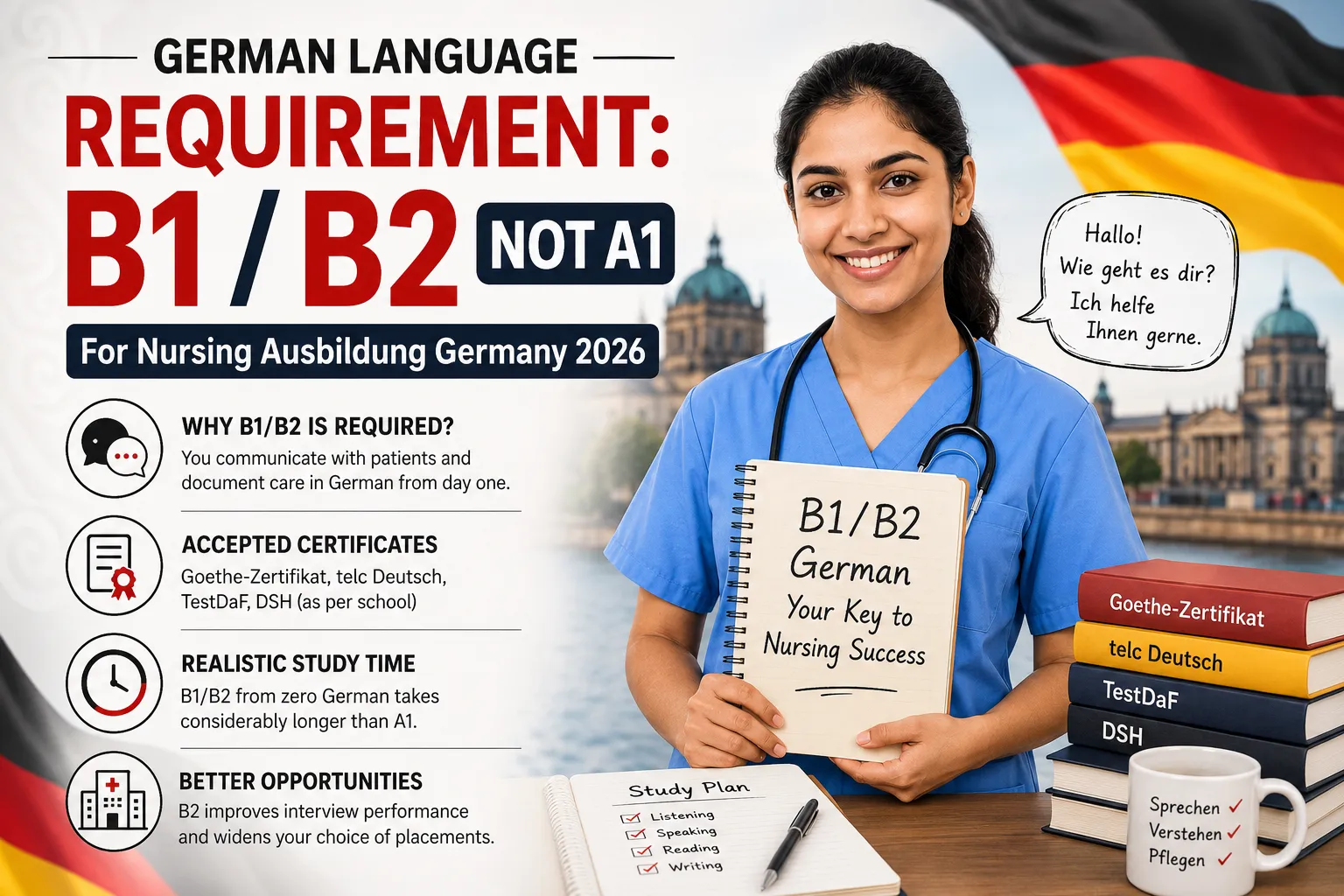
Accepted certificates include the Goethe-Zertifikat, telc Deutsch, TestDaF, and DSH, depending on the specific school’s requirement. Budget realistic study time. Reaching a confident B1/B2 from zero German typically takes considerably longer than the A1 level required for other visa categories.
Nursing Ausbildung Germany 2026 Stipend: What You’re Actually Paid
This is what makes the route financially attractive. Compared with most other international nursing pathways, Germany pays you to train, rather than the other way around. The Federal Employment Agency publishes official 2025 collective bargaining figures (TVAöD) for this. Gross monthly training pay generally runs as follows:
- Year 1: approximately €1,341
- Year 2: approximately €1,402
- Year 3: approximately €1,503
These are gross figures before tax and social security deductions. Individual hospitals can pay slightly above or below scale. The training income counts as a genuine salary, not a stipend on paper. Because of that, many applicants with a signed training contract skip the blocked account (Sperrkonto) requirement entirely. The training income itself usually covers that proof of means.
Visa Route: Section 16a Vocational Training Visa
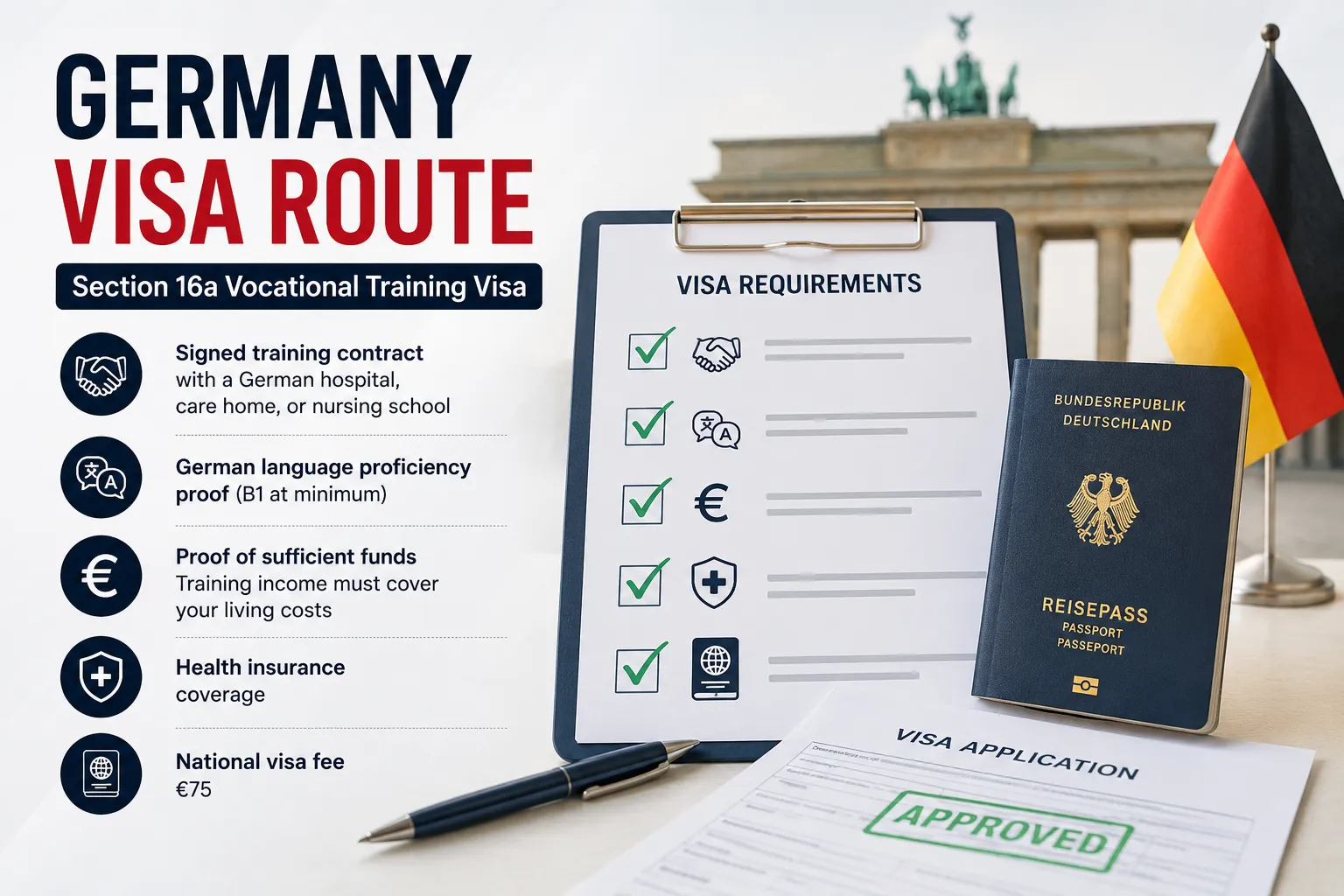
Non-EU applicants, including Indians, need a residence title before starting. The relevant category is the visa for vocational training under Section 16a of the German Residence Act. In broad terms, you will need:
- A signed training contract with a German hospital, care home, or nursing school
- Proof of German language proficiency (B1 at minimum)
- Proof that the training income covers your living costs, typically enough once you have a signed contract
- Health insurance coverage
- The current national visa fee, which stands at €75
If you haven’t secured a training place yet, a separate visa lets you search for one inside Germany. You can stay for up to nine months on this visa. That’s useful if you want to interview with hospitals in person before committing.
Documents You’ll Need to Prepare
- Secondary school leaving certificate, properly authenticated
- German language certificate (B1 or B2, depending on the employer)
- Signed training contract or offer letter from the hospital/nursing school
- Curriculum Vitae in the German “Lebenslauf” (Europass) format
- Motivation letter explaining your interest in nursing and Germany specifically
- Health clearance, including Hepatitis B vaccination proof
- Passport and visa application form
For Indian applicants, certificate authentication runs through four steps. These are notarisation, state-level HRD verification, MEA apostille, and a certified sworn translation into German. Kerala HRD is a common example for candidates from that state. Start this chain early — it is consistently the slowest part of the whole file, not the language exam.
Step-by-Step Application Process
- Reach B1/B2 German through structured, exam-focused coursework rather than casual self-study.
- Apply directly to German hospitals, care homes, or nursing schools offering Ausbildung places. Applications go straight to the employer, not through a central university portal.
- Attend interviews, which typically assess motivation, communication, and basic German conversation ability.
- Sign your training contract once selected.
- Authenticate and translate your documents, starting the HRD/apostille chain immediately.
- Apply for your Section 16a visa at the German Mission responsible for your state.
- Relocate and begin training, combining nursing school with practical hospital rotations.
Alternative Route: Pflegehilfe (Nursing Assistant) Bridge
Not quite ready for the full three-year program? Germany also runs a shorter nursing assistant track called Pflegehilfe, typically one to two years. It has its own visa regulation for assistants in nursing. Use it as a stepping stone into the full Pflegefachfrau/Pflegefachmann qualification once your language level catches up.
After Ausbildung: Career and Residency Path
Once you qualify, you hold a fully recognised German nursing licence. You can then move onto a skilled-worker residence permit tied to your profession. Germany has a well-documented, long-running shortage of qualified nursing staff, so employment prospects for graduates stay consistently strong. Continuous qualifying employment can put you on a realistic path toward a settlement permit (Niederlassungserlaubnis) within a few years of finishing training.
One planning note: bringing a spouse to Germany on a trainee’s income is usually not possible. Most applicants wait until they move to a full work permit after qualifying, so plan family timelines accordingly.
Common Mistakes Indian Applicants Make
- Assuming an APS certificate is required, and wasting months on it unnecessarily
- Underestimating the German level needed — arriving at A1/A2 when B1/B2 is expected
- Starting document authentication late, once the language exam is already cleared
- Applying to only one or two hospitals instead of building a wider pipeline
- Ignoring the Pflegehilfe bridge option when their German isn’t yet at B1
FAQs on Nursing Ausbildung Germany 2026
Do I need a nursing degree to apply?
No. Nursing Ausbildung Germany 2026 is an entry-level vocational program open to secondary school leavers. You don’t need a prior nursing qualification.
Is an APS certificate mandatory?
No, not for the hospital-based Ausbildung route. Only the academic Bachelor’s degree in nursing (Pflegestudiengang) requires APS.
What German level do I actually need?
B1 is the general minimum for the vocational training visa. Many hospitals and nursing schools now prefer B2 for stronger placements and better interview outcomes.
Will I be paid during training?
Yes. Official 2025 figures put gross monthly pay at roughly €1,341 in year one, rising to about €1,503 by year three.
Can I bring my spouse while I’m training?
Generally not on a trainee income — most applicants wait until they move to a work permit after completing the Ausbildung.
Final Thoughts
Nursing Ausbildung Germany 2026 remains one of the few genuinely paid international training routes into a stable, in-demand profession. The absence of an academic-degree requirement makes it accessible to a much wider group of Indian applicants than most people assume. The real bottleneck isn’t your educational background. It’s reaching a confident B1/B2 in German early enough to apply with a strong file.
If you’re preparing for this route, explore Germanacharya’s B1/B2 German courses. They’re built around live, interactive sessions rather than passive grammar drills. You can also check our dedicated Nursing careers page for programme-specific guidance. Or book a free 1:1 consultation, or browse more guides on our blog.
For official government information, refer to the Make it in Germany nursing professional profile and the special regulation for nursing assistants.

unlocker.ai – The Ultimate AI Tool for Bypassing Restrictions and Unlocking Content Seamlessly!
### Persönliches Profil
Mein Name ist Ritika, ich bin 24 Jahre alt und komme aus Indien. Ich wurde in Neu-Delhi geboren. Im Jahr 2018 habe ich mein Abitur mit dem Schwerpunkt Kunst abgeschlossen. Ich besitze das Goethe-Zertifikat B1 und habe bereits drei Module der B2-Prüfung beim Goethe-Institut erfolgreich bestanden. Derzeit studiere ich an der Universität Delhi. Außerdem habe ich ein Jahr Berufserfahrung als Assistentin in einer Mutter-Kind-Klinik gesammelt und dabei erste praktische Erfahrungen im medizinischen und pflegerischen Bereich erworben. In meiner Freizeit lese ich gerne und höre Musik. Ich interessiere mich sehr für den Pflegeberuf und möchte in Deutschland eine Ausbildung zur Pflegefachfrau absolvieren.
My name is Ritika; I am 24 years old and from India. I was born in New Delhi. In 2018, I completed my secondary education with a focus on art. I hold the Goethe-Zertifikat B1 and have already successfully passed three modules of the B2 exam at the Goethe-Institut. I am currently studying at the University of Delhi. Additionally, I have gained one year of professional experience as an assistant at a mother-child clinic, where I acquired initial practical experience in the medical and nursing fields. In my free time, I enjoy reading and listening to music. I am very interested in the nursing profession and would like to complete a nursing apprenticeship in Germany.
[7108]qq1221 Official Login | Best Online Slots Malaysia Fast Payout,qq1221 offers a seamless app download for players seeking the best online slots in Malaysia. Enjoy fast payouts and learn how to play baccarat. Join us today! visit: qq1221
[9523]salju777 | Login Resmi Link Alternatif Slot Gacor Hari Ini,salju777 menyediakan akses login resmi dan link alternatif terbaru. Nikmati kemudahan judi online deposit dana dan panduan cara main baccarat. Daftar sekarang! visit: salju777
The slots here are so addictive and the themes are really cool. I had a blast winning a few big pots last night. Check out dremjilislot today.
Great vibe and the games are always updated. I appreciate the transparency with the odds. bd8e884 is a winner in my book.
[1365]top555 Official Login | সেরা অনলাইন স্লট ও দ্রুত বিকাশ পেমেন্ট,top555 এর অফিসিয়াল লগইন করে সেরা অনলাইন স্লট গেমগুলো উপভোগ করুন। দ্রুত বিকাশ পেমেন্ট এবং সহজ নিয়মে আজই অ্যাপটি ডাউনলোড করে খেলা শুরু করুন। visit: top555
Super easy to navigate and the registration process took me less than a minute. It’s refreshing to find a site like zuply that doesn’t overcomplicate things for the users.
The jackpot hits here are actually decent. I love how fast the page loads even on mobile data. Definitely my go to spot now at mahesa189slot.
Everything is so professional here. I feel secure with my transactions and the variety of options is just great. neu88online is the real deal.