
German Cases for Beginners: Nominativ to Genitiv
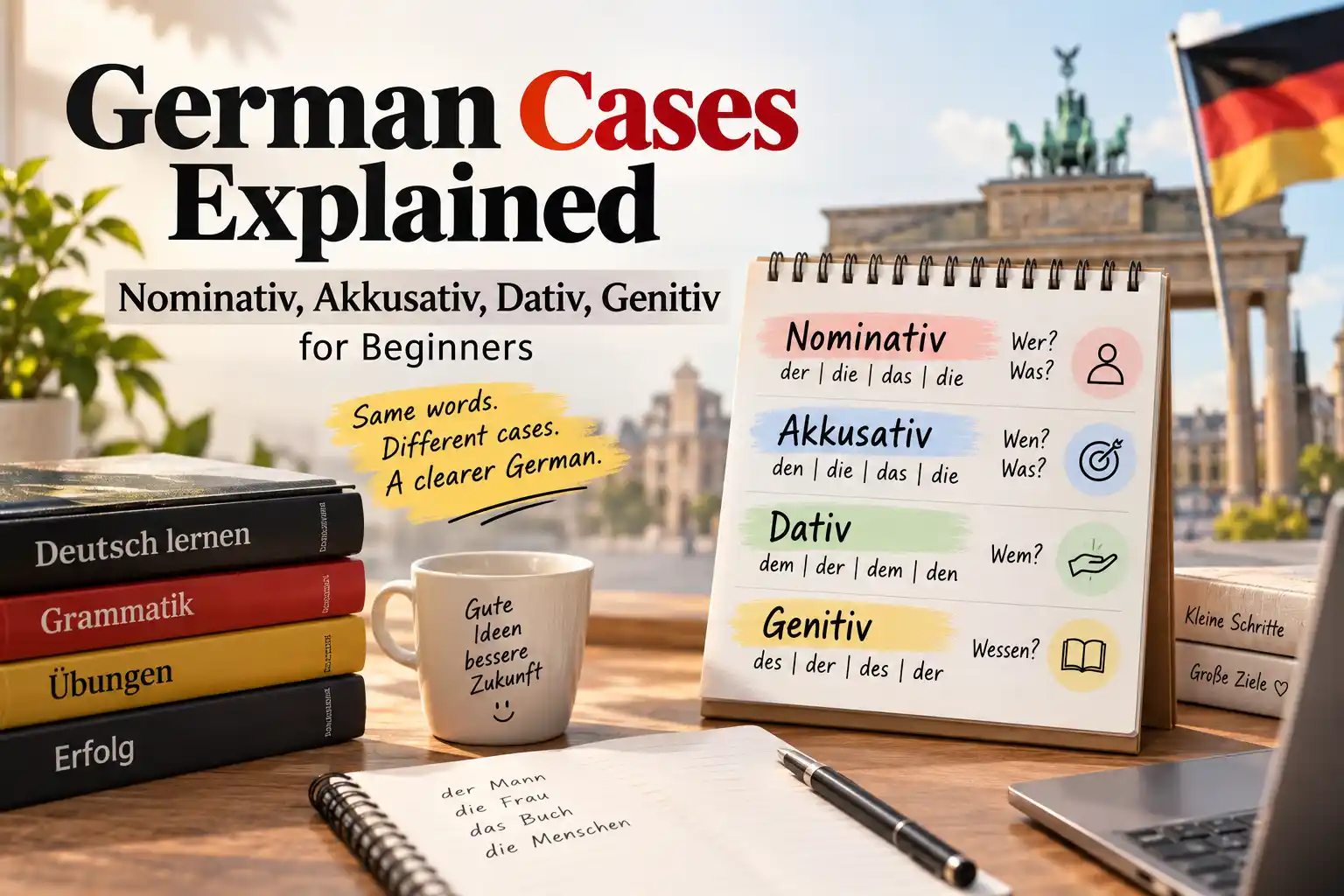
German Cases Explained: Nominativ, Akkusativ, Dativ, Genitiv for Beginners
German cases for beginners usually feel like the moment German stops feeling like English with different words. That feeling is normal, and it passes faster than you’d expect. This guide breaks down all four cases — Nominativ, Akkusativ, Dativ, and Genitiv — with the tables, examples, and quick tricks that actually make them click.
What Is a “Case” in German, Really?
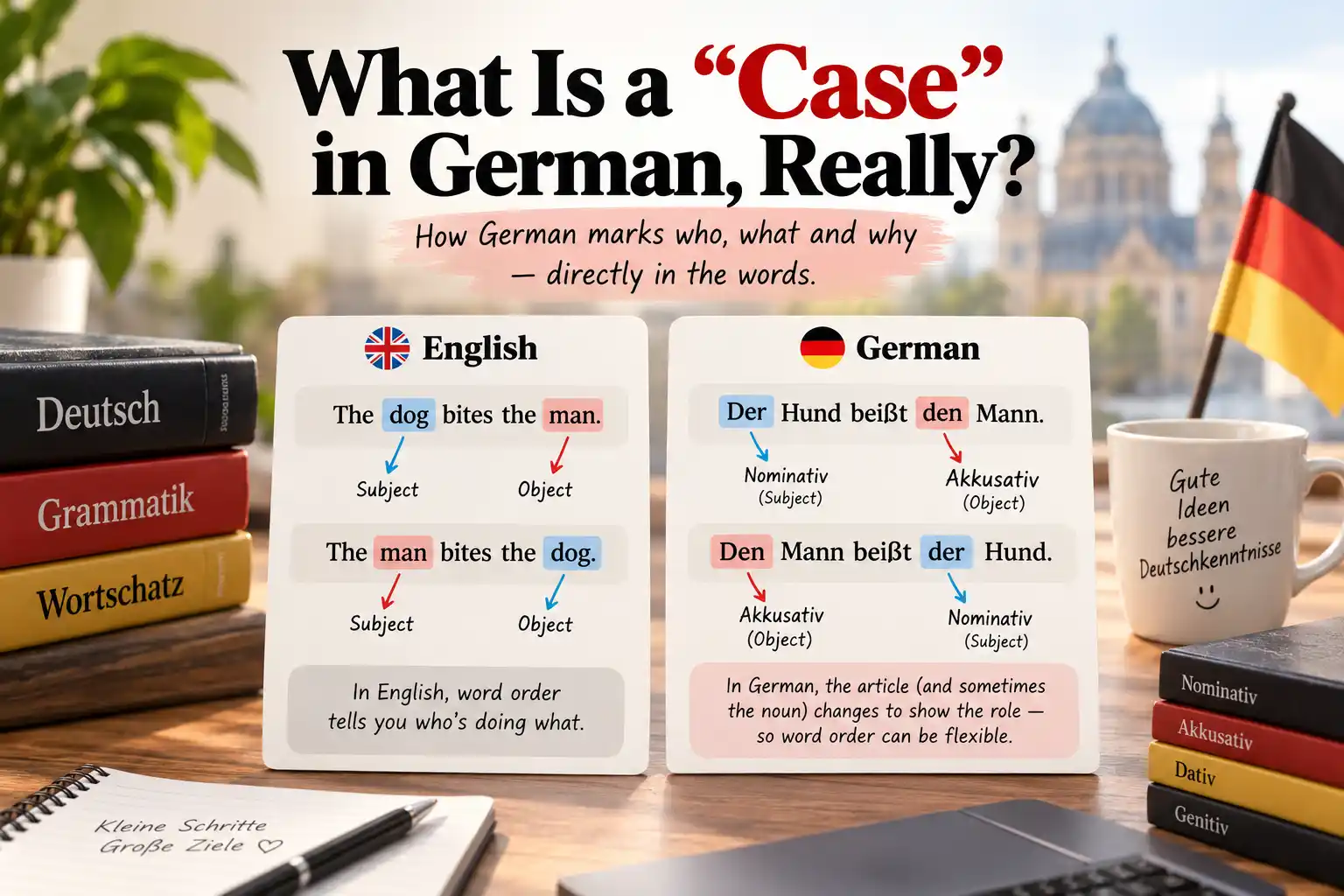
In English, word order tells you who’s doing what. “The dog bites the man” and “the man bites the dog” mean opposite things, purely because of order. German works differently. It marks roles directly on the article and, sometimes, the noun itself.
That’s what a case actually is: a signal, built into the word, telling you whether something is the subject, the object, or something else entirely. Once that clicks, German word order actually becomes more flexible than English, not less.
Nominativ: The Subject Case
Nominativ marks the subject — whoever or whatever is doing the action. It answers the question “Wer?” (who) or “Was?” (what).
Der Mann isst. — The man eats. Here, “der Mann” is Nominativ, because he’s the one doing the eating. Every German sentence has exactly one Nominativ, and it’s usually the easiest case to spot.
Akkusativ: The Direct Object Case
Akkusativ marks the direct object — the thing directly receiving the action. It answers “Wen?” (whom) or “Was?” (what), but this time asking about the object, not the subject.
Ich sehe den Mann. — I see the man. Notice “der Mann” became “den Mann.” That single letter change is the entire point of case: the article shifted to signal a new grammatical role.
Dativ: The Indirect Object Case
Dativ marks the indirect object, usually the person something is done for or given to. It answers “Wem?” (to whom).
Ich gebe dem Mann das Buch. — I give the man the book. Here, “das Buch” is what’s being given (Akkusativ), while “dem Mann” is who’s receiving it (Dativ). Many German sentences use both cases side by side, exactly like this one.
Genitiv: The Possession Case
Genitiv shows possession or a close relationship between two nouns. It answers “Wessen?” (whose).
Das Buch des Mannes. — The book of the man. In everyday spoken German, people increasingly replace Genitiv with a Dativ construction instead, saying something closer to “dem Mann sein Buch.” Genitiv still matters for writing and formal speech, though, so don’t skip it entirely.
German Cases for Beginners: The Article Table You’ll Actually Use
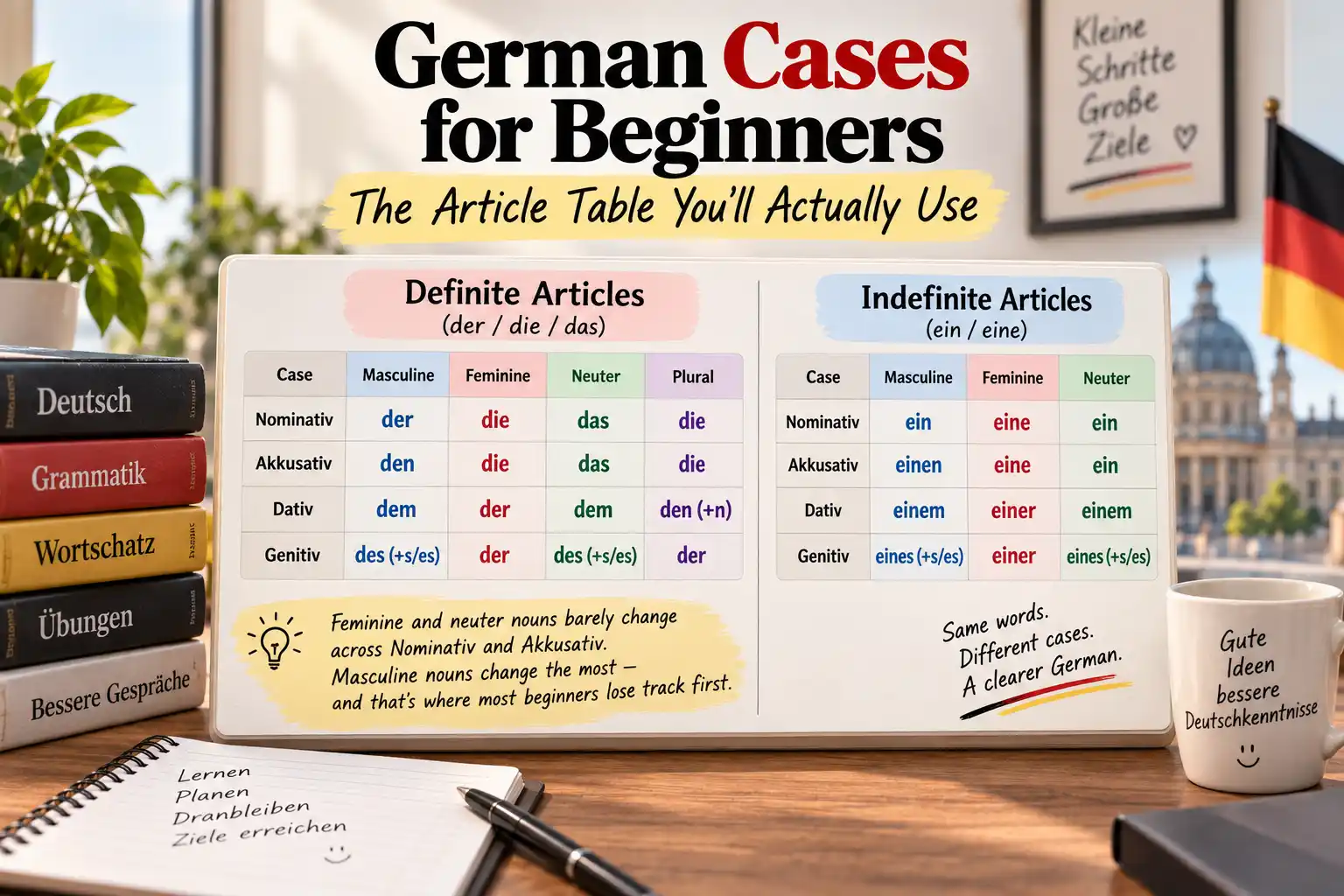
This table is worth bookmarking. It’s the single most useful reference for all four cases, using the definite article (der/die/das):
| Case | Masculine | Feminine | Neuter | Plural |
|---|---|---|---|---|
| Nominativ | der | die | das | die |
| Akkusativ | den | die | das | die |
| Dativ | dem | der | dem | den (+n) |
| Genitiv | des (+s/es) | der | des (+s/es) | der |
The indefinite article (ein/eine) follows a similar pattern, with one key difference — it has no plural form:
| Case | Masculine | Feminine | Neuter |
|---|---|---|---|
| Nominativ | ein | eine | ein |
| Akkusativ | einen | eine | ein |
| Dativ | einem | einer | einem |
| Genitiv | eines (+s/es) | einer | eines (+s/es) |
Notice something important. Feminine and neuter nouns barely change across Nominativ and Akkusativ. Masculine nouns change the most, and that’s exactly where most beginners lose track first.
The W-Question Trick to Identify Any Case
When you’re unsure which case a noun needs, ask the matching W-question about it. Wer or was points to Nominativ. Wen or was points to Akkusativ. Wem points to Dativ. Wessen points to Genitiv.
Take the sentence “Ich schenke meiner Schwester ein Buch.” Ask “Wem schenke ich das Buch?” — to my sister — and you’ve confirmed Dativ. This trick works even in long, complicated sentences once you get used to asking it out loud.
Prepositions That Force a Case
Certain German prepositions always demand a specific case, regardless of context. Learning these as fixed groups saves enormous guesswork later.
Akkusativ prepositions include durch, für, gegen, ohne, and um. Dativ prepositions include aus, bei, mit, nach, seit, von, and zu. Genitiv prepositions include trotz, während, wegen, and statt, though several of these increasingly appear with Dativ in casual speech too.
Two-Way Prepositions: Wechselpräpositionen
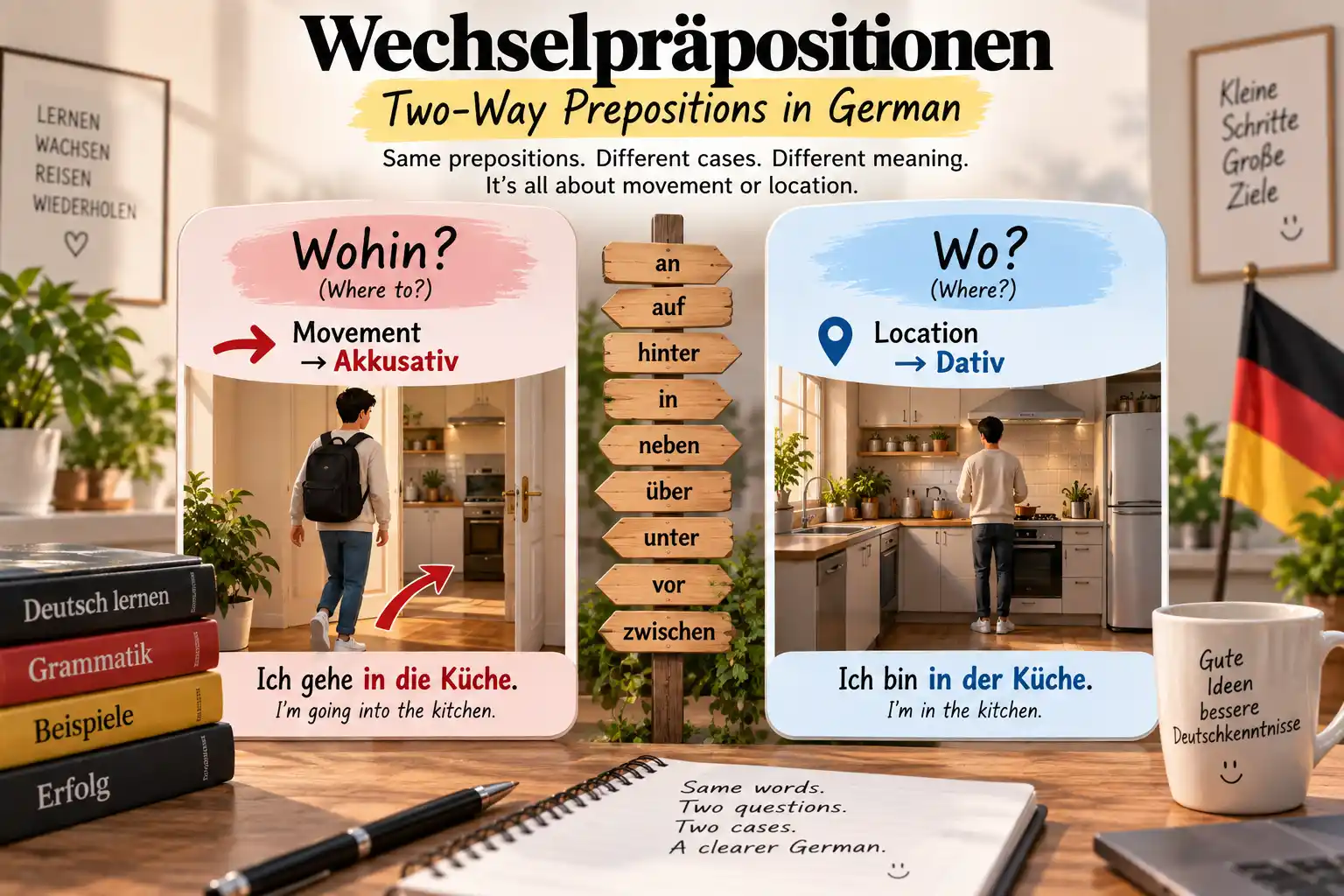
A small group of prepositions — an, auf, hinter, in, neben, über, unter, vor, and zwischen — can take either Akkusativ or Dativ, depending entirely on meaning.
Ask “wohin?” (where to?) for movement, and use Akkusativ: Ich gehe in die Küche. Ask “wo?” (where?) for a fixed location, and use Dativ: Ich bin in der Küche. This single distinction resolves most of the confusion around these nine prepositions.
Dative Verbs That Trip Up Beginners
Some German verbs simply take a Dativ object by rule, even where English logic suggests otherwise. Common ones include helfen (to help), danken (to thank), gefallen (to please), and gehören (to belong to).
Ich helfe dir. — I help you. English treats “you” as a direct object here, but German insists on Dativ for helfen specifically. These verbs don’t follow a clean pattern, so they’re generally worth memorising individually as you meet them.
German Cases for Beginners: A Simple Practice Method
Pick five short sentences you already know well, and rebuild each one across all four cases by hand. Say each sentence out loud, and ask yourself the matching W-question as you go. Repetition with real sentences beats memorising tables in isolation, every time.
Common Mistakes Learners Make
- Memorising the tables without practising real sentences alongside them
- Assuming word order carries meaning the way it does in English
- Treating dative verbs like helfen as regular accusative verbs, based on English logic
- Ignoring two-way prepositions until they cause a real mistake in conversation
- Skipping Genitiv entirely, then struggling with formal writing and reading later
FAQs on German Cases for Beginners
Why does German need four cases at all?
Cases let German mark grammatical roles directly on words, which frees up word order for emphasis and style instead of fixed subject-verb-object structure.
Which case should I learn first?
Nominativ and Akkusativ first, since they cover most basic sentences. Dativ follows naturally once you’re comfortable with those two, and Genitiv can come later.
Is Genitiv actually still used in Germany?
Yes, especially in writing and formal speech, though everyday spoken German often replaces it with a Dativ construction instead.
What’s the fastest way to memorise the case tables?
Practice with real sentences you build yourself, using the W-question trick, rather than trying to memorise the tables as abstract grids.
Final Thoughts
German cases for beginners feel overwhelming for about the first month, then start clicking piece by piece after that. Nominativ and Akkusativ come first naturally. Dativ and Genitiv follow with steady practice, not raw memorisation. The W-question trick alone will carry you through most real conversations long before the grammar feels fully automatic.
If you’re working through this stage of German, explore Germanacharya’s structured A1/A2 courses, built around exactly this kind of foundational grammar. Book a free 1:1 consultation if you want a personalised study plan, or browse more guides on our blog.
For a deeper grammatical reference, see Duden’s own explainer on Kasus and the four German cases.

The app interface is super smooth and the login process is a breeze. I really love how fast the games load. Definitely a great choice for anyone looking for a reliable platform. Check out 666jililoginapp
The APK installation was a breeze and the app runs perfectly on my Android phone. Super convenient for playing on the go. Go grab the 55bmwapploginapk now.