
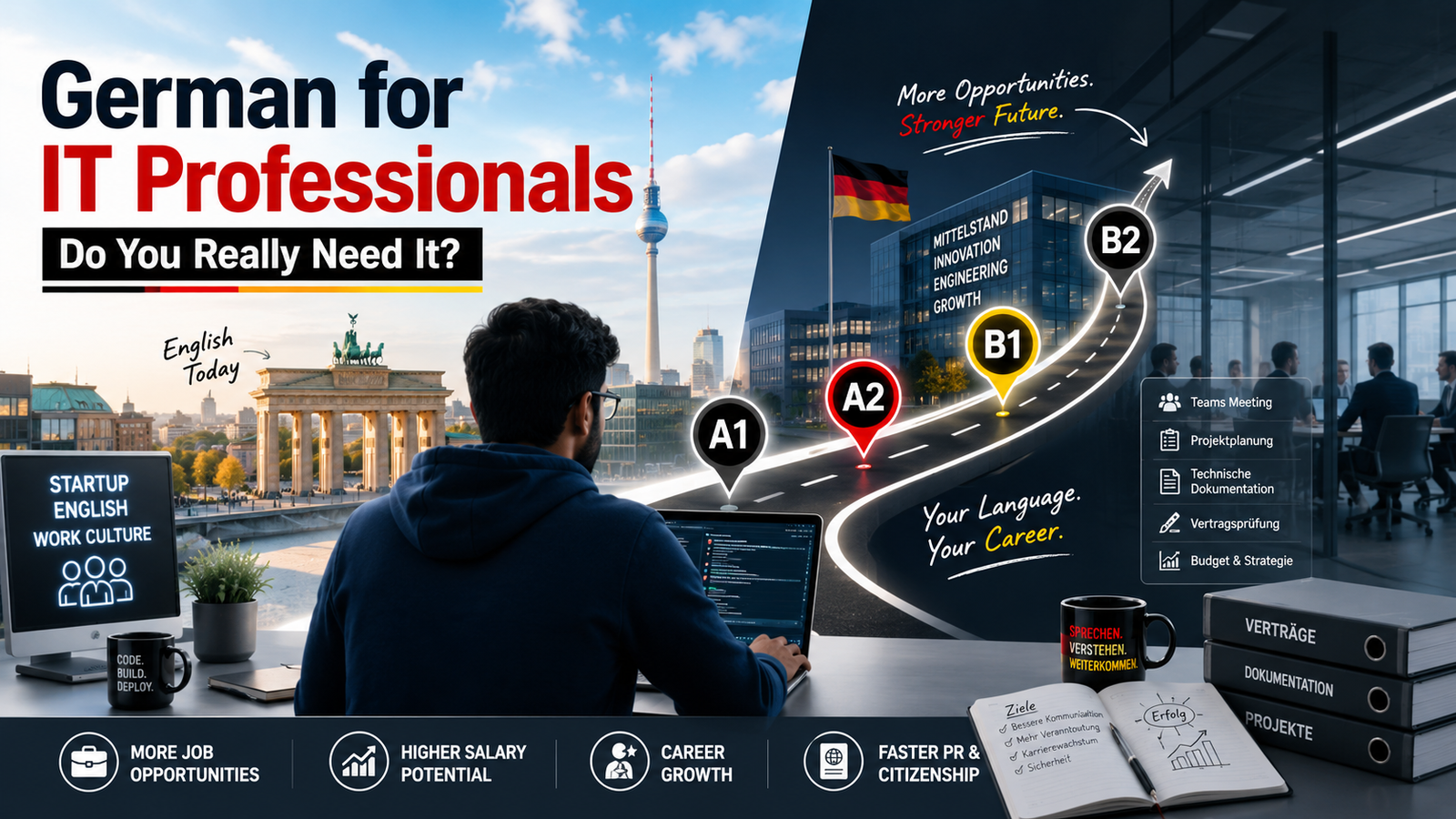
German for IT Professionals: Do You Really Need It?
Berlin’s startup scene runs almost entirely in English. That single fact convinces thousands of Indian developers that German is optional for a tech career in Germany. It is not. German for IT Professionals matters far more than most job listings admit. The gap shows up later than you’d expect, usually around year two or three, right when promotions start getting decided. This guide separates the real exceptions from the long-term reality, so you can plan your German learning around your actual career goals instead of a misleading job posting.
The Short Answer: It Depends on Which Company You Join
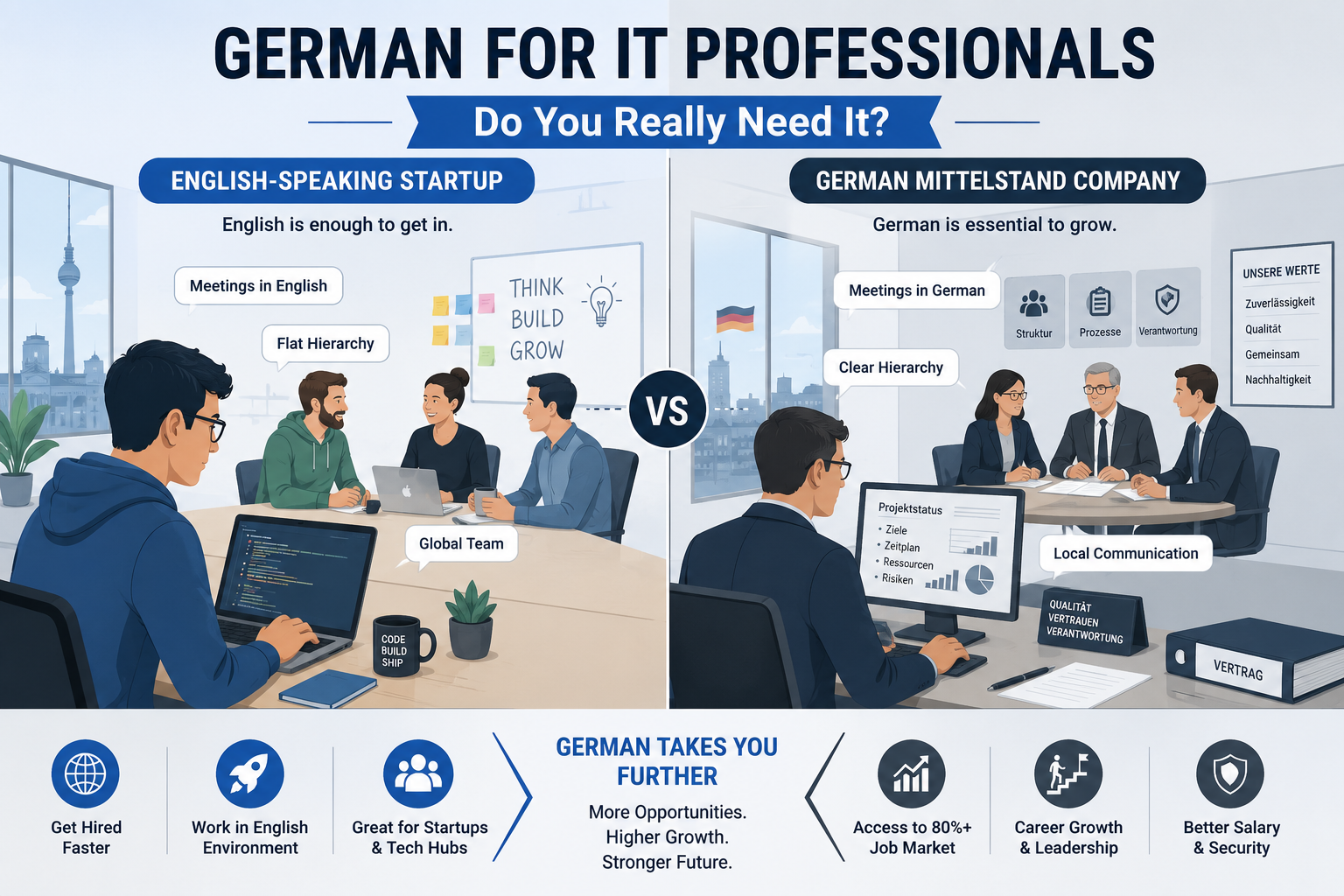
Germany currently has 109,000 unfilled IT positions, according to Bitkom’s 2025 labour market study. That number alone tells you demand is real and the door is genuinely open. But the language requirement splits sharply by company type. Startups and international tech subsidiaries hire in English routinely. Mittelstand companies and large German corporates rarely do, at least not past the entry level.
German for IT Professionals: When English Really Is Enough
Berlin, Munich, and Frankfurt all host a real English-speaking tech scene. Startups build their entire culture around English as the working language. Subsidiaries of American giants, including AWS and Google Cloud teams based in Germany, also operate almost entirely in English. Entry-level and mid-level engineering roles at these companies rarely demand German at the hiring stage. If your goal is simply to land your first German tech job and gain experience, this route works, and it works well.
Where German for IT Professionals Becomes Non-Negotiable
Step outside that English-speaking bubble, and the picture changes fast. Mittelstand firms, the mid-sized industrial and engineering companies that form the backbone of the German economy, conduct internal communication almost entirely in German. HR policies, contracts, and everyday paperwork follow the same pattern. Large corporates like SAP, Siemens, and BMW mirror this too, especially beyond the first year. Roughly 80% of German tech roles outside the startup bubble expect B2-level German or higher. Skip German entirely, and you quietly rule out most of the market.
The Career Ceiling Nobody Warns You About
Here is the part recruiters rarely mention during your first interview. Even inside an English-first company, leadership roles usually still require German. You cannot easily become an engineering manager or team lead at a mostly-German organisation without speaking the language. Company-wide meetings, budget discussions, and cross-department politics tend to shift back into German the moment you move up the ladder. Staying in your English-speaking bubble also limits your mobility. If that specific company or role ever disappears, most of the wider German job market becomes harder to access.
How Much German Do You Actually Need? A1 to B2 Explained
Not every job needs the same level, and knowing the difference saves you months of over-preparing or under-preparing. A1 and A2 cover survival German: groceries, public transport, small talk with neighbours. B1 gets you through daily office chat, reading routine emails, and following most meetings without much strain. B2 is where you start actively contributing in meetings, reading technical documentation, and writing professional emails unassisted. It is the level most Mittelstand employers expect as standard. You can see the full breakdown of what each level unlocks on our German language levels page.
German for IT Professionals and the Points-Based Visas
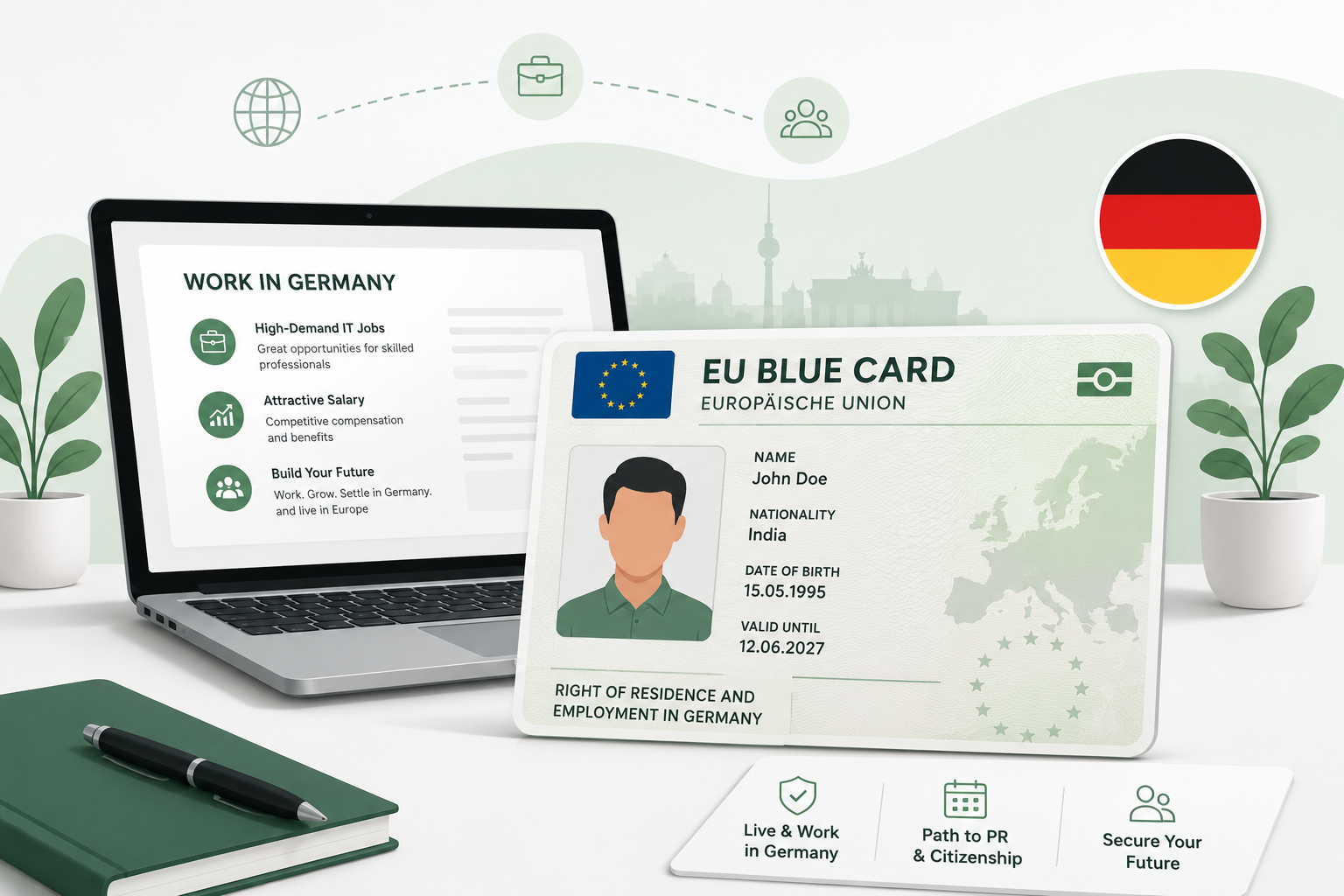
Language does not just affect your day-to-day work. It also affects how you get into the country in the first place. The EU Blue Card sets a lower salary threshold of €45,934.20 for IT, since it counts as an official shortage occupation. German fluency accelerates your permanent residency too. B1 German gets you settlement in 21 months on the Blue Card, while A1 stretches that out to 27 months. Six months is a meaningful head start on citizenship eligibility and long-term stability, and it comes down entirely to language preparation you control.
What IT Recruiters Actually Look For Beyond Code
Even at English-first companies, some German signals genuinely help your candidacy. Recruiters read basic German ability as a sign of long-term commitment to living in the country, not just working remotely from it. Technical German vocabulary also matters more than people expect, since documentation, ticket systems, and internal wikis at many companies mix English and German freely. Showing up with even conversational German often separates you from equally skilled candidates who show up with none.
Does Speaking German Change Your IT Salary?
Money is where this decision shows up most clearly. English-only roles at startups often pay competitively at the entry level, but salary growth tends to plateau faster without German. Mittelstand and large corporate roles usually require B2 German. They frequently offer stronger long-term compensation, better job security, and significantly better pension contributions. Specialists in high-demand areas like IT security or SAP consulting, roles concentrated in German-speaking corporate environments, often earn well above the market average. Choosing the English-only path is not wrong, but it does trade some of that long-term upside for short-term simplicity.
Common Mistakes IT Professionals Make About German
Assuming Berlin represents the whole country is the most common mistake. Munich, Stuttgart, and the wider industrial belt run on a different language reality than Berlin’s startup scene. Assuming an English-language job contract means you will never need German at work is another frequent misjudgment; internal culture rarely matches the hiring language exactly. Underestimating the long-term career ceiling is the costliest mistake of all. It only becomes visible once you are already a few years into your role, right when you are ready for the next step up.
Frequently Asked Questions
Can I get an IT job in Germany without speaking German at all?
Yes, particularly at Berlin startups and subsidiaries of American tech companies. Your options narrow significantly once you look beyond that specific segment of the market.
What German level do most IT companies actually require?
B1 covers daily office communication comfortably. B2 is the level most Mittelstand employers expect for full participation in meetings and technical work.
Does German help with the EU Blue Card for IT professionals?
Yes. B1 German shortens your path to permanent residency to 21 months, compared with 27 months on A1 German alone.
Will I eventually need German even at an English-first company?
Very likely, especially for leadership roles. Company-wide communication and management-level discussions tend to shift into German as you move up.
How long does it take to reach B2 German for a career in IT?
Most learners with consistent study reach B2 in roughly 12 to 18 months, depending on their starting point and weekly study hours.
Conclusion
German for IT Professionals is not a yes-or-no question. It is a timing question. English gets you in the door at plenty of companies, especially in Berlin’s startup scene. That door is wide open right now, with 109,000 unfilled IT roles across the country. But German decides how far you go once you are inside. It also decides how fast your permanent residency comes through, and how many companies you can realistically consider beyond your first job. Start building your German alongside your job search, not after it, and you remove the ceiling before it ever becomes a problem.

[3882]Tarotogel | Login Resmi Link Alternatif Slot Gacor Deposit Pulsa,Tarotogel menyediakan akses login resmi dan link alternatif terbaru. Nikmati kemudahan daftar judi online terpercaya dengan deposit pulsa tanpa potongan. Gabung sekarang! visit: tarotogel
Quick deposits and even quicker withdrawals. That is all I care about in a gaming site. Keep up the good work ppc88login.
Finally found an app that doesn’t lag during big wins. The bonus offers are actually fair and easy to claim. Give pkb9app a try guys, it’s a game changer.
[1078]Velvet লগইন ও অ্যাপ ডাউনলোড | সেরা অনলাইন স্লটস গেম,velvet লগইন করুন এবং সেরা অনলাইন slots গেম উপভোগ করুন। বিকাশ দিয়ে casino ডিপোজিট করে সহজেই casino বোনাস পাওয়ার নিয়ম জেনে নিন। আজই যুক্ত হন। visit: velvet
I was worried about the login process but it was seamless. No lag and everything worked perfectly on my mobile browser. Glad I found arena39login.
Solid platform with a great vibe. I appreciate the transparency and the fair play. If you are searching for a reliable spot, phtayacom is definitely it.