
Goethe vs TELC
Goethe vs TELC: Which German Exam Should You Choose?
Sooner or later, every serious German learner faces the same question. Goethe vs. TELC: Which Exam Should You Book? Both certificates carry international recognition. Both map cleanly onto the CEFR scale from A1 to C2. Universities, employers, and visa offices across German-speaking countries accept both. That overlap makes the decision hard, not easy. The two exams test the same four skills, but they use noticeably different formats. Preparing for the wrong one can waste weeks of study time. This guide breaks down the real differences in structure, cost, difficulty, and recognition, so you can pick with confidence instead of guessing.
What Is the Goethe-Institut Exam?
Germany’s Foreign Office founded the Goethe-Institut in 1951 as the country’s official cultural institute. Today it runs over a hundred branches worldwide. In India, it operates through the Max Mueller Bhavan centres in Delhi, Mumbai, Bangalore, Chennai, Kolkata, and Pune, plus several accredited partner centres.
This institutional weight gives the Goethe-Zertifikat a reputation as the traditional benchmark for German proficiency. From B1 upward, the exam works on a modular system. You can sit each of the four skills — Reading, Listening, Writing, Speaking — as separate tests. Then you combine your passes over time, rather than clearing everything in one sitting. Each module needs a 60% score to pass. Goethe also allocates the writing section plenty of time, since it places heavy emphasis on well-structured, formally correct German.
What Is the TELC Exam?
TELC stands for The European Language Certificates. telc gGmbH develops the exams and operates as a subsidiary of Germany’s Adult Education Association (Deutscher Volkshochschul-Verband). Unlike Goethe, telc doesn’t run its own dedicated centres. Instead, it certifies a wide network of partner institutes and language schools. That’s part of why you can usually find exam dates on shorter notice.
TELC’s format leans practical. It includes a dedicated “Language Elements” section that tests grammar and vocabulary directly — something the Goethe format skips as a standalone section. It also uses compensatory scoring, so a strong result in one skill can offset a weaker one elsewhere. TELC is also the go-to certificate in healthcare. The B1–B2 Pflege and B2–C1 Medizin exams focus specifically on nursing and medical vocabulary, patient communication, and clinical scenarios.
Goethe vs TELC: Exam Format and Structure
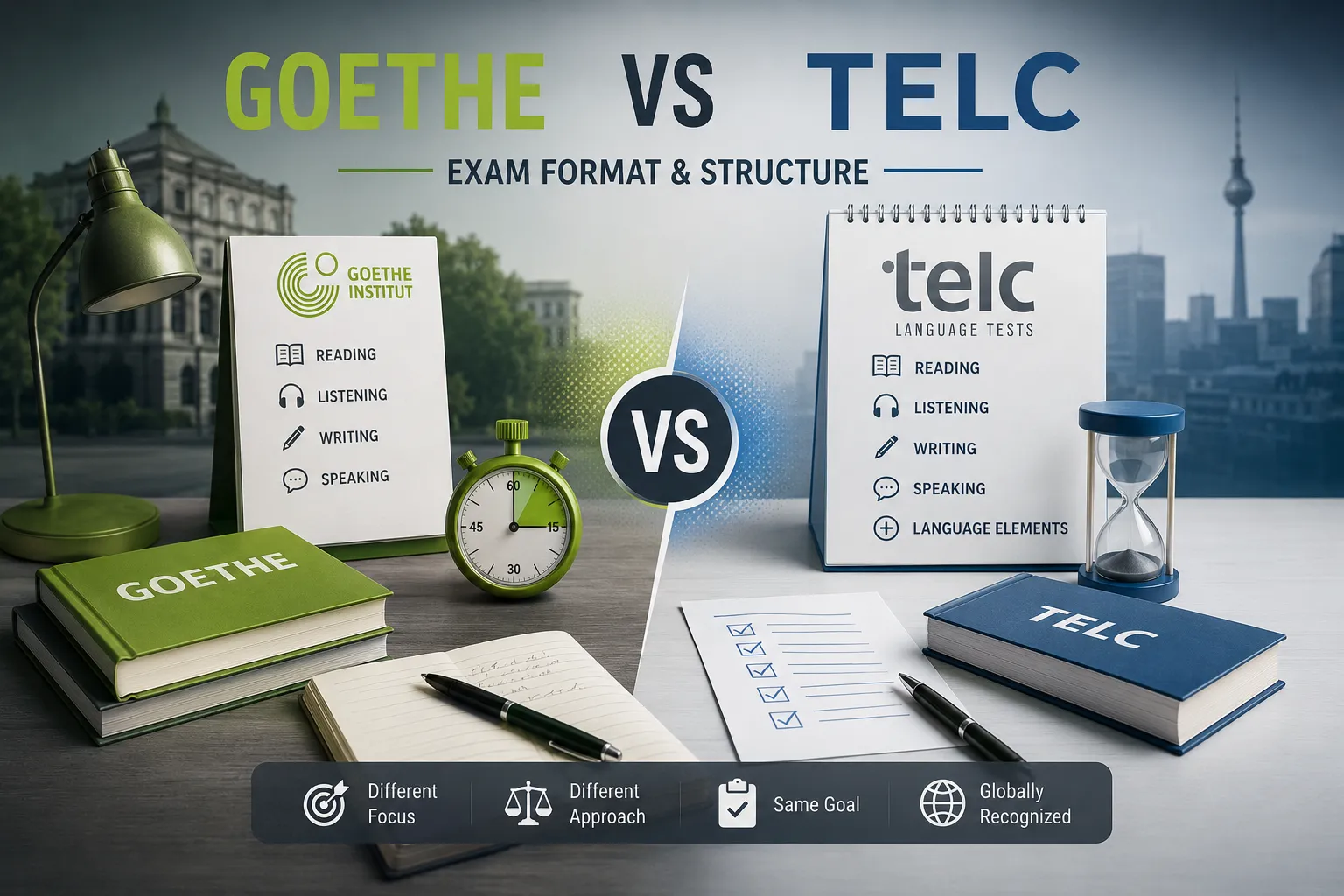
Both exams cover the same four areas — Reading, Listening, Writing, and Speaking — but they weigh them differently.
| Feature | Goethe | TELC |
|---|---|---|
| Grammar/vocabulary section | Not tested separately | Dedicated “Language Elements” section |
| Writing time (B2) | Around 75 minutes | Around 30 minutes |
| Scoring style | Pass/fail per module (60% each) | Compensatory across sections |
| Retake flexibility | Modular — retake only the failed skill | Usually the full exam is retaken |
| Exam centres (India) | Goethe-Institut / Max Mueller Bhavan | Wide network of authorised partner institutes |
If you’re comfortable producing longer, structured written responses under time pressure, the Goethe format plays to that strength. If you’d rather have a mix of predictable grammar questions alongside shorter writing tasks, TELC often feels more approachable.
Goethe vs TELC: Cost and Availability
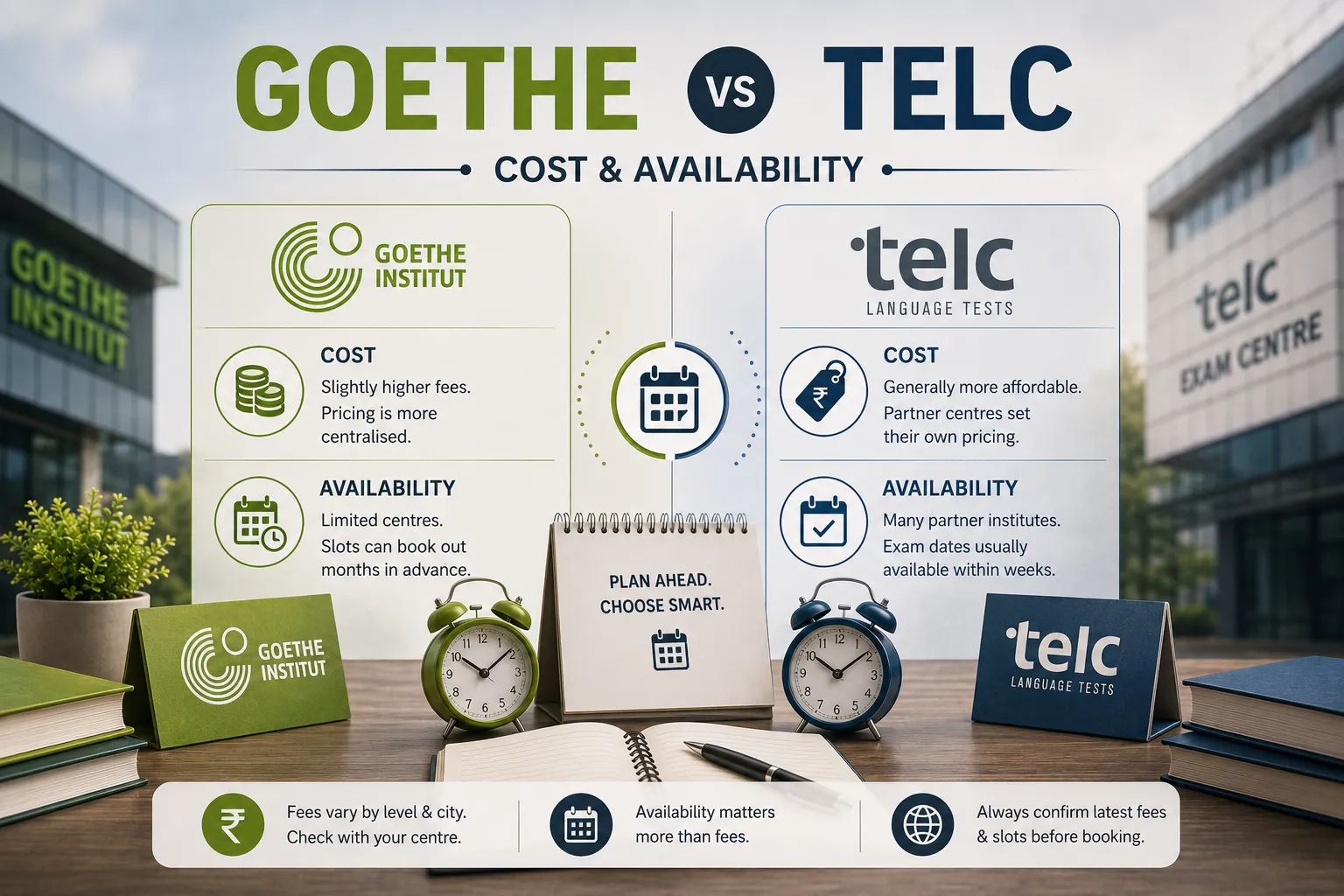
Fees vary by level and by city. As a general pattern, TELC tends to run somewhat cheaper in India, since individual partner centres set their own pricing and competition keeps it flexible. Goethe keeps its pricing more centralised, and for popular levels like B1 and B2, it tends to sit a little higher.
Availability is where the gap shows up more clearly. Goethe exam slots at official centres can book out months in advance. This happens especially around visa application seasons, simply because fewer official venues exist. TELC spreads across many more partner institutes, so it generally offers exam dates within a few weeks. If your visa or admission deadline is tight, that scheduling difference can matter more than the fee difference.
Always check current fees and slot availability directly with your nearest exam centre, since both organisations revise pricing periodically.
Which Exam Is Easier?
Neither exam is “easier” in the sense of testing a lower proficiency level. Both follow the same CEFR standards, and immigration and academic bodies treat a B1 or B2 pass identically regardless of provider. The real difference lies in how each exam distributes its difficulty.
Goethe spreads its difficulty evenly across all four skills and rewards strong, sustained writing ability. TELC’s compensatory scoring changes the calculation: a candidate who’s weaker at speaking but strong at reading and language elements can still pass comfortably. Many test-takers find that more forgiving in practice. If you tend to freeze up on long, open-ended writing tasks, that alone might tip the decision toward TELC.
Recognition: Universities, Visas, and Citizenship
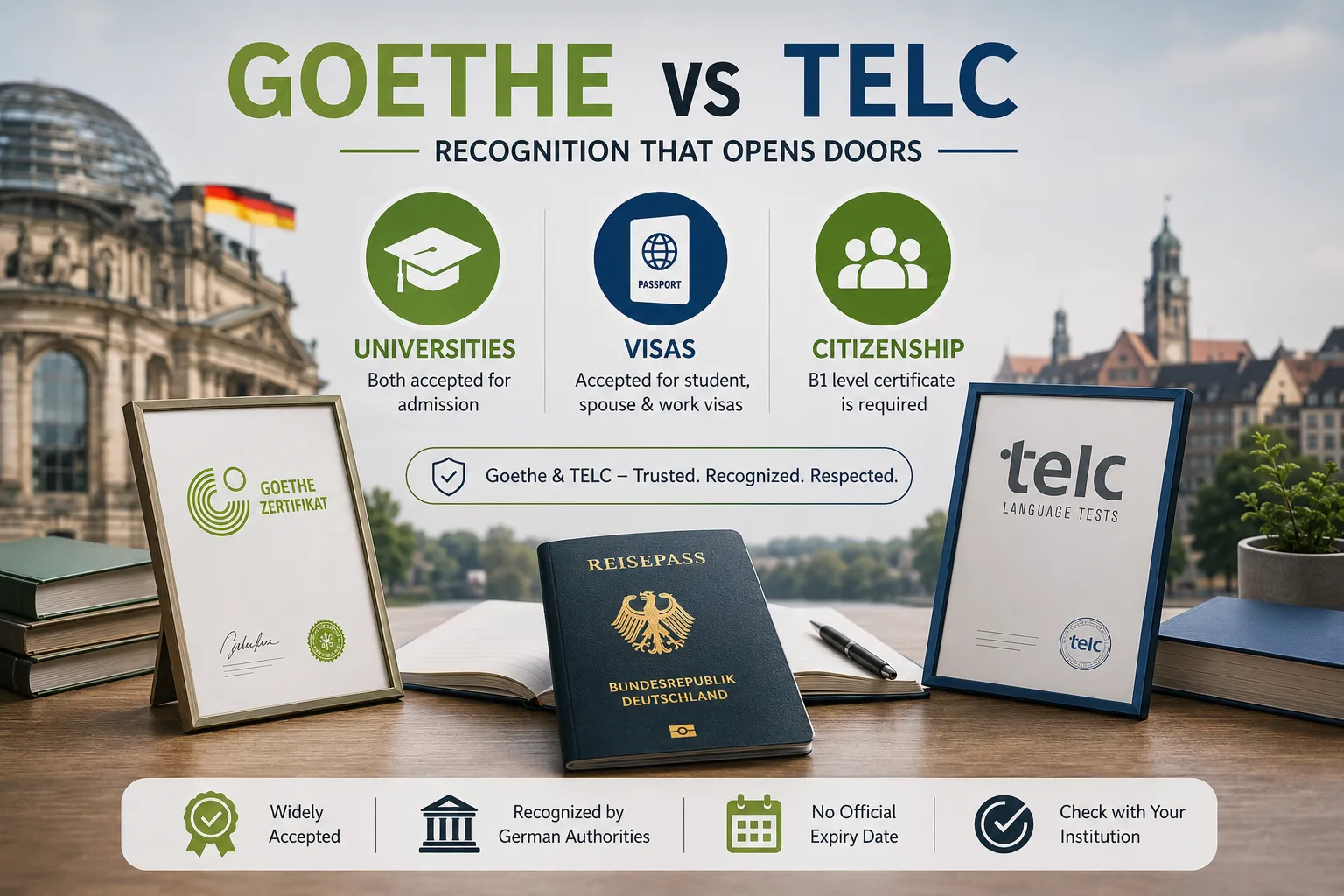
For most everyday purposes — student visas, spouse visas, employment, and general admission — German institutions and embassies accept both Goethe and TELC certificates without preference. Germany’s Standing Conference of Ministers of Education (KMK) does maintain a shortlist of five certificates that guarantee university admission with no further language test. Both the Goethe-Zertifikat C2 and telc Deutsch C1 Hochschule sit on that list. At lower levels, individual universities may lean toward one or the other, so check directly with your target institution before you register.
For German citizenship (Einbürgerung), the Staatsangehörigkeitsgesetz simply requires a B1-level certificate. The law doesn’t name a specific provider — immigration offices accept Goethe, TELC, and ÖSD certificates equally. Neither certificate carries an official expiry date. That said, some employers or consulates may ask for one issued within the last year or two, as proof of current ability.
Goethe vs TELC for Healthcare Professionals
Say you’re a nurse, physiotherapist, or another healthcare professional planning to work in Germany, Austria, or Switzerland. Here, the Goethe vs TELC decision has a fairly clear answer. TELC’s specialised Pflege and Medizin exams build around exactly the vocabulary and patient-interaction scenarios you’ll face on the job. German hospitals and licensing boards frequently ask for these certificates by name. A standard Goethe certificate demonstrates general proficiency, but it doesn’t cover this specialised ground in the same way. Our nursing and physiotherapy course tracks pair general German training with exactly the vocabulary these exams expect.
How to Decide: Goethe vs TELC by Goal
- Applying to a university that names a specific exam: Follow their requirement exactly. If you want a certificate accepted everywhere, lean toward Goethe-Zertifikat C2 or telc Deutsch C1 Hochschule.
- Applying for a spouse or family reunion visa: Either works; choose based on which exam date fits your timeline.
- Working in nursing or healthcare: TELC’s Pflege or Medizin exams are usually the stronger fit.
- Applying for German citizenship: Either B1 certificate satisfies the legal requirement.
- Strong writer, comfortable with longer essays: Goethe plays to that strength.
- Prefer a mix of grammar questions and shorter writing tasks: TELC tends to feel more manageable.
- Tight deadline: Check slot availability first — TELC is often quicker to book.
Final Thoughts on Goethe vs TELC
There’s no universally “better” option in the Goethe vs TELC debate. The right choice simply fits your goal, timeline, and strengths as a learner. If your target university, employer, or visa category names a certificate explicitly, that already settles it for you. If it doesn’t, weigh two things: your comfort with long-form writing, and how much you value scheduling flexibility. Then pick the format that leaves you feeling prepared rather than anxious.
Whichever exam you choose, structured preparation matters more than the name on the certificate. At Germanacharya, our A1–B2 courses include exam-oriented training for both Goethe and TELC formats. That means you can decide later and still walk in ready. Read more about our approach on our About Us page. Or get in touch for a free consultation to find out which exam fits your goal.
Frequently Asked Questions
Is TELC easier than Goethe? Not in terms of proficiency level — both follow the same CEFR standards. TELC’s compensatory scoring and shorter writing section make it feel more forgiving to many test-takers, but “easier” depends on your personal strengths.
Can I switch from Goethe to TELC preparation partway through? Yes. Since both exams test the same CEFR levels, general German training up to B2 prepares you for either. Most learners need only two to three weeks to adjust to the different exam style.
Which certificate is better for a spouse visa to Germany? German embassies generally accept both for spouse and family reunion visas at the B1 level. Always confirm current requirements with the specific embassy or consulate handling your application.
Do Goethe and TELC certificates expire? No, neither certificate carries an official expiry date. That said, some employers, universities, or consulates may ask for a certificate from the past one to three years as proof of current proficiency.

The graphics are stunning and the gameplay is very addictive. I’ve tried a few other apps but this one stands out. Check out 1777badapk
A very solid platform with a great selection of betting options. Everything is transparent and easy to understand. Big thumbs up for cobetbox
The odds on the football matches are some of the best I have seen in Nigeria. The site loads quickly and betting is super straightforward. ngbet365
Just what I was looking for. Easy navigation and very responsive on all my devices. I’ll be coming back to bd7c7775 for sure
I’ve been trying a few platforms lately and this one really stands out. The interface is super smooth and the payouts are quick. Definitely worth a try for anyone looking for a steady spot to play. Check out brrapwin
Very reliable and transparent with their rules. It is refreshing to find a site that treats players fairly. My choice is phjilimk.