
Ausbildung vs University: Which Is Better for Your Future?
The debate around Ausbildung vs University is one that every student in Germany faces sooner or later. One path leads to a university lecture hall, the other straight into a company’s training program. Both are genuinely respected, well-structured, and lead to solid careers — so how do you decide? The honest answer is: it depends on who you are, what you want, and how you learn best.
If you have been wondering whether Ausbildung vs University is the right comparison to make for your future, you are not alone. Thousands of students — both local and international — struggle with this exact question every year. Let’s break it down properly, without sugarcoating either side.
What Is Ausbildung? Understanding the Basics
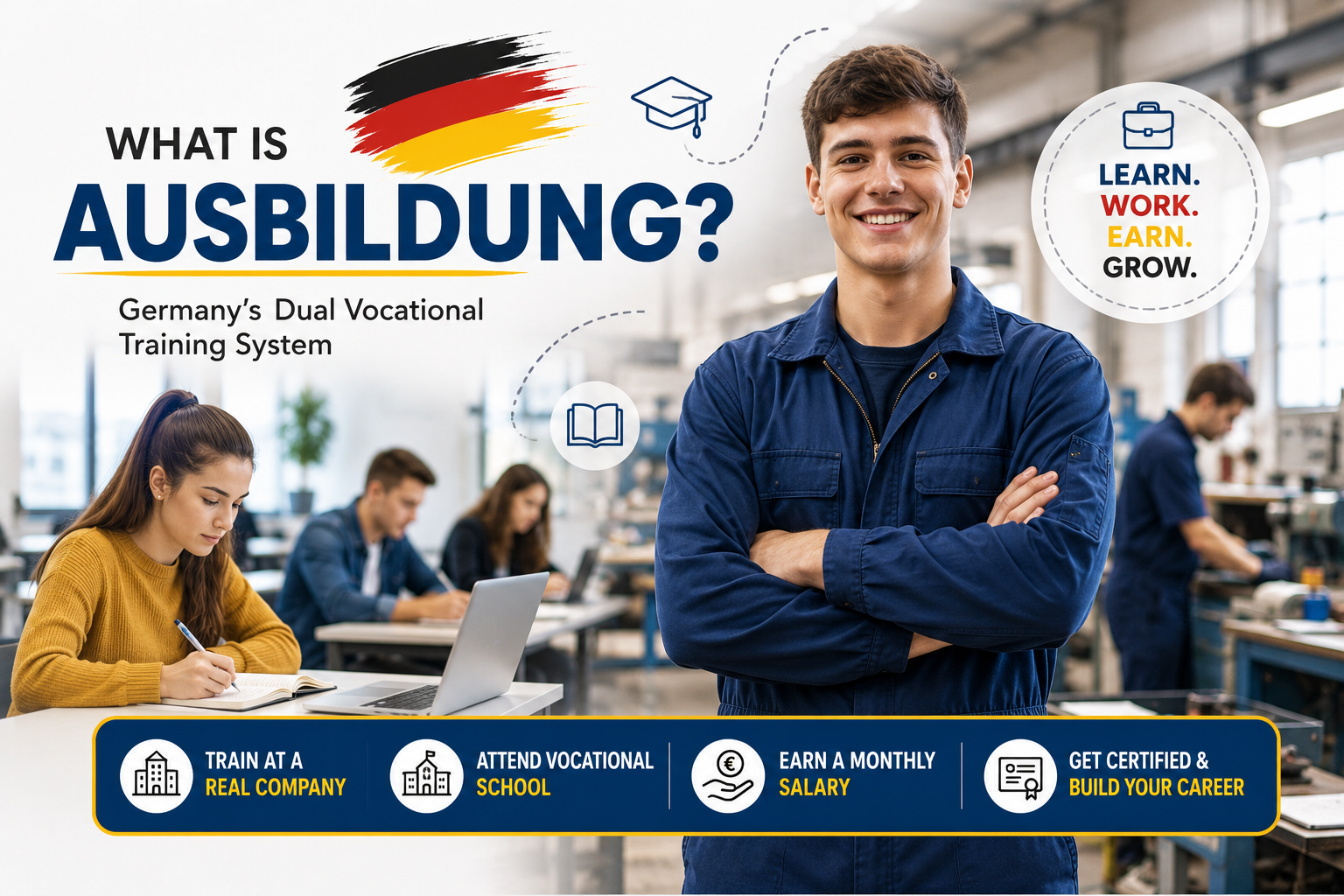
Ausbildung is Germany’s dual vocational training system. It’s a practical, hands-on education model where you split your time between a company and a vocational school (Berufsschule). You learn a trade, a skill, or a profession by actually doing it — not just reading about it in a textbook.
How the Ausbildung System Actually Works
The “dual” part means you get real-world experience from day one. Roughly three to four days a week, you work at your training company. The remaining one to two days, you attend school where the theoretical side of your profession is taught. By the end, you have both a certificate and work experience under your belt.
Duration and Training Period
Most Ausbildung programs run between two and three and a half years. The exact length depends on the profession. For example, training as a medical assistant (Medizinische Fachangestellte) takes three years, while a cook’s (Koch) training takes the same. Some programs can be shortened if you already have relevant qualifications.
Getting Paid While You Train
One of the biggest advantages that often gets overlooked: Ausbildung trainees receive a monthly salary called Ausbildungsvergütung. It’s not a full income, but it typically ranges from €600 to €1,200 per month depending on the industry and employer. You’re earning while learning — something university students generally can’t say.
Who Pays for Your Training?
The company you train with covers the costs of your on-the-job education. The government funds the vocational school portion. So as a trainee, you don’t pay tuition fees. In fact, money flows toward you, not away from you.
What Is University Education? The Academic Route
University education in Germany is a more familiar concept globally. You study a subject in depth over three to five years, earn a Bachelor’s or Master’s degree, and build a theoretical foundation in your chosen field. German public universities charge very low or no tuition fees for most programs, which makes this route financially accessible compared to countries like the UK or USA.
The Structure of a University Degree in Germany
A typical Bachelor’s degree takes three years (six semesters). A Master’s follows with another one to two years. During this time, you attend lectures, write papers, do research, and often complete internships to gain practical exposure.
Research, Specialization, and Academic Depth
University gives you room to go deep. If you’re passionate about engineering, medicine, law, economics, or sciences, a university degree lets you specialize, publish, conduct research, and eventually move into academia or high-level industry roles. The depth of knowledge you gain simply isn’t replicated in an Ausbildung.
Student Life and Its Real Costs
Here’s where reality hits. Even though tuition fees are minimal, living as a student costs money. Rent, food, health insurance, transportation — all of this adds up to around €800 to €1,200 per month in most German cities. You may take on student debt (BAföG support helps, but not everyone qualifies), work part-time, or rely on family support for years.
Key Differences: Ausbildung vs University Side by Side
Let’s be direct about how these two paths differ in the areas that matter most. For a full official overview, check Make it in Germany — a government-backed resource for anyone planning to train or study in Germany.
If you are planning your move to Germany, our complete guide to career options in Germany on Germanacharya covers everything you need to know before you start.
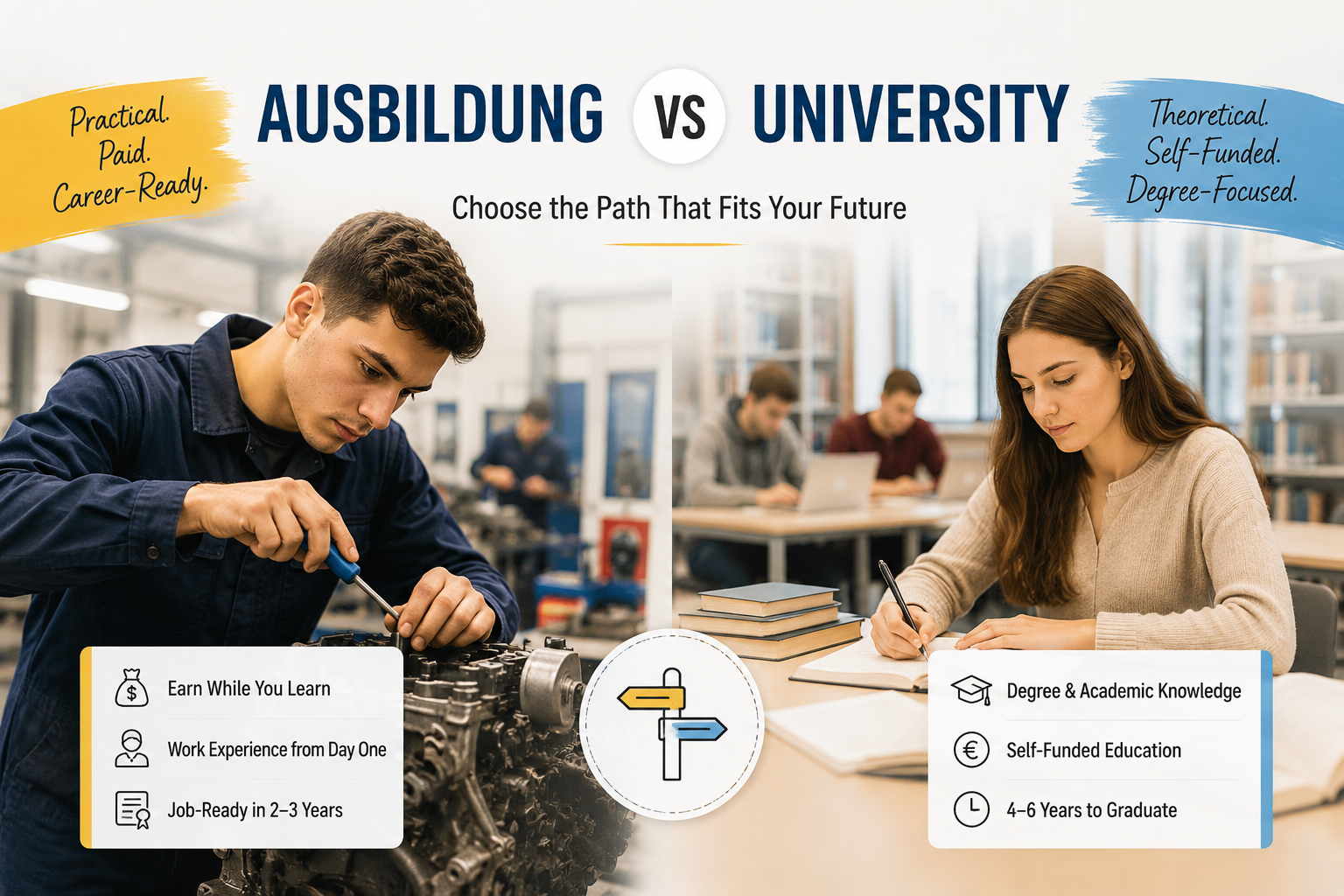
Ausbildung vs University: Time to Enter the Workforce
Ausbildung graduates are ready to work in two to three years. University graduates typically take four to six years before they’re fully qualified and job-ready. If you want to start earning sooner, Ausbildung wins on this front.
Financial Reality During Training
| Factor | Ausbildung | University |
|---|---|---|
| Monthly Income | €600–€1,200 (paid to you) | €0 (you pay expenses) |
| Tuition Fees | None | Low/None (public unis) |
| Living Costs | Self-funded, but earning helps | Primarily self-funded |
| Debt Risk | Very low | Moderate |
Career Ceiling and Growth Potential
This is where people have genuine debates. University graduates often have access to management, research, and highly specialized roles that require a degree by law or convention. Ausbildung graduates can still rise through the ranks — especially in trades, healthcare, logistics, IT, and business — but some upper-level positions remain degree-gated.
That said, Germany has excellent pathways for Ausbildung graduates to later pursue a Meister qualification, or even go to university through evening programs or technical colleges (Berufsakademie). The two paths are not mutually exclusive.
Pros and Cons of Ausbildung
Why Ausbildung Makes Sense
- You earn money from month one
- No student debt or financial pressure
- High employment rates after completion
- Companies often keep their trainees as full employees
- Practical skills are immediately applicable
- Germany has a severe shortage of skilled tradespeople — demand is high
Where Ausbildung Falls Short
- Fewer academic options for those who love theory
- Some leadership and management roles require degrees
- Changing career fields later may require retraining
- Less international recognition outside Germany in some sectors
Pros and Cons of University
Why University Is Worth It
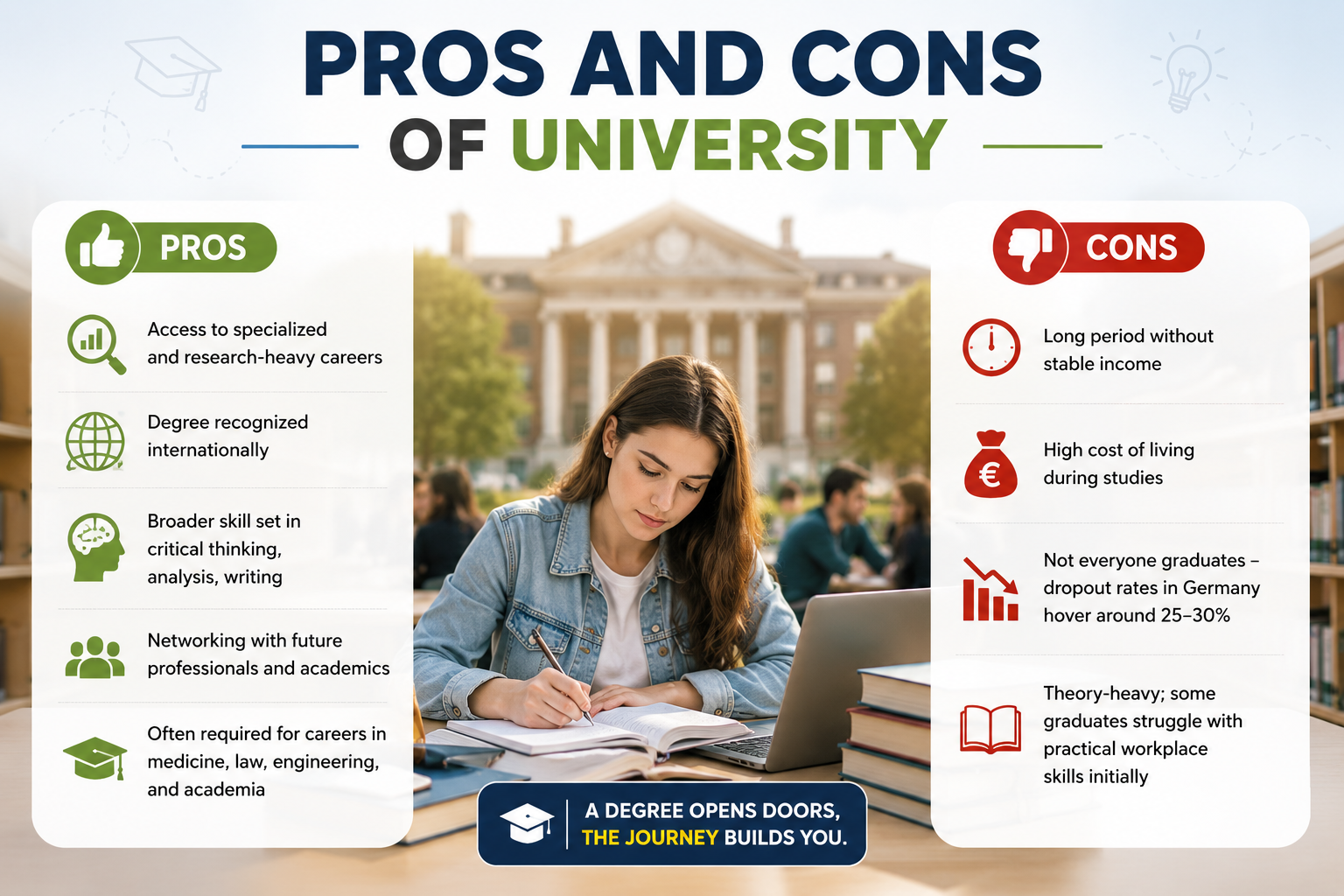
- Access to specialized and research-heavy careers
- Degree recognized internationally
- Broader skill set in critical thinking, analysis, writing
- Networking with future professionals and academics
- Often required for careers in medicine, law, engineering, and academia
The Downsides of University
- Long period without stable income
- High cost of living during studies
- Not everyone graduates — dropout rates in Germany hover around 25-30%
- Theory-heavy; some graduates struggle with practical workplace skills initially
So, Who Should Choose Ausbildung?
Ausbildung is the smarter choice if you are someone who learns by doing, not by sitting in lectures. If you already know the kind of work you want to do — mechanic, nurse, IT specialist, hotel manager, baker, logistics coordinator — Ausbildung gets you there faster, with money in your pocket and a job waiting at the end. It’s also the right call if financial independence matters to you early in life.
For international students and immigrants in Germany, Ausbildung is often the most practical entry point. It gives you German language exposure daily, builds local professional networks, and leads to stable residency options.
And Who Should Go to University?
University makes sense if your dream career legally requires a degree — think doctor, lawyer, architect, or professor. It also suits you if you’re genuinely curious about a subject at an academic level, enjoy research, and want global career flexibility. If you’re not sure what you want to do yet, university can also provide time to figure that out — though that’s an expensive way to soul-search.
What the German Job Market Actually Thinks
Germany has enormous respect for both paths. A Meister-qualified electrician is not considered below a university graduate in professional standing. German employers care about competence, reliability, and results. However, sectors like finance, consulting, tech startups, and academia do tend to favor degree holders for senior positions. Trade and technical industries strongly prefer Ausbildung-trained professionals.
The Final Verdict: Ausbildung vs University
The question “Ausbildung vs University — which is better?” doesn’t have one right answer. It has your answer.
If you want to earn early, get your hands dirty, and build a concrete skill — Ausbildung is excellent. If you want depth, academic prestige, and access to specialized careers — university is your road. Germany is rare in that it genuinely values both. You won’t be looked down upon for either choice.
What matters most is that you choose with clarity, not just because everyone around you is doing one or the other. Know your strengths, understand your goals, and pick the path that actually fits your life.
Frequently Asked Questions (FAQs) — Ausbildung vs University
People often have specific questions when deciding between Ausbildung vs University in Germany. Here are the most common ones, answered honestly.
1. Can I do Ausbildung after completing a university degree?
Yes, you can. Many people switch paths after a degree to gain hands-on skills in a specific trade. German employers are generally open to it.
2. Which option earns more money in the long run?
University graduates typically earn more over a full career, especially in medicine, engineering, or finance. However, a Meister-qualified Ausbildung professional running their own business can easily match or beat that.
3. Is Ausbildung recognized outside Germany?
Within the EU, yes — especially in Austria and Switzerland. Outside Europe, recognition varies by country and profession. University degrees generally travel better internationally.
4. Can international students apply for Ausbildung in Germany?
Yes. You need a recognized school qualification, B1–B2 German language level, and a signed training contract with a German company. Germany actively needs skilled workers and welcomes international trainees.
5. How much German do I need for Ausbildung?
At least B1, though B2 is strongly preferred. Since both work and school happen in German, stronger language skills make the entire experience smoother and more rewarding.

[4910]musikkalidow | Login Resmi Slot Gacor dan Casino Deposit Pulsa,musikkalidow menyediakan akses login resmi untuk slot gacor dan judi casino. Download APK sekarang untuk kemudahan deposit pulsa dan main baccarat online. Daftar yuk! visit: musikkalidow
Honestly the best experience I have had in a long time. The bonuses are actually generous and the games load instantly. Definitely sticking with 5k5k777 from now on.
Solid platform with a very professional feel. I trust this site more than others I have used before. Check out 20kcwin
Ronbuzz is kind of my guilty pleasure. It’s just a simple site with some quick games, but it’s good for killing time. Take a look if you’re bored: ronbuzz