
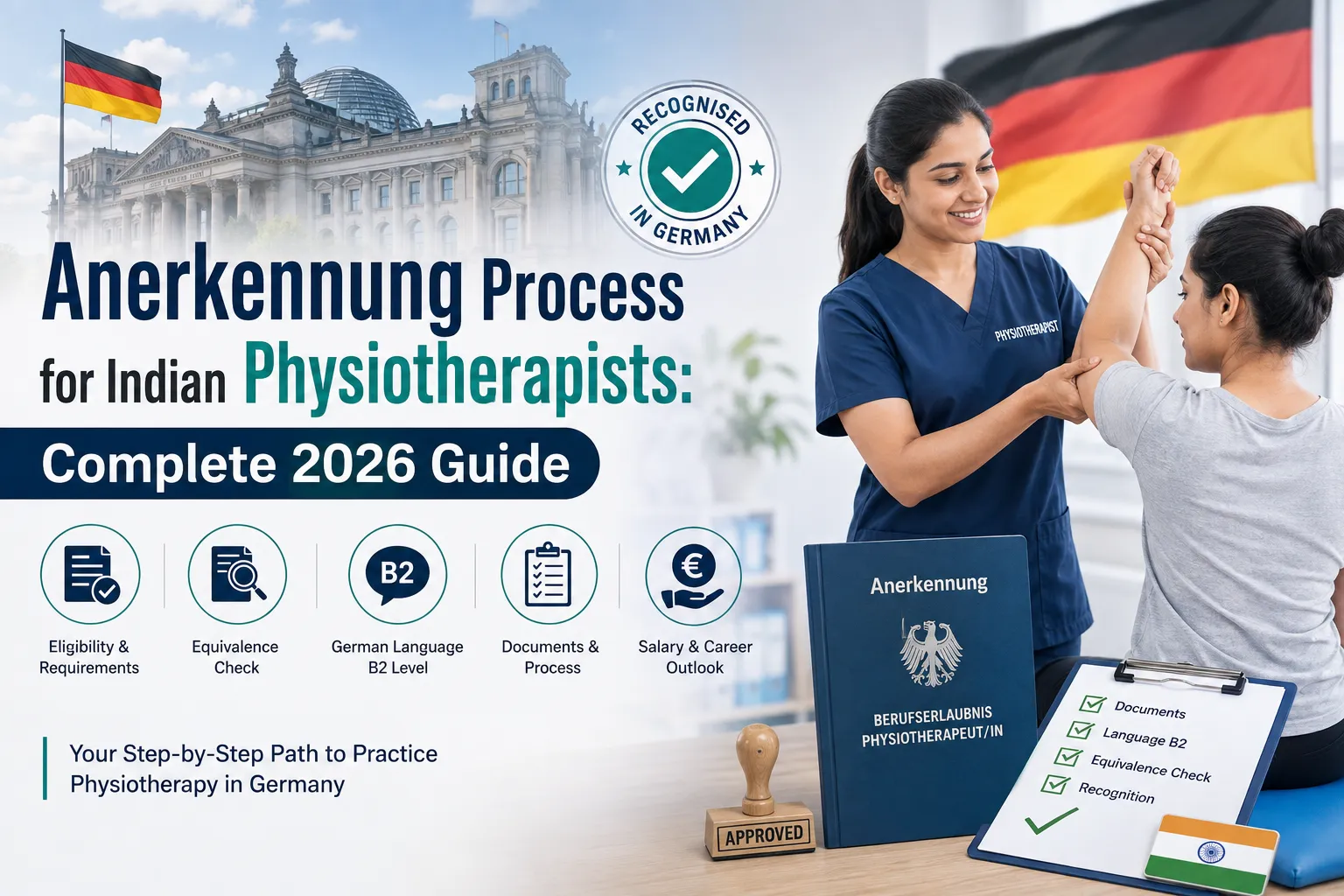
Anerkennung Process Indian Physiotherapists:
Anerkennung Process for Indian Physiotherapists: Complete 2026 Guide
The Anerkennung process Indian physiotherapists must complete decides whether you can work as a physiotherapist in Germany at all. Physiotherapy is a regulated profession there. Your Indian BPT or MPT degree doesn’t automatically count. This guide walks through eligibility, the equivalence check, documents, language rules, timeline, and realistic salary expectations for 2026.
What Is Anerkennung, and Why Physiotherapists Need It
Anerkennung simply means “recognition” in German. For a regulated profession like physiotherapy, it’s not optional paperwork — it’s the legal gateway to practising at all. Without it, you cannot use the professional title “Physiotherapeut/in” or treat patients in Germany. That’s true no matter how many years you’ve practised in India.
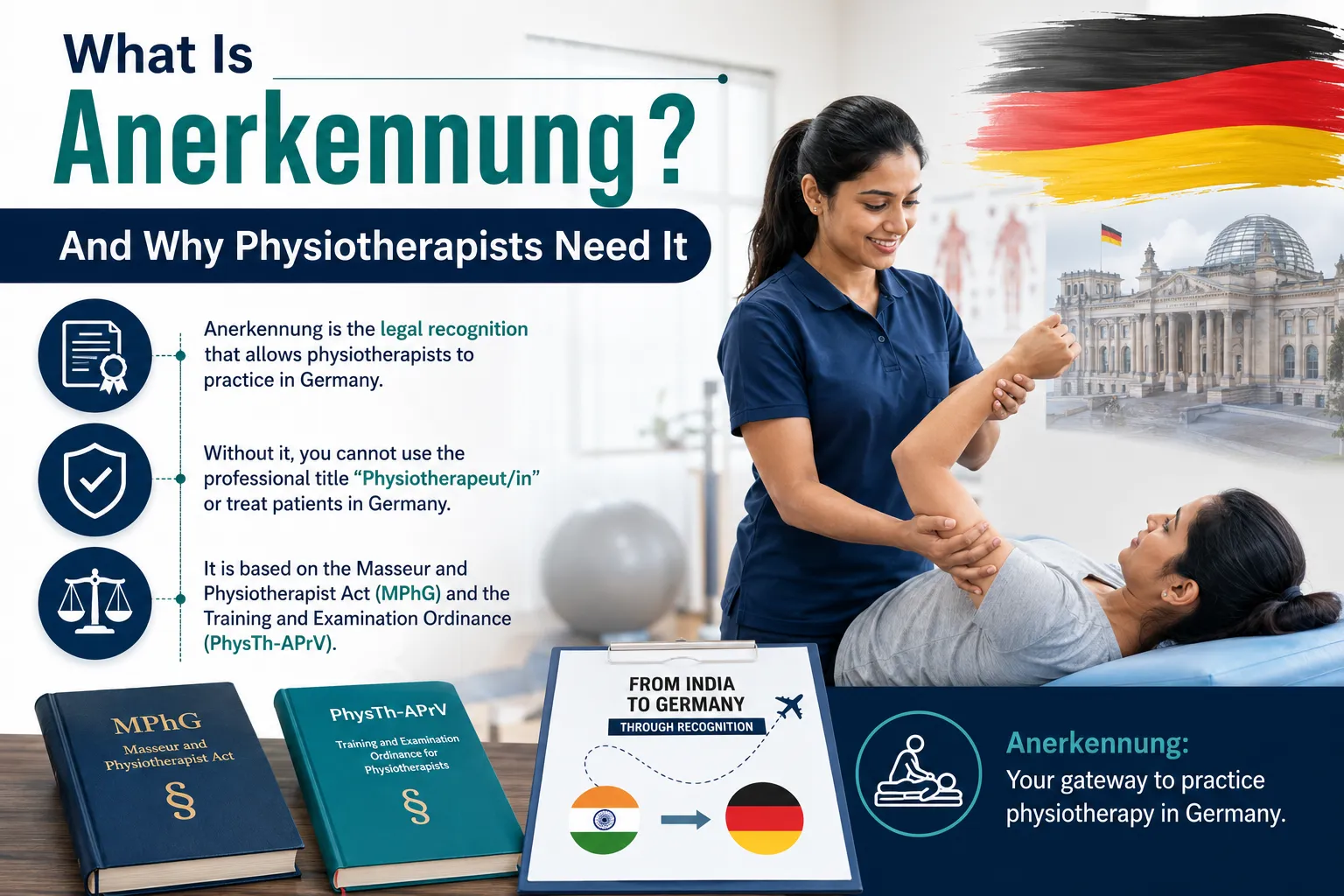
The relevant law is the Masseur and Physiotherapist Act (MPhG), along with the Training and Examination Ordinance for Physiotherapists (PhysTh-APrV). Together, they define what German training must cover, and that’s exactly what your Indian qualification gets compared against.
Anerkennung Process Indian Physiotherapists Follow: The Legal Basis
German physiotherapy training runs to roughly 4,500 hours in total. That splits into around 2,900 hours of theory and 1,600 hours of supervised clinical practice. The competent authority in your target German state checks your Indian training against this benchmark. It compares subject by subject, and hour by hour.
This is why a plain degree certificate isn’t enough on its own. Authorities want to see the actual content and hours behind it, not just the qualification title.
Who Is Eligible: BPT, MPT, and Registration Requirements
Both BPT (Bachelor of Physiotherapy) and MPT (Master of Physiotherapy) graduates from a recognised Indian university can apply. Neither degree is automatically preferred over the other for this process — what matters is the training content behind it.
You’ll also need valid registration with your state physiotherapy council or the Indian Association of Physiotherapists. Most employers additionally prefer at least a year of clinical experience, although fresh graduates can still apply. There’s no official upper age limit, though most successful applicants fall between 22 and 40.
How the Equivalence Check Actually Works
The competent authority compares your training, subject by subject, against the German curriculum. Three outcomes are possible.
- Full equivalence: your training matches closely enough, and you receive your licence directly.
- Partial gaps: you complete an adaptation course (Anpassungslehrgang) that fills the specific missing content.
- Substantial gaps: instead, you sit a knowledge exam (Kenntnisprüfung) that tests exactly what your training didn’t cover.
Most experienced Indian physiotherapists land in the partial-gap category. Indian physiotherapy education overlaps heavily with the German curriculum, but it rarely matches it hour for hour.
German Language Requirement: B2, With a B1 Bridge
Most physiotherapy roles that involve direct patient contact require B2 German. That level lets you follow a doctor’s instructions, explain a treatment plan, and handle everyday clinical conversation confidently.
Some employers do accept B1 initially, provided you commit to reaching B2 during a defined adaptation phase. Either way, start German early — this, not the paperwork, is usually the slowest part of the entire journey.
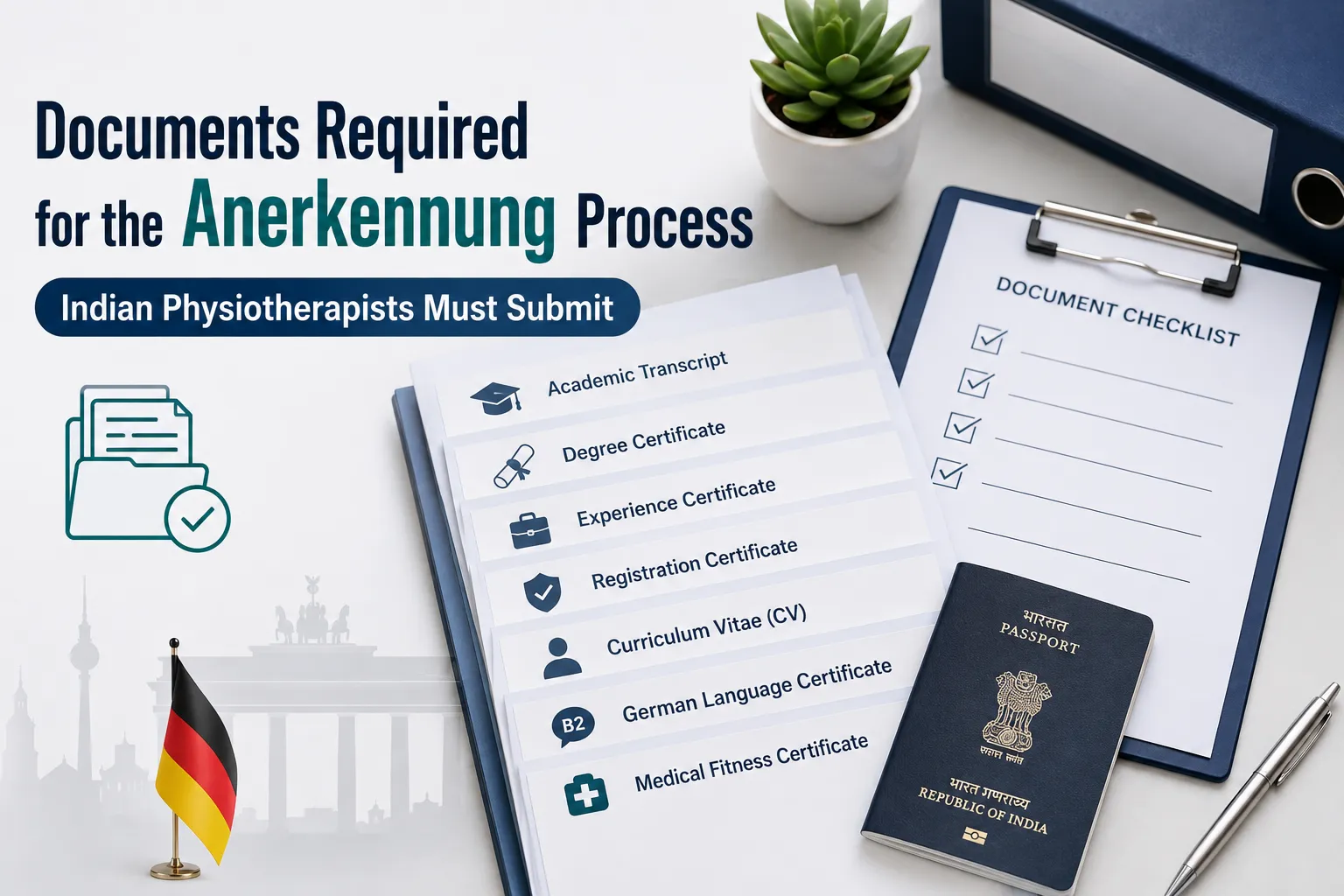
Documents Required for the Anerkennung Process Indian Physiotherapists Must Submit
- Complete academic transcript, listing subjects, hours, and marks (your full syllabus, not just a summary)
- BPT or MPT degree certificate, officially translated
- Proof of post-qualification clinical experience, where applicable
- Registration with your state physiotherapy council or the Indian Association of Physiotherapists
- CV in point form, referencing your education clearly
- B2 (or B1, where accepted) German language certificate
- Medical fitness certificate, generally from a Germany-licensed doctor once you’re in the process
Step-by-Step: The Anerkennung Process Indian Physiotherapists Should Follow
- Identify your competent authority. Each German state assigns its own recognition office. The official Recognition Finder tool points you to the right one, based on where you plan to work.
- Gather and translate your documents, especially your full academic transcript with hours and subjects.
- Submit your application, either from India or after arrival — both routes are allowed.
- Go through the equivalence check. The authority compares your training against the German curriculum.
- Complete any adaptation course or Kenntnisprüfung, if the authority identifies gaps.
- Receive your Berufserlaubnis (permission to use the professional title) once everything checks out.
- Apply for your visa and start job hunting, now backed by a recognised qualification.
Which Authority Handles Your Application
There’s no single national office for this. Instead, each of Germany’s states designates its own competent authority for physiotherapy recognition. The Anabin database and the official Recognition Finder both let you search by profession and location. Either one finds the exact office responsible for your case. Get this step right early — applying to the wrong authority just wastes months.
Timeline: How Long Anerkennung Actually Takes
For a straightforward file with full equivalence, expect roughly three to six months from submission to decision. Add extra time if an adaptation course or Kenntnisprüfung comes into play, since those run on their own separate schedule. Because you can apply from India before relocating, many candidates start this clock well before their visa process even begins.
Salary and Career Outlook After Recognition
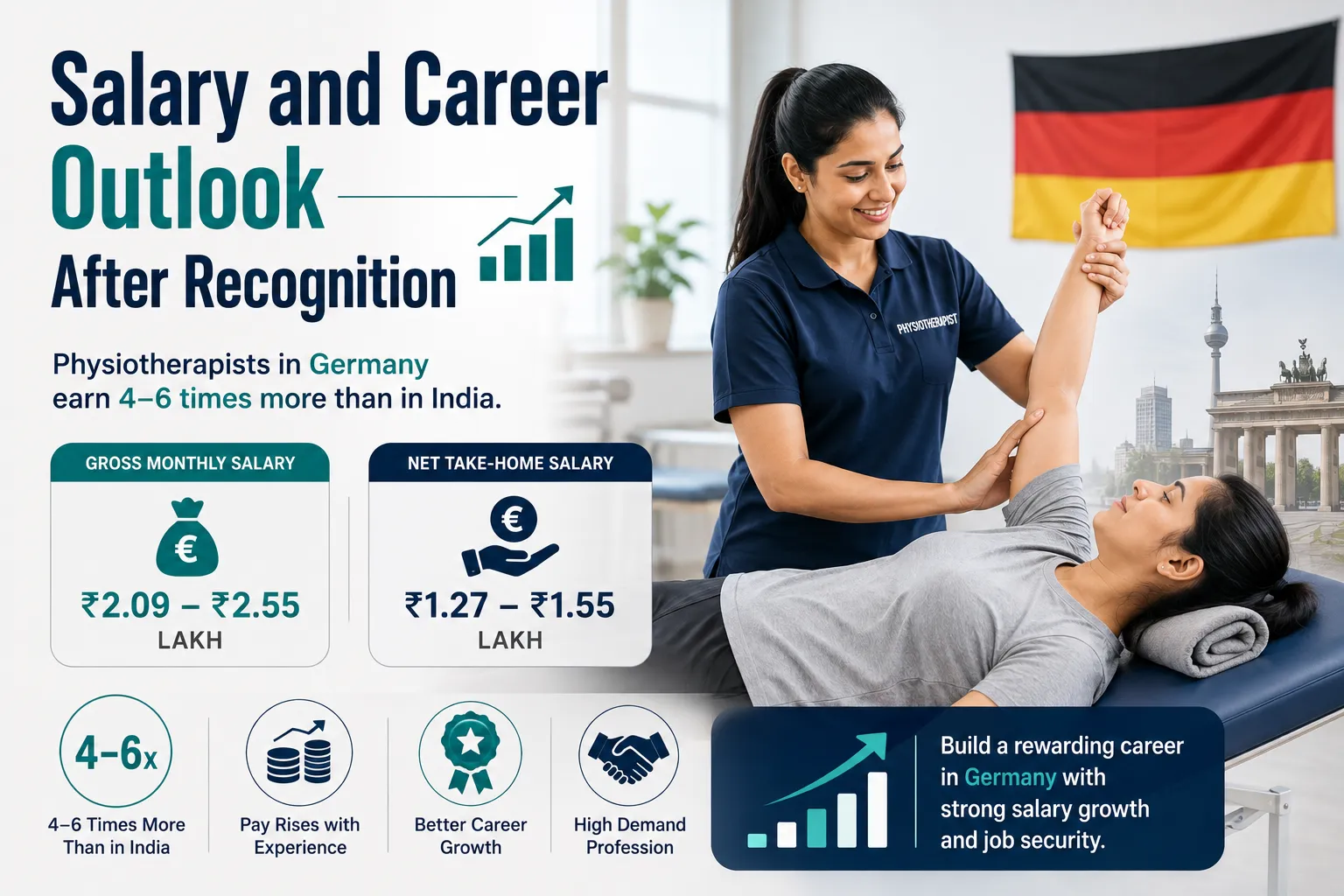
Entry-level physiotherapists in Germany typically earn a gross monthly salary in the range of ₹2.09 to ₹2.55 lakh. After German tax and social security deductions, net take-home usually works out to roughly ₹1.27 to ₹1.55 lakh a month. That’s commonly four to six times what an equivalent role pays in India. Pay generally rises further with experience and specialisation.
Permanent Residency Timeline
Once you’re working as a licensed physiotherapist in Germany, the residency clock starts. You typically become eligible for permanent residency after around four years of qualifying employment. Consistent, documented work history matters here, so keep your contracts and payslips organised from day one.
Common Mistakes Indian Physiotherapists Make
- Applying to the wrong state authority, instead of confirming it through the official finder first
- Submitting a summary certificate instead of the full subject-and-hours transcript authorities actually want
- Underestimating the German requirement and arriving at B1 when B2 is expected
- Waiting to start the Anerkennung process until after arriving in Germany
- Assuming an MPT gets faster recognition than a BPT — content match matters more than the degree level
FAQs on the Anerkennung Process Indian Physiotherapists Follow
Can I apply for Anerkennung from India?
Yes. You can submit your application, and even complete much of the process, before you relocate. That’s exactly what most successful applicants do.
Does the German requirement mean B2, or does A1/B1 also work?
Most patient-facing roles expect B2. A handful of employers accept B1 initially, but only alongside a firm commitment to reach B2 soon after.
What happens if my training doesn’t fully match the German curriculum? You complete either an adaptation course or a Kenntnisprüfung, depending on how large the gap is. Neither one blocks you permanently — both simply add time.
Is an MPT recognised faster than a BPT?
Not necessarily. Authorities compare training content and hours, not just your degree title. Either qualification can move at a similar pace, depending on the actual curriculum.
Final Thoughts
The Anerkennung process Indian physiotherapists go through can feel bureaucratic. That said, it follows a predictable structure once you understand the equivalence-check logic. Start your documents and your German early, and apply to the right state authority. The rest of the process becomes far more manageable.
If you’re preparing for this route, explore Germanacharya’s B2 German courses, built specifically around medical and clinical vocabulary. Visit our dedicated Physiotherapy careers page for programme-specific guidance. Or book a free 1:1 consultation to map your Anerkennung timeline, or browse more guides on our blog.
For official information, use the Recognition in Germany Finder to locate your competent authority. The German Missions in India page on qualification recognition and the Indo-German Chamber of Commerce recognition support portal are also useful for India-based queries.
I’ve tried a few sites but this one is really smooth. The graphics are great and the payouts feel fair. Highly recommend phjiligems for anyone looking for some fun.
I’ve been trying a few sites lately and this one really stands out. The interface is smooth and the payouts are fast. Definitely recommend checking out plataforma7brwin if you want a reliable spot.
I had a great run last weekend! The platform is stable and the rewards are fair. I will be returning to phnustra for sure.
I’ve tried a few platforms recently but this one really stands out. The interface is super smooth and the games load instantly. Highly recommend gamespkvip to anyone looking for a reliable spot.
No more login issues for me. This portal is stable and gets me straight into the action every time. Cheers to jili999login
Top notch service and a very fair gaming environment. It feels like they actually care about the players. Check out winpgclub for some quality entertainment.
I’ve been trying a few different sites lately and this one really stands out. The interface is smooth and the payouts are surprisingly fast. Definitely worth a check vnnn88game
[7004]bet winner লগইন ও অ্যাপ ডাউনলোড | বিকাশ ক্যাসিনো ডিপোজিট,bet winner লগইন করে লাইভ ডিলার ক্যাসিনো গেম উপভোগ করুন। বিকাশ দিয়ে ক্যাসিনো ডিপোজিট এবং অনলাইন স্লট গেম খেলার নিয়ম জানতে আজই ভিজিট করুন। visit: bet winner
If you are looking for a premium gaming experience, this is the place to be. Everything feels top-notch at yyphvip
Great vibes and even better wins. I appreciate how straightforward the registration is. Love phtaya111
Finally found a safe link to get the app running on my phone. Installation was a breeze and it works perfectly. Highly recommend lucky33download for everyone.
Finally found a reliable link to get the app. The download was smooth and the installation didn’t take long. Definitely the best way to get megaparidownload working on my phone.